
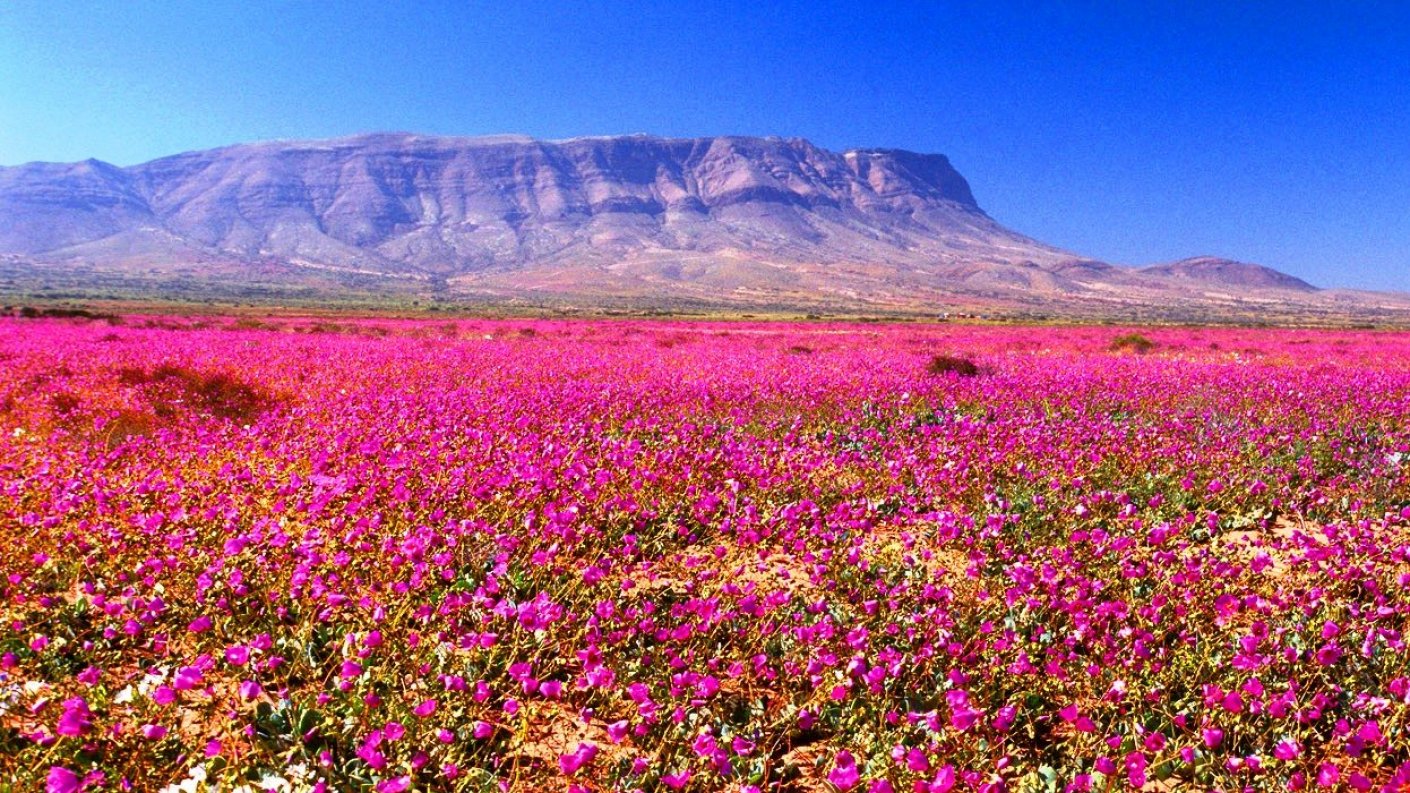
There are places on Earth where rain is not a meteorological nuisance but a near-mythic event. The Atacama Desert, in northern Chile, is one of them: certain areas there had not seen a drop of water for years. Yet, all it took was a drizzle as modest as it was fleeting, barely 15 millimeters according to measurements, for this lunar landscape of sand and rock to morph into an ocean of pink and yellow petals. A shift so spectacular that it almost seems unreal, prompting reflection on what truly lies beneath soil long deemed barren.
- Only 15 mm of rain was enough to wake dormant seeds that had slept for decades in the Atacama Desert, one of the driest places on Earth.
- In a matter of days, a carpet of pink and yellow flowers spread across several kilometers, visible from satellites.
- This burst of life attracts pollinating insects, birds, and small mammals, and could become more frequent as climate disruption progresses.
- A rainless desert for years transforms in just a few days
- Seeds that have slept for decades beneath the sand
- A carpet of flowers so vast it can be seen from space
- What this flash bloom reveals about the climate of tomorrow
A rainless desert for years transforms in just a few days
To grasp the magnitude of the event, one must first grasp how exceptional the Atacama is. Regarded as one of the world’s driest deserts, it receives on average less than one millimeter of precipitation per year in its most extreme zones. In other words, fifteen millimeters of rain falling at once equates, locally, to the equivalent of several decades of typical rainfall concentrated into a few hours.
This unexpected deluge did more than moisten the soil: it literally changed its color. Where there once stretched an ochre, mineral, uniform expanse as far as the eye could see, within a few days shades of green appeared, followed by pink and yellow. The contrast is so striking that region residents, accustomed to the caprices of weather, found it difficult to recognize the landscapes they traverse daily.
Seeds Dormant for Decades Beneath the Sand
What makes this phenomenon particularly fascinating is that it is not simply a spontaneous sprouting. Under the Atacama’s dry surface lie dormant seeds, capable of waiting for years, even decades, in a lifelike sleep state until conditions are ideal to germinate. These plants, adapted to extreme environments, have developed a remarkably efficient survival strategy: rather than expending energy in a harsh setting, they bide their time.
As soon as humidity reaches a sufficient threshold, these seeds awaken almost simultaneously, as if an invisible signal had been sent to the entire plant population. This synchronization explains the phenomenon’s startling speed: in just a few days, millions of plants germinate, grow, and bloom, taking advantage of a climatic window that will last only a few weeks before drought resumes.
A Carpet of Flowers So Vast It Can Be Seen From Space
The scale of this bloom surpasses local anecdote by far. The colored patches extend across several kilometers, forming mosaics visible from Earth-observing satellites. Such a large-scale landscape upheaval remains rare enough to be scrutinized with care by satellite imagery, which allows monitoring the phenomenon day by day, almost like tracking the spread of a wave across the ocean.
This spectacle draws far more than the gaze of scientists. The local fauna, too, benefits from this unexpected bounty. Pollinators, small mammals, and birds converge on these flowering zones, temporarily transforming a quasi-desert environment into a veritable pantry. This life surge, though temporary, plays a meaningful role in the region’s ecological cycles, offering a timely yet crucial food resource for many species.
What This Flash Bloom Reveals About the Climate of Tomorrow
Beyond its striking beauty, this episode raises questions about the climatic mechanisms at work in these extreme regions. These bloom events, though documented for a long time in Atacama’s history, appear to be occurring more frequently or with greater intensity according to recent observations, prompting questions about possible links to global climate disruptions. Extraordinary rainfall in areas typically spared from rain could indeed become less of an anomaly in the future.
This type of event also provides a valuable field for understanding how life manages to adapt to the harshest conditions. These seeds capable of waiting for decades in near-mineral sleep before reemerging in a few days form a fascinating model of biological resilience, whose study might one day illuminate our understanding of ecosystems subjected to increasing hydric stress elsewhere in the world.
From this seemingly modest rain fell a powerful reminder: even in the most inhospitable environments, life always finds a way to wait, then resurgence with unexpected vigor. As the Atacama returns to its quiet, mineral expanse, a lingering question remains, almost poetic: how long will these invisible seeds have to wait before their next awakening?
