
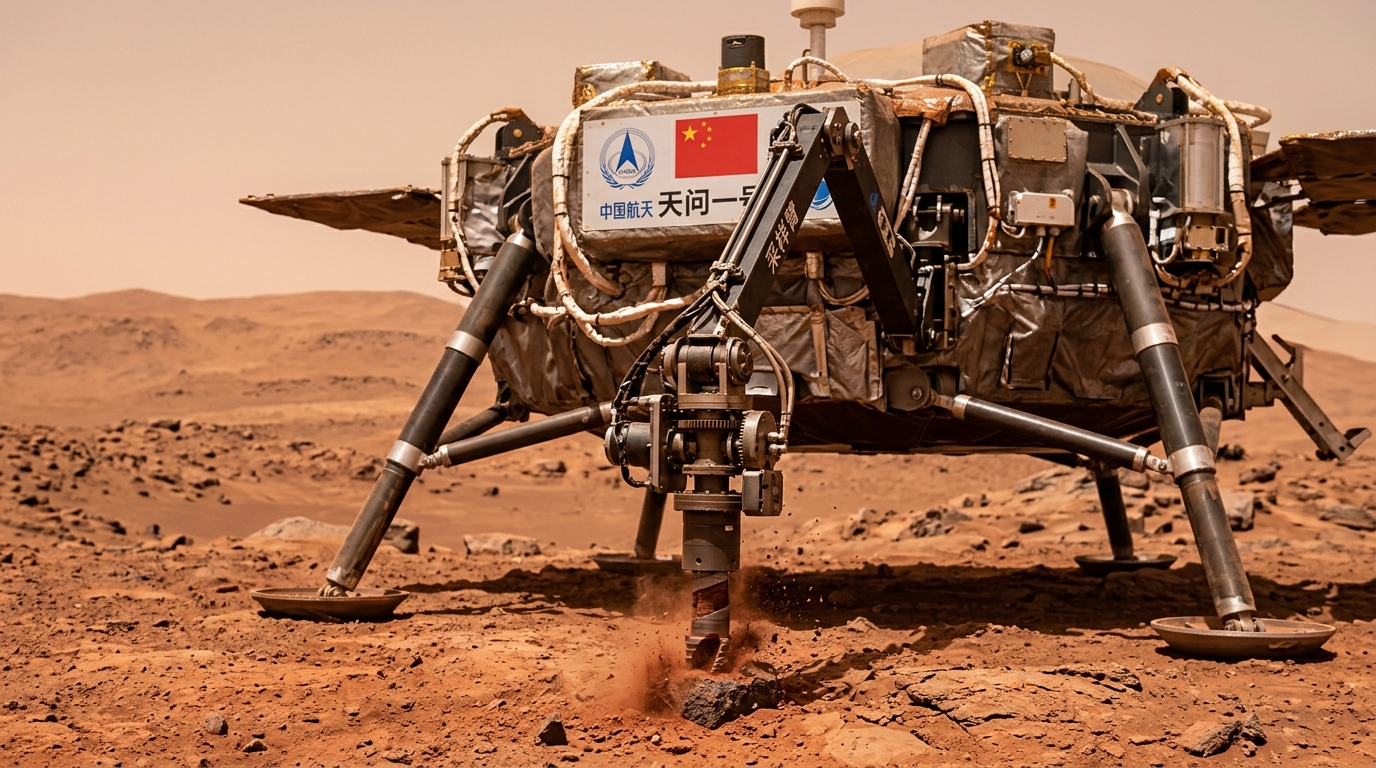
Important note: the Chinese Tianwen 3 mission has not yet left the ground, but its timetable is already precise enough to make Washington frown. While NASA navigates by sight on its own Mars sample-return program, without a clear roadmap or a fixed date, China is moving methodically toward a defined objective: to bring back to Earth around 500 grams of Martian soil by 2031. Two Long March 5 heavy-lift rockets, a launch site on the tropical island of Hainan, and an organization that seems to operate like clockwork. But scratch a bit beneath the surface of this technical feat, and it is not so much the speed of execution that concerns American experts as the very nature of what Beijing aims to discover there.
- The Tianwen 3 mission, targeting a launch between December 2028 and January 2029, rests on five modules (lander, ascent module, service module, orbiter, return module) and is specifically seeking traces of Martian microbial life.
- The landing site should be fixed by late 2026, while NASA still has no firm timetable for its own Mars sample-return program.
- Scott Hubbard, a former NASA official, likens China’s advance to a ‘Sputnik moment’, arguing that Washington’s challenge lies more in strategic consistency than in budgetary or technical might.
- The real stakes aren’t the launch date, it’s what they’re seeking there
- Tianwen 3, a five-piece mechanism designed to leave nothing to chance
- Why a former NASA official calls it a Sputnik moment
- The real question now facing Washington
The real stake isn’t the launch date, it’s what they’re seeking there
Setting a launch window between December 2028 and January 2029 is no small matter: favorable alignments between Earth and Mars occur only every 26 months, which leaves engineers little room for error. But reducing Tianwen 3 to a mere timing issue would miss the point entirely. The scientific objective stated by the Chinese teams is explicit: to search for traces of microbial life or unknown life forms, potentially arising from a biological history unique to the Red Planet.
It is precisely this point that reframes the debate. This is no longer just a technological race between two space powers; it is a quest touching one of humanity’s most fundamental questions: are we alone in the universe? Hou Zengqian, the mission’s chief scientist with the Chinese space agency, emphasizes that even without proof of life, these samples will hold immense scientific value for understanding Mars’s geology and its past habitability.
Tianwen 3, a five-piece mechanism designed to leave nothing to chance
Technically, the mission rests on an exceptionally sophisticated assembly, like a clockwork mechanism where every component must click into place with the next. The system comprises a lander designed to touch down gently on Martian soil, an ascent module capable of lifting off from the surface, a service module, an orbiter that will maintain the link from space, and finally an Earth-return capsule intended to carry the samples back home with care.
This five-stage architecture demonstrates just how much thought has gone into minimizing failure risk. The choice of landing site, which must be finalised by the end of 2026, will be based on a new, comprehensive geological map of Mars that is currently being developed. Once the samples are retrieved, they will be analyzed at microscopic, molecular, and isotopic scales to extract the maximum information about the possible origins of Martian life. The equipment development has already entered prototyping, mobilising numerous scientific teams across the country.
Why a former NASA official calls it a Sputnik moment
The phrase was not chosen at random. Scott Hubbard, who held the position often dubbed Mars Czar at NASA for several years, compared the Chinese progress to a potential Sputnik moment, referencing the shock caused by the launch of the first Soviet satellite in the middle of the Cold War. This comparison captures well the concern currently felt in certain American scientific circles: if China could bring back the first traces of extraterrestrial life to Earth, it would mark a major symbolic turning point, far beyond a mere technological feat.
What makes this prospect especially sensitive is that it does not rest on overwhelming budgetary or industrial supremacy, but on a question of priority and consistency. While Beijing advances step by step toward a clearly defined objective, the American Mars sample-return program remains mired in persistent ambiguity, with no firm schedule in place to this day.
The real question now facing Washington
In the end, the stakes for the United States are no longer about whether they can catch up with China on the technical front, but whether they are still willing to invest in a long-term ambition without an immediate payoff. The question isn’t so much about speed as it is about strategic vision: what will happen if, in 2031, Chinese scientists are the first to open those capsules containing the eagerly awaited 500 grams of Martian soil?
This situation illustrates a broader shift in space exploration, where consistency and clarity of objectives sometimes count more than sheer financial power. It remains to be seen whether, by the end of the decade, Washington will regain the momentum needed to avoid merely watching China write, alone, what could become a historic chapter in Martian exploration.
