
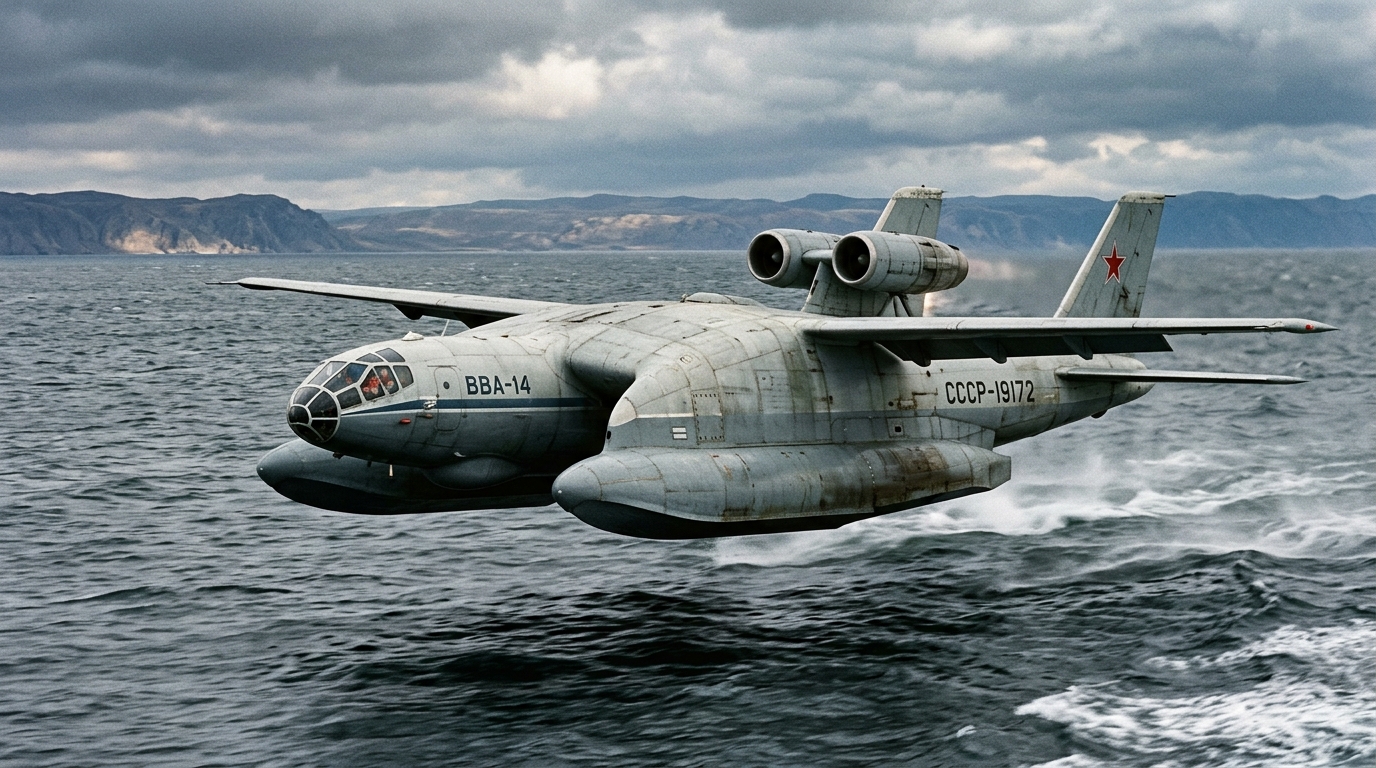
Imagine for a moment a machine that can leap off the surface of a lake without any takeoff runway, without a catapult, not even a meter of tarmac beneath its floats. A kind of maritime UFO, designed to hunt enemy nuclear submarines in utmost secrecy. This isn’t science fiction, but a real program of Soviet aviation, kept in the shadows for decades before resurfacing, so to speak, in the collective memory of engineering enthusiasts. Its name: the Beriev VVA-14. A 52-ton behemoth that should have revolutionized anti-submarine warfare, and which ultimately fell not to the ground, but under the weight of its own ambitions.
- The Beriev VVA-14, designed by engineer Robert Bartini, was meant to take off vertically using twelve lift engines never delivered by the Soviet industry.
- The machine aimed to combine aircraft, seaplane, and ekranoplan functions to hunt nuclear submarines, but this excessive hybridization made it heavy and unstable.
- The program was abandoned in 1987, and the sole surviving prototype is today housed at the Monino Museum near Moscow.
- A 52-ton monster that took off without a runway: the forgotten story of the Beriev VVA-14
- Moscow dreamed of an extraordinary amphibious anti-submarine hunter
- Neither hull nor fuel: the real reason for the VVA-14’s failure
- Monino, a silent tomb of a project with no heir elsewhere
A 52-Ton Monster That Took Off Without a Runway: The Forgotten Story of the Beriev VVA-14
In the early 1970s, during the height of the Cold War, the USSR desperately sought a counter to American Polaris-equipped submarines capable of striking Soviet territory from the ocean depths. It is within this tense backdrop that an idea as ambitious as it was improbable emerged: a hybrid craft, half airplane, half ship, able to take off vertically and then patrol low over the water. The mind behind this technical madness belonged to Robert Bartini, an Italian-born engineer exiled to the USSR, renowned for visionary—and sometimes utterly unconventional—concepts.
The end product bore a name almost as intricate as the machine itself: Vertikalno-Vzletayushchaya Amphibiya, literally the vertical-takeoff amphibian. A 52-ton machine that, on paper, was supposed to launch itself from any surface—land, snow, or sea—using inflatable floats and, in the long run, an air cushion comparable to a giant hovercraft.
Moscow Dreamed of an Extraordinary Amphibious Anti-Submarine Hunter
What makes the VVA-14 so captivating is the sheer breadth of its promises. It wasn’t merely about producing a better seaplane; it was about merging three aviation disciplines into a single machine. The craft was to be able to fly high like a patrol aircraft, while also rushing along the water’s surface by exploiting the ground-effect—the extra lift generated at very low altitude, a principle already used on the famous Soviet ekranoplans. The appeal was twofold: save fuel by skimming the waves and elude enemy radar more effectively.
But the real feat lay elsewhere. The VVA-14 was supposed to carry as many as twelve lift engines dedicated solely to vertical takeoff—a configuration that would allow this multi-ton mass to rise straight up, without a runway or clear space for takeoff. It was a dream engineers often joke about as challenging the laws of physics, offering the Soviet Navy a platform that could appear anywhere to hunt enemy submarines before they could retaliate.
Neither Hull Nor Fuel: The Real Reason for the VVA-14’s Failure
Two prototypes of the VVA-14 did take to the air starting in 1972, proving the concept wasn’t entirely out of reach. Yet, contrary to what one might assume, it wasn’t a fuel issue or a hull flaw that doomed the program. The true breaking point lay in the industry’s inability to deliver the twelve lift engines originally planned. Without this dedicated propulsion, the machine never managed to lift off vertically, greatly diminishing its military appeal.
Beyond this technical shortfall, the aircraft suffered from extreme aerodynamic complexity. The ambition to fuse the attributes of a conventional airplane, a seaplane, and an ekranoplan into a single airframe produced a heavy, difficult-to-fly machine that lacked stable flight characteristics. Each technical compromise made to satisfy one of the three functions eroded the others, as if attempting to create a Swiss Army knife that could cut, saw, and screw with the same efficiency as a specialized tool. The coup de grâce arrived in 1974 with the death of Robert Bartini himself. Deprived of its principal visionary, the project quickly lost support from the Soviet authorities, weary of the astronomical costs of a program that struggled to keep its early promises.
Monino, Silent Tomb of a Project with No Heir Anywhere Else
The program was officially abandoned in 1987, bringing fifteen years of research and testing to a definitive close. The sole surviving prototype, designated PT-3 and modified with forward-mounted engines to test the ground effect, narrowly avoided being scrapped. It was dismantled, then transported by barge to the Central Museum of the Russian Air Forces in Monino, near Moscow.
For decades, what remained of this extraordinary machine—a fuselage stripped of its wings and engines—stood neglected, exposed to the elements and looters. The wreck resembled more a stranded spacecraft in a forest than an aircraft that had actually flown. It would be only in recent years that volunteer enthusiasts began cleaning and restoring the relic to preserve this unique witness of an era when audacious engineering often outpaced the available industrial capacity. Even today, no country has attempted to replicate this hybrid concept, making the VVA-14 a singular case in the annals of world aviation.
Ultimately, the Beriev VVA-14’s story is less one of outright failure than a lesson in technological humility. It demonstrates how a brilliant idea can collide with the real limits of industry and time, two factors as decisive as the genius of its designer. Now tucked away in a forested corner near Moscow, this metal giant continues to fascinate those drawn to the bold dead ends of technological exploration. One lingering question remains: how many other ambitious projects sleep in the dusty Cold War archives, forgotten and unpursued?
