
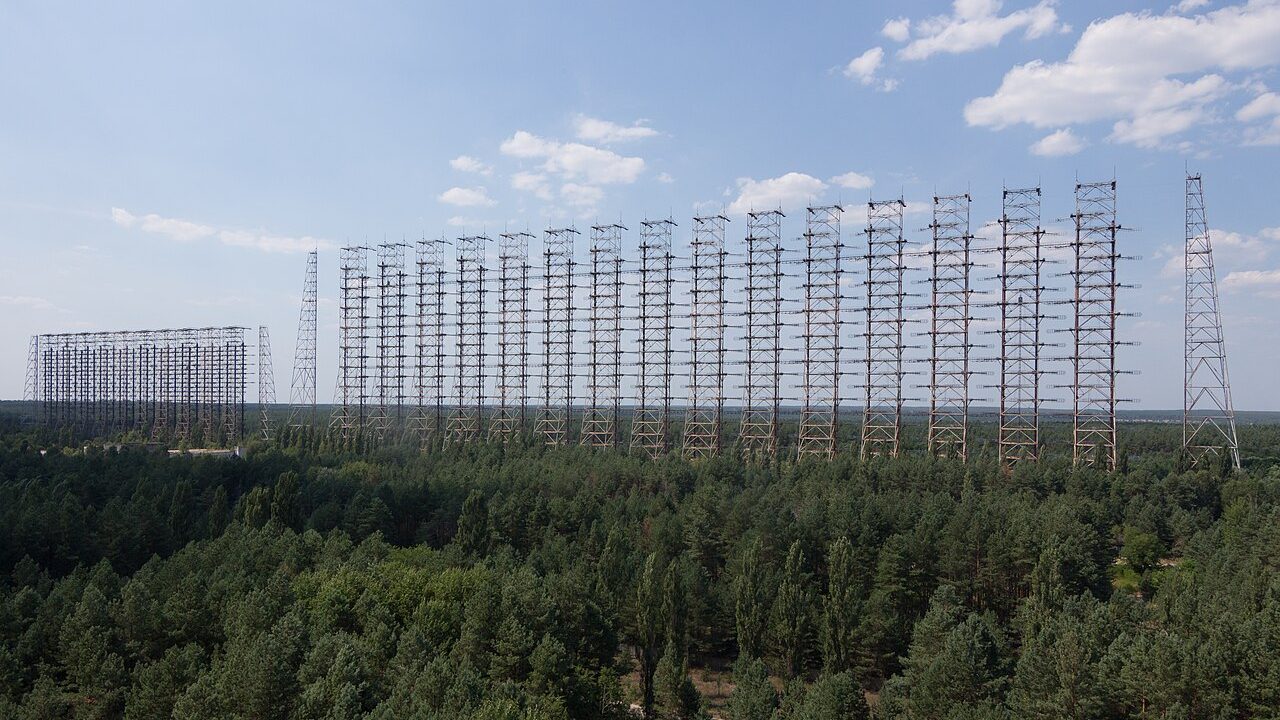
The title is accurate, but not in the way you might imagine. The 150-meter steel wall planted in the Chernobyl-2 forest never emitted a signal: it listened. The racket that saturated the shortwave bands around the globe came from another site, about sixty kilometers away.
The “Russian woodpecker” did exist, indeed, between 1976 and 1989.
- The steel wall at Chernobyl-2 was a receiving antenna, not an emitter, part of the Soviet Duga-1 radar system
- The “Russian woodpecker” that jammed radios worldwide between 1976 and 1989 originated from a transmitter located 57 km northeast, near Slavutych
- The Duga-1 radar operated for thirteen years without ever being formally adopted by the Soviet Ministry of Defense
A 10-Hertz Drumbeat Across All Bands
From July 1976 to December 1989, shortwave radios around the world picked up a sharp clack, repeated ten times per second. Some Duga installations exceeded 10 megawatts of power, and their random frequency jumps disrupted broadcasting, amateur radio, commercial aviation communications, and even power grids. Thousands of complaints reached governments in several countries. Some receiver manufacturers eventually incorporated a “woodpecker blanker,” a circuit designed to erase this tapping.
In the absence of an official explanation, hypotheses flourished: mind-control experiments, weather manipulation. The amateur radio community, for its part, quickly understood that it was a long-range radar, but confirmation only arrived after the collapse of the Soviet Union.
The principle is straightforward physics in a few lines. Shortwave waves bounce off the ionosphere, fall far ahead, are reflected from the ground toward the sky, and return along the same path, allowing the detection of objects up to 4,500 km away. For Soviet military planners, the calculation was simple: an American missile would reach the USSR in less than an hour, and every minute of warning counted.
Two Sites, One Silent Wall
Duga-1 consisted of two distinct installations: the transmitting antennas at Liubetch-1, and the receiving antennas at Chernobyl-2. The structure visitors photograph today, about 150 meters tall and 700 meters long, belongs to the latter group, and a smaller antenna, around 90 meters, stands nearby. The transmitter was located roughly 57 km to the northeast, near Slavutych, the town where the residents of Pripyat were later relocated.
The wall at Chernobyl therefore listened; it did not shout.
A persistent confusion has people referring to “Duga-3” to designate the Ukrainian site. This third radar was never built: there was a prototype near Mykolaiv, Duga-1 in Northern Ukraine, and Duga-2 at the far end of the country, in Komsomolsk-on-Amur. The one at Chernobyl was aimed north, toward the United States.
A Well-Guarded Secret Amid the Pines
Around the antenna stood a small military town named Chernobyl-2, with schools, shops, and a cinema, named after a nearby city to mislead spies. About 1,500 people (military personnel, scientists, technicians) worked there, and the site appeared to locals as a summer camp for children. According to some estimates, the installation consumed about a third of the nearby power plant’s output, a neighborhood presence that was hardly accidental.
According to the site Chernobylstory, this system designed to detect intercontinental missiles was never formally adopted by the Soviet Ministry of Defense. Yet it operated for thirteen years.
Rusty, but Classified
Ukraine has listed the radar as a national-importance architectural monument.
The visitor approaching it from the exclusion zone’s forest encounters a steel wall that looms like a 45- to 50-story building. Cables hang, rust has taken hold of the lattice, and complete silence reigns.
One area of ambiguity remains: the dates vary by source. Some place commissioning in 1976, others mention an official start of operation in May 1982, and construction is said to have been completed around 1979. Technical documents on the Duga radars, according to several accounts, were destroyed or locked away long ago, leaving historians with incomplete archives.
Sources: chernobylstory.com | chernobyl.one | urbex.nl
