
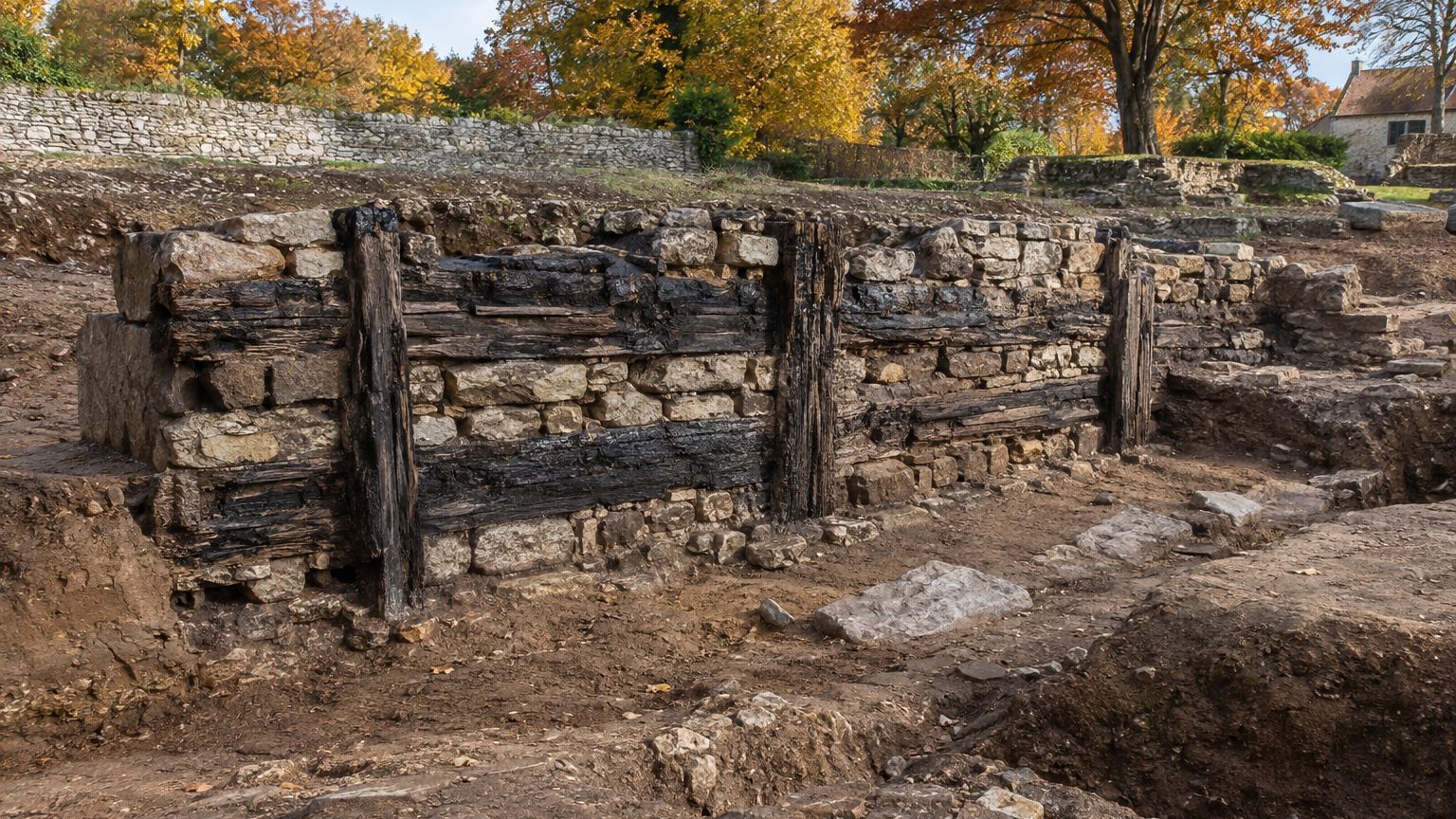
Since February 2026, archaeologists from the City of Paris and Inrap have been excavating two courtyards of the Hôtel-Dieu. This summer, they uncovered a wall that mixes stone and timber, preserved for about 20 meters. Almost the length of a tennis court, just a few steps from Notre-Dame. Its facing shows traces of a violent fire, and it could be the first material vestige of the rampart of Gaulish Lutetia.
In the absence of evidence, some placed Lutetia elsewhere.
- A 20-meter-long wall of stone and wood was discovered beneath the Hôtel-Dieu in July 2026
- Burn marks and a Gaulish spear found at its base point to a context of Gaulish destruction
- Radiocarbon dating places the wall between 200 BCE and 10 BCE, spanning the year 52 BCE of Caesar’s conquest
Blocks, Beams, and Two Meters of Sand Behind
The Ministry of Culture presented the discovery on September 23, 2026. The excavation is led by the City of Paris Archaeology Service (DHAAP) with Inrap, under the supervision of DRAC. Its head, David Couturier, directs the operations. Found in July beneath the Hôtel-Dieu, the structure was unveiled to the press on Wednesday.
The wall combines stone blocks and horizontal wooden elements. This technique is characteristic of Gaulish fortifications from the late Iron Age. Archaeologists have also identified, behind it, an artificial platform of sands and gravels that reaches nearly 2 meters in thickness.
These sands and gravels were brought in from outside and deposited deliberately. A mass of this size, adjacent to a stone-and-wood wall, resembles a defensive device, hence the idea of a rampart. The exact function remains to be demonstrated.
The radiocarbon dating provides an initial frame. The early radiocarbon dates place the wooden elements between 200 BCE and 10 BCE. The range spans 190 years, roughly the same width as dating an object from 1836 to today if it were a nineteenth-century artifact. It includes 52 BCE, the year of Caesar’s conquest of the region, though at this stage we cannot say on which side of that date the wall was built.
A Burned Wooden Building, a Gaulish Spear, and a Caesar Text
In front of the wall, the diggers found remnants of a wooden building that had been destroyed by a fierce fire. The facing itself is blackened by the blaze. Charred seeds were also found nearby. At the base of the wall lay a Gaulish spear, an indicator that points toward a Gaulish context and, perhaps, toward an episode of combat or destruction.
Caesar places Lutetia on an island in the Seine.
In the The Gallic War, the narrative is precise on one point: in 52 BCE, the Parisi were the ones who set fire to their oppidum before the arrival of the Roman troops. Yet no Gaulish vestige had ever been recognized on the Île de la Cité to confirm this scene. Hence the hypothesis, defended by some, of Lutetia being located at Nanterre.
The mayor of Paris, Emmanuel Grégoire, spoke before the wall of being “vertiginous” and of an origin “probably” found for the city. Caution is warranted: the wording is political, not scientific. The archaeologists, for their part, remain cautious and use the conditional tense.
What the Wall Has Not Yet Revealed
Two questions remain open, and they are the most important: what exactly was the purpose of this wall, and when was it built and then burned? Radiocarbon dating dates the death of the trees, not the moment when the beams were erected or when the fire occurred. To connect the structure to Caesar’s account, the chronology will need to be tightened.
There is still no proof that this is the rampart Caesar described.
The excavation will continue for several months. The broken amphorae, the spearhead, and the coin found beside the wall will be studied, as will the layers of sand and gravel. David Couturier himself says: “We cannot rule out further surprises.”
For now, all that can be affirmed in one sentence is this: beneath one courtyard of Hôtel-Dieu lies a burned wall of stone and wood, dated between 200 BCE and 10 BCE, waiting to say to which moment in Lutetia’s history it belongs.
Sources: futura-sciences.com | epochtimes.fr | ici.fr
