
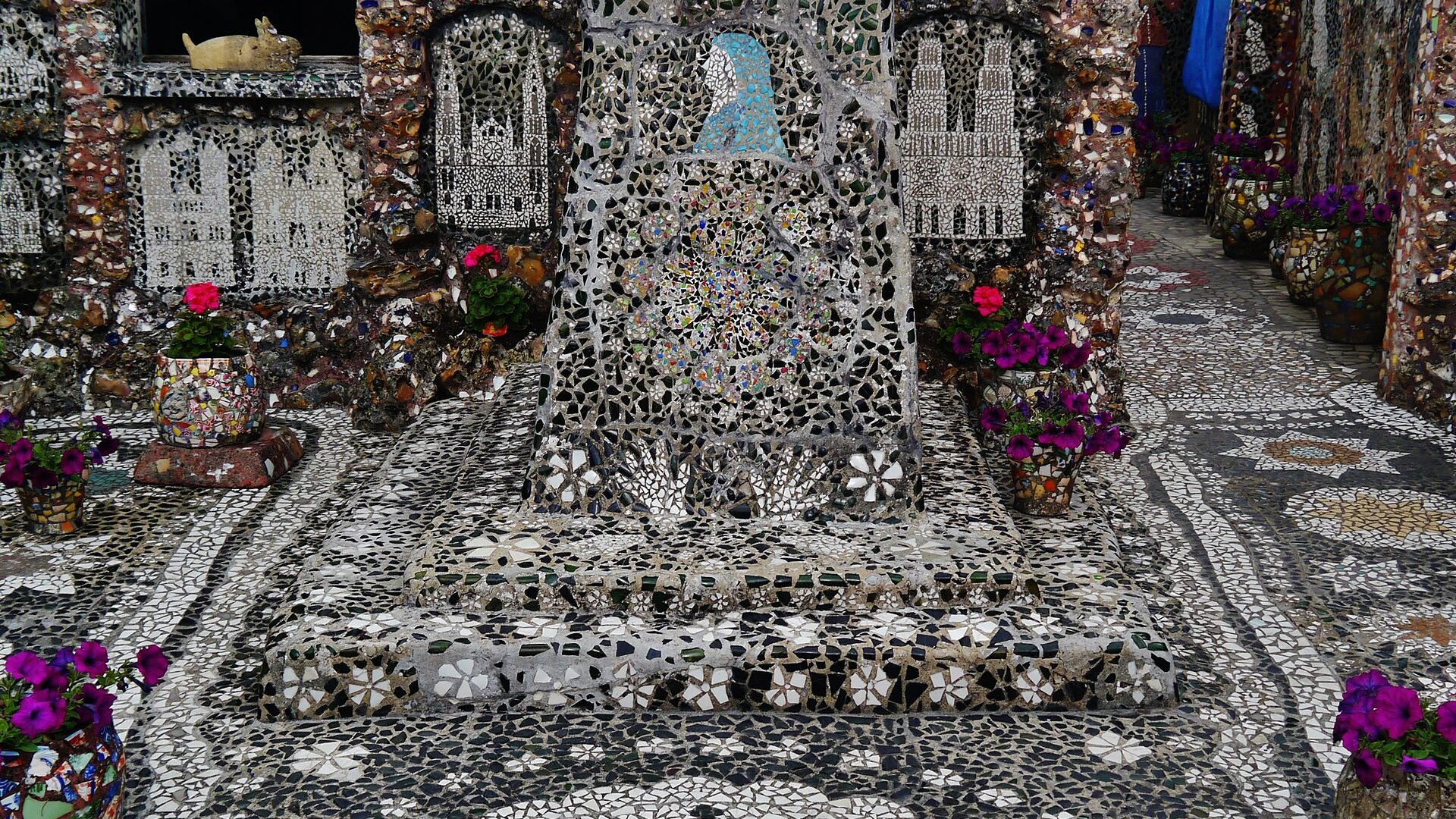
For a long time, in the streets of Chartres, people laughed at him. Raymond Isidore would go home with pockets full of shards picked up along the roads, in dumps, during his rounds. His neighbors nicknamed him Picassiette, a sobriquet both mocking and affectionate, playing on the word pique-assiette. Today, his house draws visitors from all over the world, curious to discover what this municipal employee built on his own, shard after shard, for more than twenty years.
Raymond Isidore worked for the city of Chartres. He was employed there as a cantonnier before being assigned as a sweeper at the Saint-Chéron cemetery. A modest job, far from any brush or artist’s studio. Nothing foreseen in him as the world’s author of one of France’s most singular houses.
- Raymond Isidore collected pieces of broken crockery for 24 years to transform his house into a unique mosaic.
- The Picassiette House comprises 4 million pieces of ceramic, glass and faience assembled meticulously.
- Classified as a historic monument in 1983, the house has become a major tourist site despite initial mockery.
Fragments of Crockery, a Day Out
It all begins by chance, in 1938. Isidore strolls through the fields around Chartres when he spots fragments of glass and broken porcelain. In his own words, as relayed by the city of Chartres, he happens upon little bits of glass, shards of porcelain, and broken crockery, which he picks up without any precise plan, drawn by their colors and their sparkle. He sorts, discards what he dislikes, and piles the rest in a corner of his garden.
The idea of turning it into a mosaic germinates afterward, almost naturally. Isidore himself says that he begins by decorating his house, initially envisioning only a partial decoration limited to the walls. But the project quickly escapes him. Each day, he covers miles in search of new debris, a quest that becomes obsessive and which, according to the city of Chartres, earns him the nickname Picassiette, a label he would never shed.
The gaze of others, at first, was not kind. The city of Chartres recalls that he was initially despised by those who knew him, sometimes literally taken for a fool. Yet Isidore pressed on, indifferent to the taunts, absorbed in his permanent chantier.
Twenty-four Years of Solitary Work
The work grows in waves. After completing the interior of the house, Isidore turns to the exterior walls, then to the courtyards. In 1956, he goes even further: he buys a neighboring plot and undertakes new constructions behind his house, including a chapel. The house no longer suffices; the garden itself becomes a canvas for creation.
The final piece of the puzzle is called the Tomb of the Spirit. Isidore completes it in 1962, bringing to a close a work begun nearly a quarter of a century earlier. Twenty-four years of solitary labor, without formal artistic training, without commissions, driven by nothing other than this obsession born from a shard picked up in a field.
His widow would later put forward figures to measure the scope of the work accomplished: 29,000 hours spent assembling the fragments, 4 million pieces of crockery, glass and faience, and up to 15 tons of debris retrieved over the years. These estimates come from her, conveyed by the city, rather than from a scientific measurement, but they convey the quiet magnitude of the undertaking.
From Mockery to Recognition
Raymond Isidore died in 1964. He would not have witnessed the institutional consecration of his work, but he did see, in life, the growing interest that his house inspired. The city of Chartres notes that he had the satisfaction of seeing his work recognized, and he himself enjoyed giving tours of his house with pleasure.
The story unfolds over several decades. The city of Chartres acquired the house in 1981. Two years later, on November 14, 1983, the Picassiette House was classified as a historic monument, according to the Mérimée database of the Ministry of Culture. A status that now protects the entire site, house and garden included, and that formalizes what the inhabitants of Chartres had long suspected: this mocked cantonnier had, without fully realizing it, created a unique work of its kind.
The site is today linked to the Chartres Beaux-Arts Museum and open to the public. Visitors who flock here come from afar, sometimes very far, to walk through these rooms where every square centimeter, from walls to the stove to the furniture, tells the same story: that of a man alone, armed with a bucket and patience, who transformed refuse into national heritage.
Sources: chartres.fr | habitants-paysagistes.musee-lam.fr
