
People often confuse a technical breakdown with a civilizational failure. The former can be repaired with a screwdriver and a bit of patience, while the latter sweeps away an entire system, sparing no distinction between scientific achievements and the political ambitions that propelled them. It is precisely this nuance that makes the story of Elbrus-3 so fascinating: this Soviet supercomputer was not felled by a design flaw nor by a conventional lack of funding. It was carried away by the disappearance of the country that had given birth to it. A tale that almost reads like a metaphor, illustrating how science, even at its brightest, remains hostage to the political context in which it evolves.
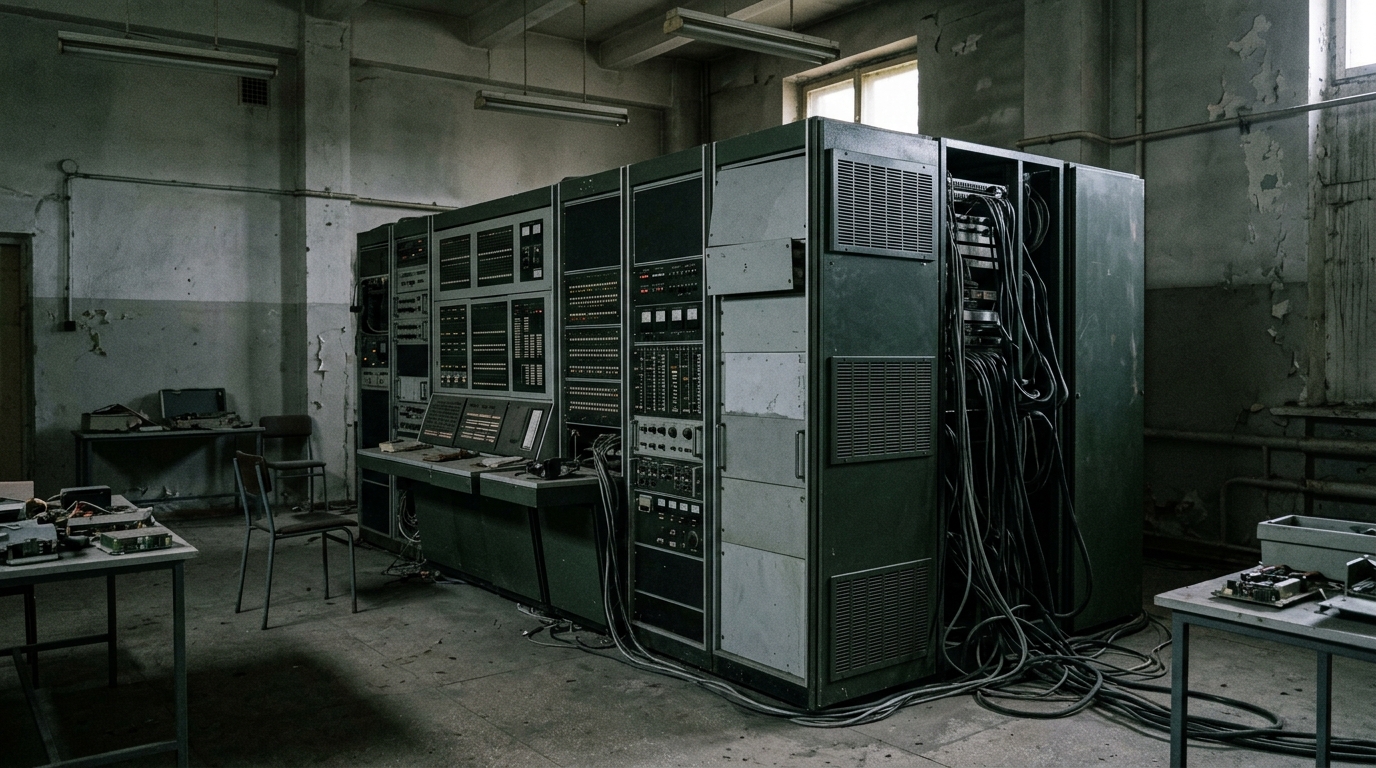
- The Elbrus-3, a Soviet VLIW architecture supercomputer with 16 processors, completes development in 1991, the year the USSR dissolves.
- Only one prototype was produced; the collapse of the Soviet state erased the orders and funding necessary for mass production.
- Research continued through the El-90 and El-95 processors, and Boris Babayan later joined Intel in 2004, fueling the hypothesis that Elbrus-3 influenced the EPIC architecture of Intel’s Itanium chips.
- The audacious dream of an empire that refused to lose the technological race
- Elbrus-3, the machine that was to humiliate American computers
- When history catches up with science: the USSR collapses before its computer
- What Elbrus-3’s failure reveals about the end of a superpower
The audacious dream of an empire determined not to lose the technological race
To grasp the ambition behind Elbrus-3, one must trace back to the origin of its institutional cradle. In 1948, under the aegis of the Soviet Academy of Sciences, the Institute of Precision Mechanics and Computer Technology, better known by its acronym ITMVT, opened its doors in Moscow. Under the leadership of pioneer Sergueï Lebedev, this institute quickly became the spearhead of high-performance computing in the USSR, a place where people dreamed of rivaling, machine against machine, the American laboratories.
It was within this tradition that the first Elbrus machines emerged—ambitious, yet far from provoking a tremor in the West. In 1985, the team led by engineer Boris Babayan decided to start from scratch. Rather than iterating on the Elbrus-1 and Elbrus-2, they embarked on the design of a radically new machine, conceived to surpass anything the Soviets had produced to that point. The objective was not merely technical; it carried a deeply symbolic weight: to prove, amid a digital Cold War, that the Eastern Bloc could still surprise the world.
Elbrus-3, the machine that was to humiliate American computers
Technically, the Elbrus-3 rests on an architecture known as VLIW, for very-long instruction word, a method that enables the parallel processing of a very large number of instructions. This approach was directly inspired by American processors such as the FPS AP-120B or the Multiflow Trace, evidence that Soviet engineers closely followed Western publications despite the Iron Curtain. Strikingly, this architecture evolved almost in parallel with the U.S.-made Cydrome Cydra-5, conceived in the United States at roughly the same time, with neither team aware of the other’s work.
The machine conceived by Babayan and his team housed 16 processors, an impressive figure for the era. Sources vary slightly on the exact completion date—some cite 1986, others 1990—but all agree on one point: the Elbrus-3 ranks among the very first VLIW systems in the world. An engineering feat that should have placed the USSR at the forefront of the global computing race, if history had not had other plans.
When history catches up with science: the USSR collapses before its computer
The development of the Elbrus-3 culminates in 1991, a date not at all incidental since it coincides exactly with the year of the Soviet Union’s dissolution. Only one prototype comes to light, but it arrives at history’s ill-timed moment. Perestroika had already begun its destabilizing work, and the collapse of the Soviet state brutally undermines the industrial fabric that supported scientific research. Orders for ITMVT machines grow scarce, then nearly vanish altogether.
The ensuing economic crisis, following the fall of the Eastern bloc, seals the deal. Funding, once guaranteed by a powerful state, suddenly dries up. This is not a matter of profitability or typical mismanagement: an entire country, with its institutions, budgets, and priorities, has disappeared from beneath the feet of those building the future of its computing. The Elbrus-3, despite its undeniable technical merits, would never reach mass production.
What the Elbrus-3’s failure reveals about the end of a superpower
Far from being entirely buried, the work accomplished on Elbrus-3 would endure in a different form. Research carried out on a microprocessor inspired by the Elbrus-2, named El-90, laid the groundwork for a VLIW chip reviving the architecture imagined by Babayan. This lineage ultimately led to the El-95, a design that would serve as leverage in negotiations with several foreign companies, at a time when Russia was desperately seeking to monetize its scientific know-how in a globalized market.
Boris Babayan, for his part, continued his career at MCST before joining Intel in 2004, where he served as director of architecture in the Software and Solutions group, while advising Intel’s Moscow research and development center. His trajectory fuels an ongoing controversy: some observers contend that the Elbrus-3’s VLIW architecture directly inspired the EPIC technology later used by Intel for its Itanium chips, developed in collaboration with HP. A striking linkage between a Soviet project buried by history and one of the most debated chips in modern computing.
