
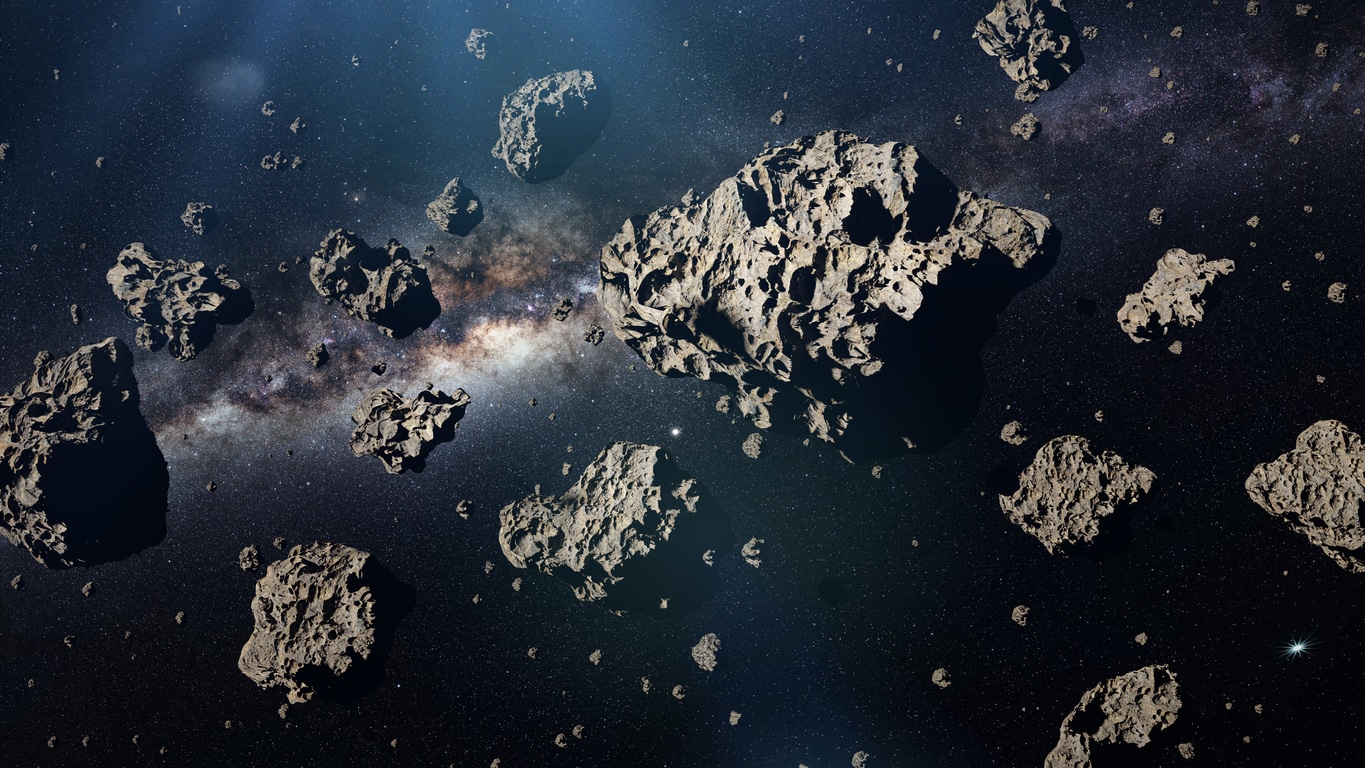
The sky above our heads could be far more dynamic than we imagine. Researchers have recently suggested that as many as one million asteroids originating from the Alpha Centauri system may be hidden within the Oort Cloud, at the edge of our solar system. These objects could drift into our cosmic neighborhood in the near future, challenging our current understanding of interstellar objects.
Interstellar Objects from Alpha Centauri in Our Solar System?
Only 4.3 light-years away from Earth, Alpha Centauri is the closest stellar system to ours. It comprises three stars. The nearest, Proxima Centauri, sits closer to our Sun than any other star, a fact that has captivated astronomers. It serves as a natural laboratory for studying stars, planets, and interstellar objects such as asteroids and comets that traverse our solar system.
A recent study explored the possibility that objects originating from Alpha Centauri could cross into our solar system. The researchers ran a simulation spanning 100 million years and found that a substantial number of asteroids, with a minimum size of 100 meters, could be ejected from this neighboring star system. They would be primarily driven by gravitational perturbations from the stars and planets of Alpha Centauri.
The Oort Cloud, a vast icy region marking the edge of our solar system, would then play a crucial role in capturing these objects. According to the simulation results, about 50 asteroids originating from Alpha Centauri could enter this region each year. However, only a handful of them would approach the Sun closely enough to be observed by astronomers.
Why are these asteroids interesting?
What makes this discovery even more fascinating is the possibility that these Alpha Centauri objects might differ from the asteroids we’ve observed in our own solar system. These asteroids could indeed contain elements and materials unique to another stellar system. If an object from Alpha Centauri were to enter the solar system and be detected, it would provide scientists with a rare opportunity to study matter originating from another stellar system without leaving Earth.
However, how can we be sure that these asteroids truly originate from Alpha Centauri? According to researchers, Alpha Centauri objects travel at specific speeds and follow distinctive trajectories, which would allow astronomers to identify them more readily. In the future, scientists could use these characteristics to confirm that a given asteroid indeed came from Alpha Centauri.
The implications of this discovery for science are significant. If such objects were detected, they would offer a fascinating glimpse into the features of neighboring stellar systems. For instance, these studies could teach us more about their chemical composition and about how objects of such size can move from one system to another.
Moreover, this research could pave the way for future space missions. Indeed, if an interstellar asteroid from Alpha Centauri were detected, it could prompt sending probes to visit and analyze its composition. This would mark a major advance in our quest to understand other stellar systems and their environments.
