
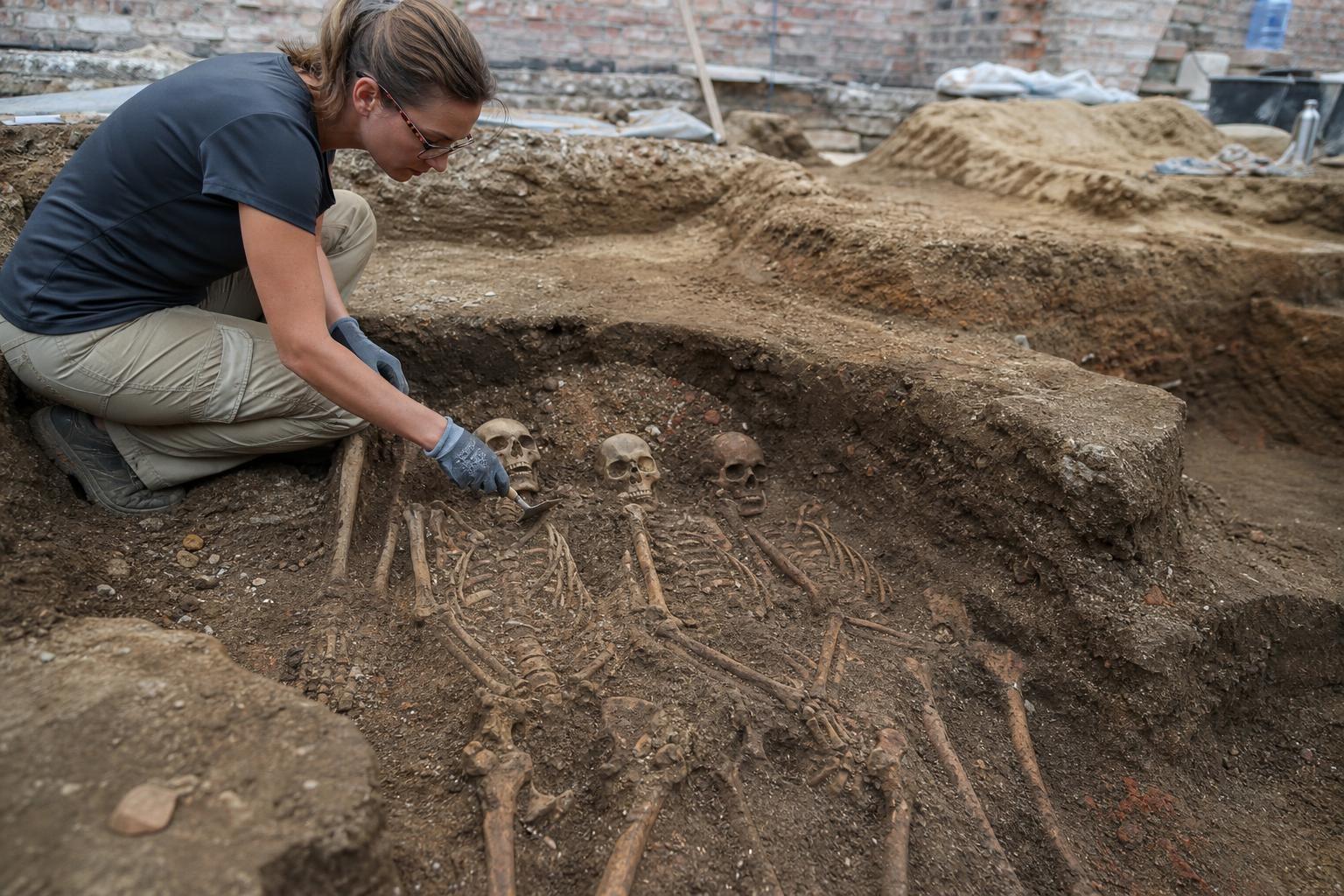
The ground in Jamestown keeps secrets, and now it has whispered four more. Beneath the footprint of a 17th‑century chapel, archaeologists traced the resting places of men who helped launch England’s first foothold in North America. Their story surfaced not with drama, but with the quiet, meticulous rhythm of science. Coffin stains, nail ghosts, and a whisper of metal drew a patient line back to the colony’s fraught beginnings.
Unearthing the Past Beneath the Pews
Tucked within the ruined outline of an early Anglican church, a team mapped anomalies beneath the former chancel—the sacred space near the altar reserved for the highest in rank. In that privileged slice of ground, four burials lay in orderly silence, their positions echoing both ritual and status. “This is as close as we can come to a handshake across four centuries,” said one field archaeologist, brushing soil from a sliver of timber. The location itself spoke volumes about hierarchy, belief, and the fragile stitchwork of an experimental outpost trying to become a home.
Clues in Timber, Soil, and Silver
The team worked layer by layer, reading the earth the way a historian reads paper. Subtle discolorations sketched the outlines of coffins—so‑called “coffin stains”—where wood had long since melted back into the soil. Iron hardware pricked the matrix like punctuation, while delicate pins hinted at burial shrouds rather than suits of everyday wear. In one grave, a tiny box—possibly a religious reliquary—glimmered with the stubborn light of belief, its presence a provocative nod to complex faith in a colony framed as staunchly Protestant. Nearby, a fragment that may have been a sword hilt suggested service, duty, and the brittle authority of martial law.
Who Were These Men?
The profiles—drawn from bones, artifacts, and archival threads—point to four early leaders of unusually high standing. A clergyman appears among them, seated in death near the liturgical center where he likely once preached, counseled, and wrestled with everyday hunger and hope. Two others show signatures of military life—youthful strain in joints, robust upper limbs, and objects tied to rank. A fourth seems to carry the stamp of noble birth, a blend of refined goods and a burial spot that whispers of social gravity. “The chancel is prime real estate for the soul,” the site director quipped, “and these men clearly had the keys.”
From Bones to Biography
Osteologists read the skeletons for age, ancestry, stress, and diet, turning enamel and femurs into quiet, telling texts. Chemical signatures—strontium and oxygen isotopes—hint at childhood origins, mapping whether these lives began on English limestone or coastal plain. Microscopic wear on teeth becomes a ledger of habits, from pipe‑biting to the rough grind of early colonial bread. DNA offers temptations but also limits; heat, humidity, and time conspire against fragile strands that could knit biographies to stubborn archival ink. Even so, cross‑checking burial order, liturgical geography, and surviving rosters sharpens the probable identities behind each grave.
What the Graves Reveal
These four burials compress a turbulent decade into a few careful meters of soil, a chronicle less boastful than the pamphlets that once sold the New World as easy fortune. Read together, they sketch how power, worship, and survival intertwined in the first English settlement to endure. Consider the lessons that rise from the chancel’s compact stage:
– Elite status bent space and ritual, placing certain bodies in a sanctified corridor of memory and authority.
– Faith was not flat or simple; objects suggest a spectrum of practice at once public and privately fervent.
– Military necessity pressed into daily life, blurring the boundary between prayer and powder.
– Mortality was immediate and omnipresent, yet the community still carved meaning through ordered burial.
A Present Tethered to First Footsteps
Standing above those measured rectangles, it is hard not to feel the tug of shared risk—storms, hunger, politics, and the experiment of living with unfamiliar neighbors. The graves also push us to widen the frame, acknowledging the Indigenous peoples whose lands anchored this colonial gamble and whose responses shaped every English decision. “Archaeology makes the past negotiable again,” one researcher noted, “because the ground does not care about our neat stories.” What it preserves, however unevenly, can still rearrange how a nation tells its origins—not as destiny, but as debate in wood, iron, and bone.
The Quiet After the Trowels
When the tools are packed and the tarps go down, the site returns to wind, river, and the steady hush of tidal marsh. Yet the narrative refuses to be reburied, stitched now into museum cases, classroom syllabi, and the imaginations of visitors who peer across an open, grassy rectangle. Four men once stood here under threat and possibility, their choices narrowing and widening the path we now call history. In the end, the earth kept faith with their memory, and careful hands helped that faith find its voice.
