
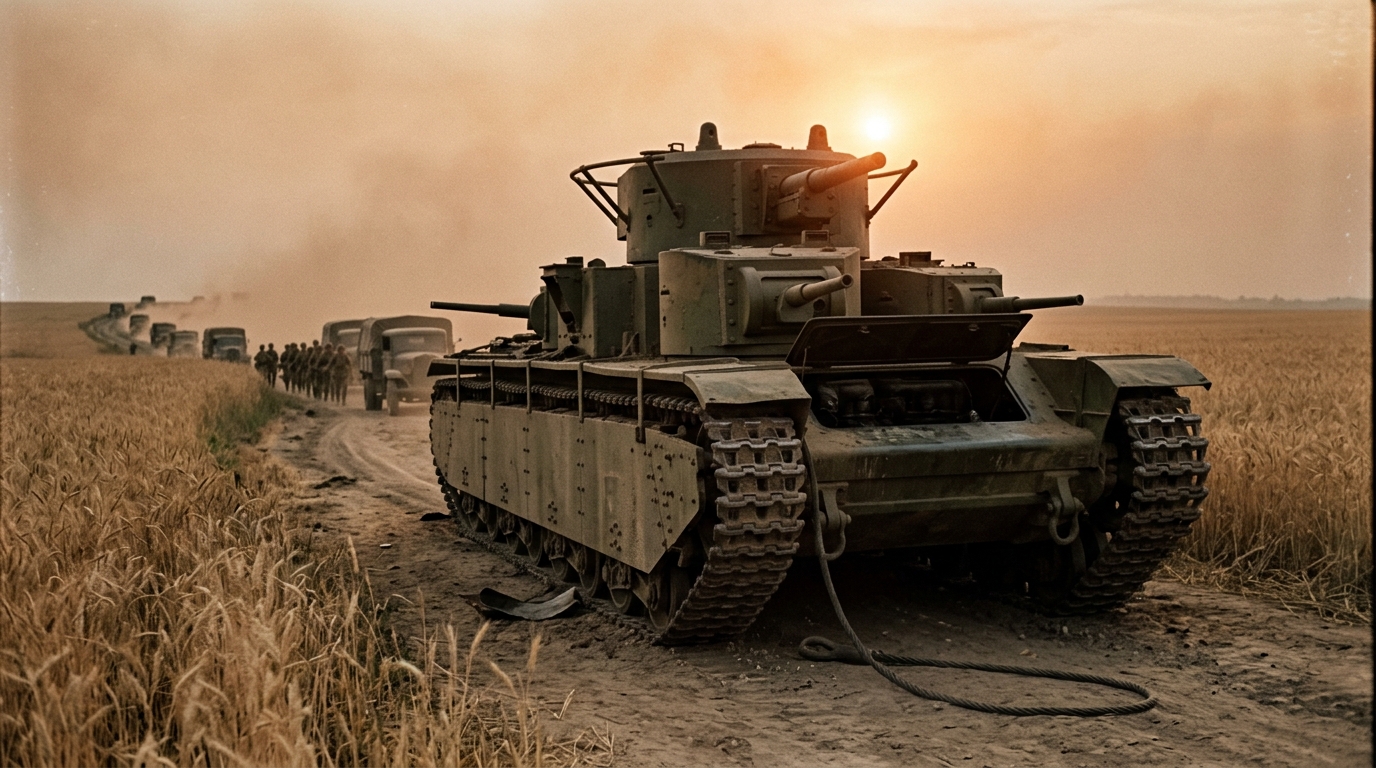
What if the greatest threat to a battle tank wasn’t the enemy, but itself? The question might seem absurd, yet it perfectly encapsulates the fate of the T-35, that Soviet behemoth mounting five turrets on its chassis as if stacking trophies. On paper, the machine has enough to make any headquarters tremble: 45 tons of steel, a silhouette that evokes a mobile fortress rather than a combat vehicle, and armament ample enough to hold its own against a small detachment. In practice, the history of this tank reads like an industrial fiasco played out far from hostilities, somewhere between a weary transmission and a motor at the end of its tether. A look back at the improbable trajectory of a machine that the Red Army ended up abandoning even before the first shot was fired.
- The T-35, a 45-ton Soviet tank with five turrets produced in 61 examples between 1933 and 1939, suffered from an unmanageable command structure with up to eleven crew members isolated in separate compartments.
- During Operation Barbarossa in 1941, most T-35s failed before any combat: 35 were lost to technical faults, 20 were destroyed in combat, and 4 were captured.
- Only a single example of the T-35 remains today, housed at the Kubinka Tank Museum in Russia, a testament to a military doctrine that prized the accumulation of weapons over mobility and reliability.
- A tank built to impress, not to fight
- Five turrets, eight men, a logistical nightmare
- 1941: Mechanical collapse before the first shot
- Why the T-35 remains the symbol of an outdated doctrine
A tank designed to impress, not to fight
In the years following the Soviet industrial upheaval, the USSR sought to project its military power onto the world stage. It is in this climate that the T-35 was born, developed between 1931 and 1933 at the Kharkov locomotive works, under the direction of engineer N.V. Barykov. The guiding idea was simple: the more turrets a tank bore, the more formidable it would appear. The result exceeded all visual expectations, with a main turret housing a 76.2 millimeter howitzer, flanked by two secondary turrets armed with 45-millimeter guns and two additional turrets fitted with 7.62 millimeter machine guns.
This display of armament made the T-35 an ideal propaganda piece. It rolled proudly through Red Square, impressed foreign military attachés, and, in the regime’s eyes, embodied Soviet technological superiority. Yet there is often a gulf between showroom spectacle and battlefield practicality, and the T-35 would illustrate this gap with remarkable consistency. Built in only 61 examples from 1933 to 1939, it remains to this day the only five-turret tank produced in series in the world, a record as unique as it is revealing of the conceptual dead end it represents.
Five turrets, eight men, a logistical nightmare
Having five turrets share a single chassis is a problem Soviet engineers never truly solved: command. Inside the T-35, up to eleven crew members are distributed across stations, each isolated in its own combat compartment. The tank commander, tasked with coordinating the whole, becomes practically unable to supervise five different firing points at once. Shouting orders through metal partitions is impossible, and coordinating fire with battlefield precision is out of reach.
This dispersion turns what should have been a devastating striking force into an assembly of poorly coordinated weapons. The limited calibers of many of the guns further diminish the platform’s overall effectiveness. The German general Heinz Guderian, a close observer of armored vehicles, would likely have likened these multi-turreted tanks to elephants: impressive in appearance, but heavy, awkward, and ultimately vulnerable. A succinct image that captures the paradox of the T-35—an imposing visual monster whose feet are made of clay.
1941: Mechanical collapse before the first shot
It was in 1941, during Operation Barbarossa, that the T-35 delivered its final verdict. The few units still in service were concentrated in the 34th Armored Division of the 8th Mechanized Corps, stationed in Ukraine to halt the German advance. Yet, combat rarely occurred. The machine’s near-45-ton mass placed extreme strain on a engine and transmission already at the edge of their capacity since design. Overheats, transmission failures, cascading breakdowns: the T-35s fell apart one after another, often before even catching sight of an enemy unit.
The numbers speak for themselves. Of the tanks lost during the campaign, 35 were due to technical malfunctions, 20 were destroyed in combat, and only 4 were captured by the Wehrmacht. In many cases, the crews sabotaged or abandoned their immobilized vehicle, unable to repair or tow it under the pressure of the German advance. The armor, capped at roughly 30 millimeters, would have offered little resistance against the era’s German anti-tank guns. The T-35 didn’t die by fighting; it literally collapsed under its own technological weight.
Why the T-35 remains the symbol of an outdated doctrine
The story of the T-35 goes far beyond a mere military anecdote. It illustrates a conception of armored warfare inherited from World War I, where the belief persisted that piling weapons onto a single platform guaranteed superiority. Yet World War II demonstrated the opposite: mobility, mechanical reliability, and command simplicity matter far more than sheer extravagance. German tanks, lighter and more maneuverable, provide a striking demonstration on the battlefield.
Today, only a single example of this steel giant survives, carefully preserved at the Kubinka Museum in Russia. The last remaining example testifies to an era when apparent power was mistaken for real effectiveness. The T-35 never required an external enemy to be defeated: its own complexity was enough to seal its fate.
From this failed mechanical venture, one takeaway extends beyond the military sphere: sophistication is never a guarantee of performance, and sometimes it is simplicity that marks the difference between a machine that advances and one that collapses. The T-35 continues, nearly a century later, to fascinate military history enthusiasts—not for its exploits, but precisely for its total lack of exploits. A way to linger in memory.
