
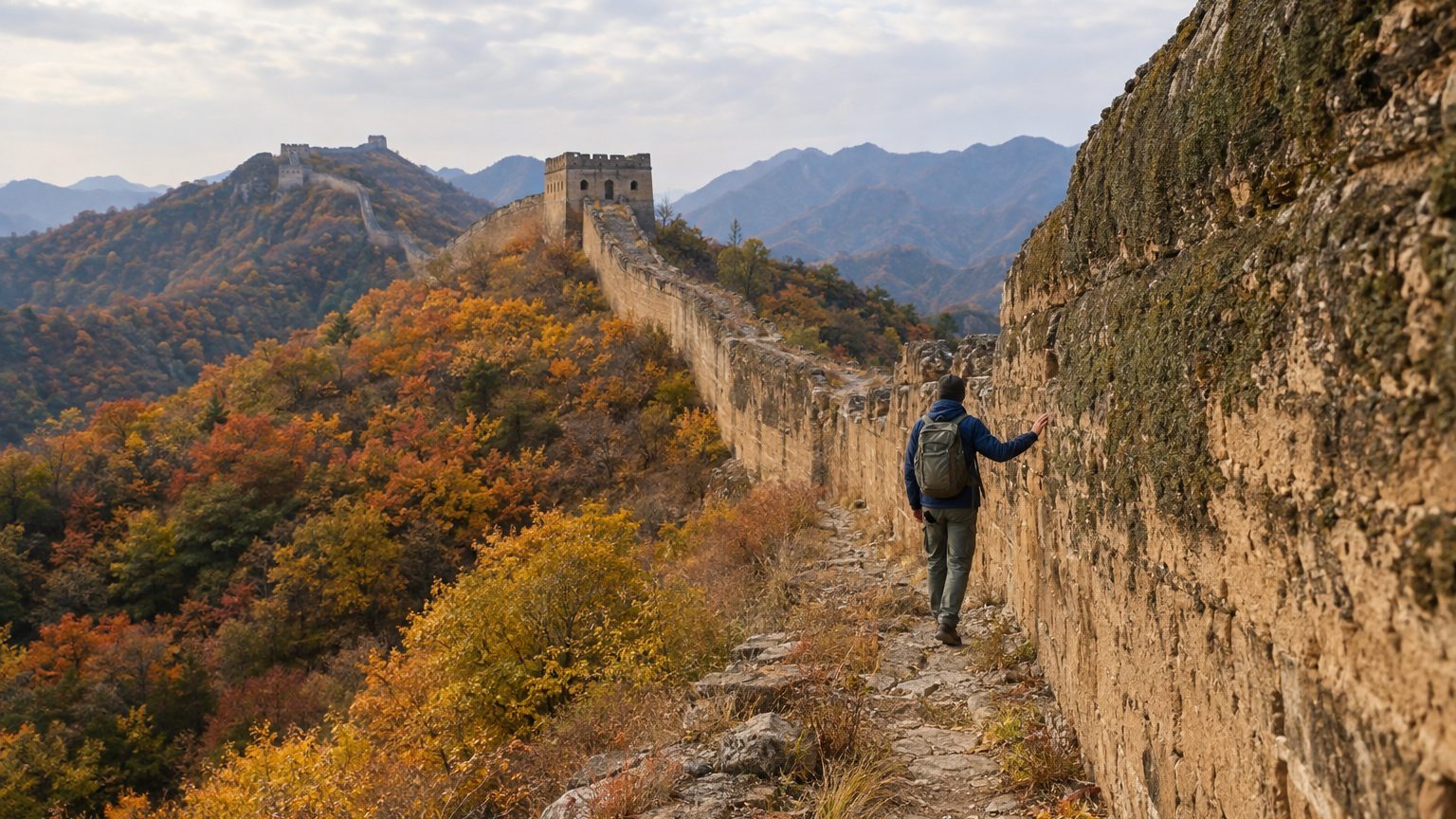
Grating off the living film that covers certain stretches of the Great Wall would be like removing their rain cloak. A study published on December 8, 2023 in Science Advances, by Yousong Cao, Matthew Bowker, Manuel Delgado-Baquerizo, and Bo Xiao, shows that these “biocrusts” protect the rammed earth from erosion. They cover 67 % of the sections studied, and the soil they conceal holds up far better than bare earth.
What is mistaken for dirt is a living fabric.
- A living crust covers 67% of the analyzed sections of the Great Wall.
- Under this layer, rammed earth resists erosion markedly better.
- Measured solidity increases by 37 to 321% depending on the tested parameters.
A Wall of Earth Eroded by Rain
The Great Wall is not a uniform block of stone. Its construction spans several centuries starting from 221 BCE, that is more than 2,200 years ago, using varied materials, mainly stone and rammed earth. Rammed earth is compacted soil, and it is this material that makes up the studied stretches, centuries old. The Smithsonian describes the structure as roughly 13,000 miles long, more than 20,000 kilometers, longer than the distance between Paris and Sydney.
Yet rammed earth is exposed to the elements. The study’s abstract notes that the structure suffers from rain and wind erosion and is largely colonized by biocrusts.
These biocrusts combine cyanobacteria, mosses, lichens, and other microorganisms bound to soil particles. For years, scientists have suspected that they accelerate erosion, reports Phys.org. Bo Xiao’s team, a soil scientist at the Chinese Academy of Agricultural Sciences in Beijing, sought to test this, because their effect on the wall’s longevity remained largely unknown.
These crusts are not unique to China: the Resoil Foundation describes them as typical of arid or semi-arid landscapes, and as an important but underappreciated natural resource. On the scale of a garden, one might think of sidewalk moss or moss on an old tile, with one difference in scale: here, researchers have measured what it does.
Less Water, More Solidity: The Details of the Measurements
The researchers conducted an extensive survey along the wall, then analyzed biocrust samples collected at several locations in laboratory tests. Field verdict: 67% of the sections carry these crusts. Compared with bare rammed earth, the crust-covered areas are less porous, retain less water, erode less, and contain less salt, with reductions ranging from 2 to 48 %. The magnitude of the effect, however, depends on crust characteristics, climate, and the type of structure.
In the observed sections, these crusts are mainly composed of mosses or cyanobacteria, photosynthetic microbes. They cover more than two-thirds of the structure, according to the Science report. Bare earth serves as a baseline for comparison.
On the solidity side, gains run from 37 to 321 %.
Four measures advance: compressive strength, penetration resistance, shear resistance, and aggregate stability. At 321%, we exceed four times the starting value. For rammed earth, this yields a material that better withstands crushing, subsidence, and layer slipping, and whose grains loosen less readily.
The abstract does not specify which parameter falls by 48% and which by 2%. For the precise details, one must consult the full open-access article.
An Armor Woven by Organisms
The crust’s robustness, according to Phys.org, hinges on the secretion of highly cross-linked polymers. Bo Xiao describes a cohesive network in which cementing substances, biological filaments, and soil aggregates mingle. Matthew Bowker, coauthor and soil ecologist, speaks of a “living skin,” a phrase echoed in the science press. This skin protects the wall from wind and water.
The authors list several possible roles: stabilizing, consolidating, serving as a sacrificial layer, and acting as a drainage roof, according to ZME Science. A sacrificial layer wears away in preference to the material it covers.
The finding disrupts a reflex: cleaning. Brushing away a patch of rammed earth to restore a neat appearance could remove the protective layer. The study’s abstract does not address cleaning, so this deduction is ours.
The researchers see it as a nature-based conservation pathway.
According to ZME Science, the approach would be inexpensive and durable. Science reports that with advances in technology, one day it might be possible to cultivate new biocrusts to shield the wall. Ecologist Nichole Barger of The Nature Conservancy calls the work “innovative and creative.” Archaeology Magazine adds that these results could illuminate the conservation of other rammed-earth edifices.
For visitors examining a rammed-earth panel, the takeaway is simple: do not scratch the crust, do not yank a piece off, and do not view it as degradation. These are study-derived conclusions, not directives issued by an institution.
Protection remains conditional, since it varies with climate and the type of structure. Human activities remain, on the other hand, a threat to the edifice, Archaeology Magazine reminds us. As for biocrusts, they cover only about two out of three of the studied sections.
