
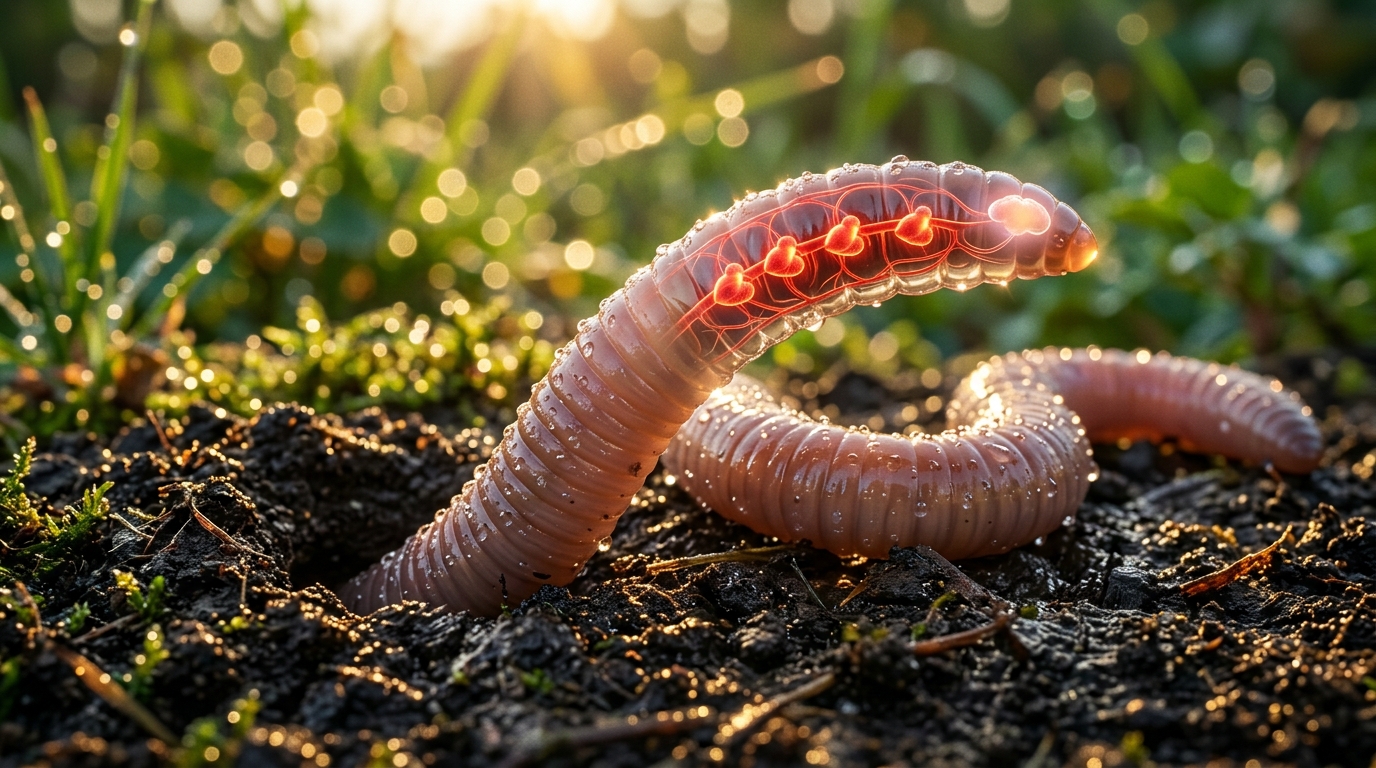
One swift shove of the shovel, a worm half still writhing in the freshly turned soil, and the received wisdom resurfaces: cut a worm in two, and you’ll end up with two live individuals. This belief, handed down for generations in gardens and on playgrounds, deserves to be subjected to anatomical scrutiny. In reality, this little segmented animal hides an internal organization far more sophisticated than it appears, including five pairs of hearts concentrated in a single region of its body. An asymmetry invisible to the naked eye, but one that completely changes the fate of each half after the cut.
- A worm cut in two never yields two living individuals, contrary to popular belief.
- Only the front half, which contains the mouth, the brain, and the five pairs of pseudo-hearts, can survive and regenerate a new tail.
- The rear half, lacking vital organs, writhes for a few hours simply due to a nerve reflex before dying, regardless of its length.
- The myth that has survived generations of gardeners
- Five hearts, one brain: the anatomy that changes everything
- The half that goes on, the one that fades
- What the act of the shovel really reveals
The myth that has survived generations of gardeners
It is difficult to find a more tenacious popular belief than this one. Each autumn, as the soil of the vegetable garden is turned over before the first frost, the scene repeats: a worm that is accidentally severed continues to wriggle on both sides, giving the impression that it has somehow given birth to two living creatures. The observation seems logical at first glance, since the worm bears no clearly marked face, no obvious limbs, only a succession of almost identical rings from one end to the other.
This reasoning, alluring as it may appear, rests on a fundamental confusion between movement and survival. A piece of worm can keep contracting for several hours after it is cut, simply because its peripheral nervous system still reacts to stimuli, much like a reflex that persists even though life does not continue behind it. It is this residual agitation that fed the myth, passed orally from gardener to gardener, without anyone really considering what was happening inside the creature’s body.
Five hearts, one brain: the anatomy that changes everything
Contrary to what its uniform appearance might suggest, the earthworm does indeed have a head and a rear, just like us. The simplest marker to distinguish the two ends remains the clitellum, that pink, slightly swollen bulge that spans several rings. The portion closest to this ridge corresponds to the head, while the opposite end forms the tail.
This distinction is far from merely anecdotal, because it is precisely in the front part that all the organs essential for the animal’s survival are concentrated: its mouth, its brain, and above all its five pairs of pseudo-hearts, small contractile vessels that function as a pump to circulate blood throughout the body. The rear part, by contrast, contains only a long digestive tube that runs to the posterior tip, with no vital organ. In other words, cutting a worm in two means separating a complete command center from a simple gut devoid of a brain and autonomous blood circulation.
The half that goes on, the half that fades
Here is the reality behind the myth: when a worm is cut, only the front half can hope to survive, provided the cut hasn’t damaged it too severely. Thanks to truly remarkable regenerative capabilities, this portion that contains the mouth, the brain, and the hearts can sometimes—over the course of a few weeks—slowly grow back a new rear end. This process is by no means guaranteed, however: it depends heavily on the precise location of the cut and the general condition of the animal.
Conversely, the rear half is doomed to die, regardless of its length. Another misconception indeed circulates on this point, the idea that the longer piece would prevail. Size, however, is entirely irrelevant here: a particularly long posterior segment but lacking a mouth, a brain, and hearts remains just as incapable of surviving as a tiny tail fragment. What matters is the presence or absence of vital organs. Interestingly, a freshwater cousin of the earthworm, the planarian, goes far beyond in this regard: it can regenerate its head and even recover a form of memory—a feat the earthworm itself does not share at all.
What the act of the shovel really reveals
After this brief anatomical detour, one conclusion stands out: a worm cut in two never gives rise to two living individuals. Only the front half, the one housing the brain and the five pairs of hearts, has a chance to survive and regenerate a new tail, while the rear half, lacking any essential organ, inevitably dies after a few hours of misleading agitation.
This story, which may seem almost anecdotal, reveals much about how certain popular beliefs are built from partial observations, never questioned. So the next time a shovelful of earth accidentally severs a garden resident, we will know, by the location of the clitellum, which of the two halves still deserves a bit of hope. Perhaps a good reason to handle the tool with a little more care during autumn work.
