
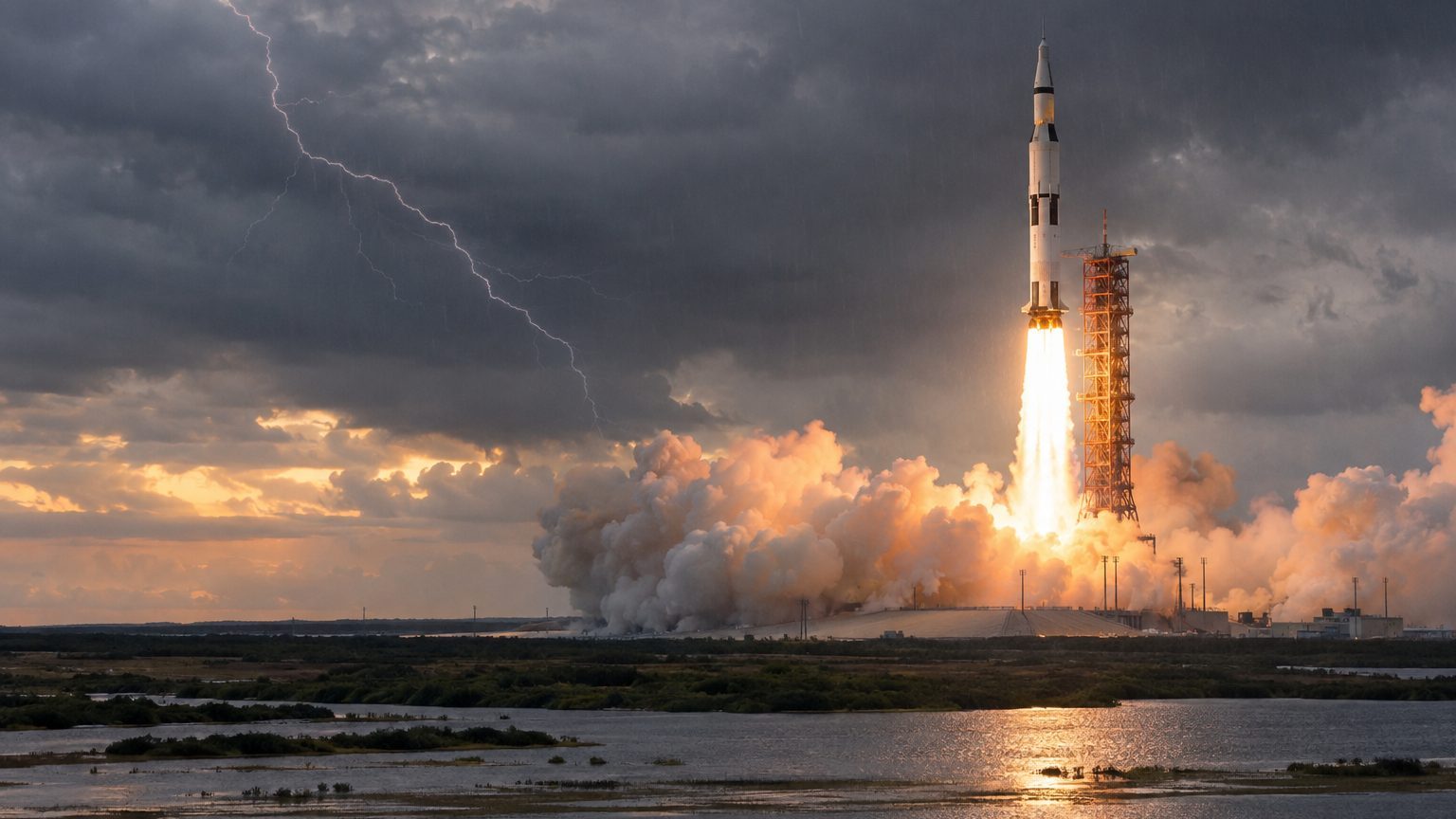
On November 14, 1969, at 11:22 a.m. Eastern Time (16:22 GMT), a Saturn V rocket (SA-507) lifted off from Launch Complex 39A at the Kennedy Space Center in Florida. On board was the capsule “Yankee Clipper,” carrying three men: Conrad, Gordon, and Bean. The sky was overcast, a light rain moistened the coast, wind blew, and the rocket would draw two lightning strikes to it.
The first struck at 36.5 seconds, the second at 52.
- Two lightning strikes hit the Saturn V of Apollo 12 at 36.5 and 52 seconds after liftoff.
- The rocket’s exhaust plumes guided the first strike to the ground.
- A directive from John Aaron, acknowledged by Alan Bean, restored data and saved the mission.
A Rocket That Makes Its Own Storm
At 36.5 seconds, the Saturn V was around 6,000 feet in altitude, about 1,800 meters—more than five times the height of the Eiffel Tower. The discharge traced the rocket’s exhaust plume down to the ground, as if the exhaust had stretched a thread from the cloud to the launch pad. It wasn’t a storm that surprised the launcher; it was the launcher that triggered the lightning. Fifteen and a half seconds later, at 52 seconds, a second strike hit, and the second discharge would have remained within the cloud, without touching the ground.
Before Apollo 12, NASA treated lightning risk only as a pre-launch concern. While the rocket remained pinned to its pad, the sky could be watched and the launch could be scrubbed. The in-flight risk did not fit this logic.
The weather that day was hardly spectacular. Not a black sky jagged with bolts, but overcast, with light rain and wind. For a motorist, it was an ordinary November day, one of those days when you simply switch on the wipers.
Warning Lights On, Data Unreadable
Inside the capsule, the warning lights illuminate. The guidance computer is lost. In Houston, the data received are unintelligible, with a loss of data contact at 36 seconds, followed by another at 52. The flight director, Gerry Griffin, contemplates scrubbing the mission.
Scrubbing would have ended what was planned to be the second crewed Moon landing in history.
With no legible readings, it becomes impossible to know which systems remain operative on board. The astronauts see alarms that ground control cannot interpret. Proceeding or aborting the flight hinges on numbers that no longer carry meaning.
“Try SCE to AUX,” an Instruction Almost Nobody Understands
At the electrical panel, John Aaron, 24 years old according to NASA records, recognizes what he sees. A year earlier, during a test, he had observed exactly the same readings. His brief instruction is: “Try SCE to AUX.” It involves transferring the signal-conditioning electronics (the SCE, which converts sensor measurements into usable data) to its auxiliary position.
The message does not come through clearly. CAPCOM Gerald Carr has the instruction repeated, and Conrad misinterprets it.
Alan Bean, however, knows where the switch and the toggle are. About a minute after the second impact, the data become readable again in Houston. NASA’s assessment lists nine nonessential sensors lost.
The gesture feels familiar. It is the move of a technician who, faced with a screen displaying anything, switches to the backup power before declaring the device dead. Here, credit goes first to memory: that of a controller who had noted a cross-check anomaly during a test, without knowing that it would someday prove useful. The chain held because each link passed the information along—Griffin, Carr, and then Bean, who knew the position of the switch.
After the Storm, the Moon
The mission could proceed. The lunar landing occurred on November 19, five days after the rain-soaked liftoff, and the crew returned to Earth on November 24, 1969.
For NASA, the lesson extended beyond mere anecdote. Until then, lightning was a concern tied to the launch ramp. Apollo 12 demonstrated that a rocket could provoke it itself in flight, under overcast, rainy conditions that would not have alarmed observers on the ground.
One final note about the hero of the day: his age varies depending on the retelling—24 years old according to NASA, 26 in other versions. In any case, he was not yet 30 when he spoke the four words that prevented a Moon flight from being canceled.
Sources: newsy-today.com | sciencing.com
