
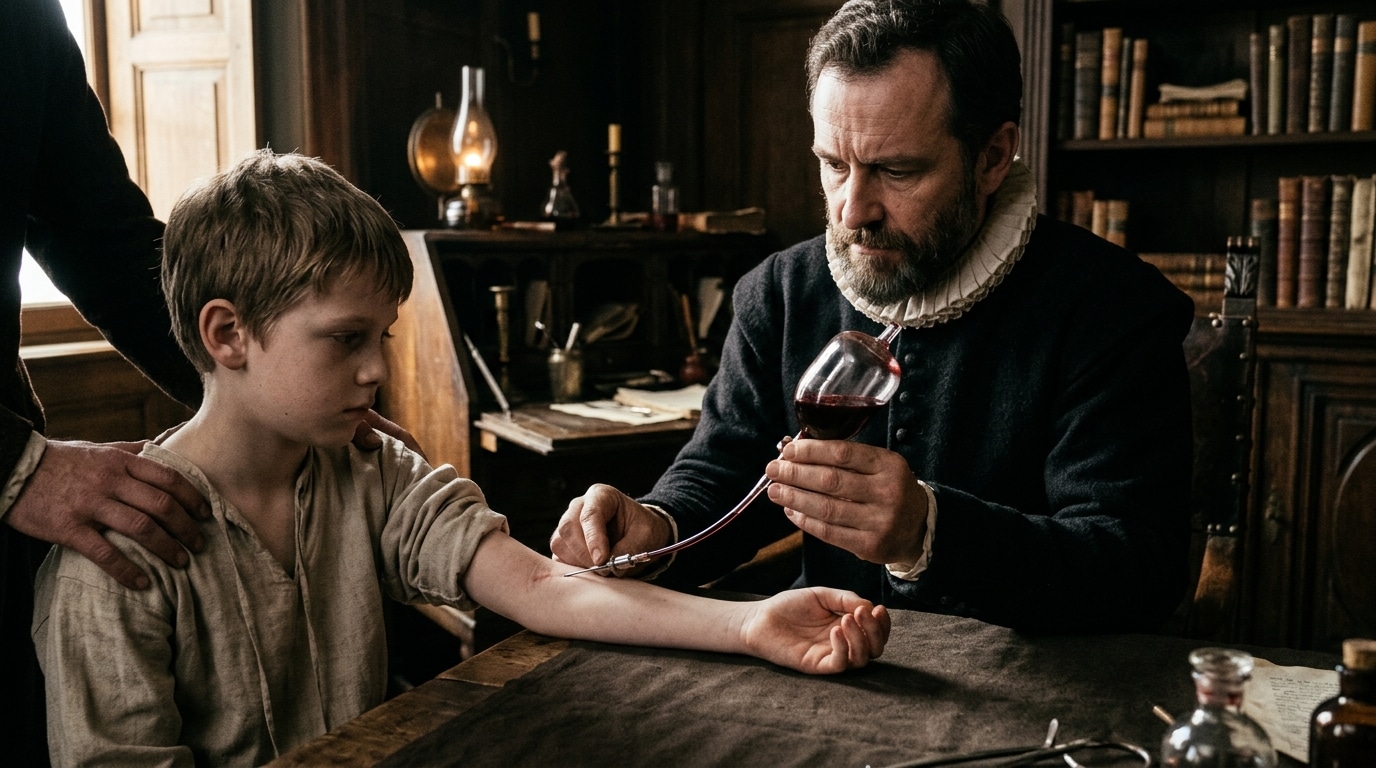
In 1667, a fifteen-year-old boy received sheep’s blood directly into his veins. This reckless act bears a name: the first documented blood transfusion in history. Jean-Baptiste Denys, physician to the king, has crossed a boundary no one had dared approach before him, risking the life of his young patient.
- In 1667, Jean-Baptiste Denys transfuses sheep blood into a feverish teenage patient, who survives despite having no knowledge of blood groups.
- After the death of Antoine Mauroy following calf-blood transfusions, a judicial scandal erupts and blood transfusion is banned in France for nearly a century and a half.
- Today, science recognizes forty-nine blood group systems, but blood remains a fragile resource requiring ten thousand donations daily in France.
- A feverish boy, a bold physician: the wild bet of 1667
- Sheep blood in human veins: an experiment at the edge of reason
- Success, scandal, and ban: the brutal fate of the first transfusion
A Feverish Boy, a Daring Doctor: the Wild Bet of 1667
Crédit : © Armamentarium chirurgicum de Johannes Scultetus (1693)
In the middle of the seventeenth century, French medicine still gropes in the dark. Bloodletting is the mainstay of treatment, humors are believed in, and the very idea of circulating blood from one body to another seems almost like sorcery. Yet it is within this context that Jean-Baptiste Denys, a physician attached to Louis XIV’s court, decides to attempt the unthinkable.
His patient is a feverish teenage boy, weakened by a stubborn fever that conventional therapies cannot quell. Repeated bleedings have left him exhausted. Denys seeks a radical solution, convinced that blood could hold the key to the problem rather than simply serving as its usual remedy.
He selects a perilous path that would today appear vertiginous in its audacity: injecting animal blood directly into the boy’s veins. Not just any animal, either. The choice falls on a sheep, long regarded at the time as a gentle and pure creature, whose blood would be less tainted than that of a sick human.
Sheep Blood in Human Veins: An Experiment at the Edge of Reason
Technically, the operation resembled craftsmanship more than science. No modern syringes or sterile tubing, but cannulas carved from bird feathers and silver tubes linked the sheep’s artery to the boy’s vein. The blood flowed directly, with no notion of compatibility.
And for good reason: no one yet knew that blood groups existed. It would take until 1900 and the work of Karl Landsteiner on the ABO system to understand why some transfusions work and others end in disaster. Denys therefore operates in total ignorance, more than two centuries before this foundational discovery.
Against all odds, the boy survives the first session. His fever seems to abate as well. This result, fragile as it is, convinces Denys that he has found something valuable. He decides to repeat the experiment on other patients, convinced that he has opened a new therapeutic path.
Success, Scandal, and Prohibition: the Brutal Fate of the First Transfusion
Buoyed by this initial result, Denys expands his attempts to other volunteers suffering from a range of ailments. Some recover without apparent lasting effects, boosting his budding reputation. But one of his patients, a man named Antoine Mauroy, dies after several successive transfusions of calf blood.
The physician files a complaint, while Mauroy’s widow accuses him of causing the death. The case makes a loud splash in Paris and becomes a genuine judicial scandal. Even though Denys is ultimately cleared, the damage is done: the practice deeply unsettles the medical authorities of the era.
The consequence follows swiftly: blood transfusion is banned in France, and later in a large part of Europe, for nearly a century and a half. It would take major advances in physiology and immunology for the technique to be reborn, this time on solid scientific foundations.
Since that bold and tragic experiment, science has traveled a long way. Today there are forty-nine known blood group systems, with the most recent, named JAMA, recognized in 2026 by the International Society of Blood Transfusion, while the Gwada negative group was identified in 2025 by the French Blood Establishment in a Guadeloupean patient—the only person known to be compatible only with her own blood. British researchers reached a milestone in 2022, during the RESTORE trial, by transfusing red blood cells cultured in the laboratory, with no adverse effects reported. Yet blood remains a fragile resource: red blood cells survive only forty-two days, platelets barely seven, and France regularly struggles to reach the ten thousand daily donations necessary to meet patients’ needs. From Jean-Baptiste Denys and his reckless bet to modern laboratories, the history of transfusion tells one overarching story: a stubborn quest to transform a once-lethal act into a care-giving act that is daily vital for thousands of patients.
