
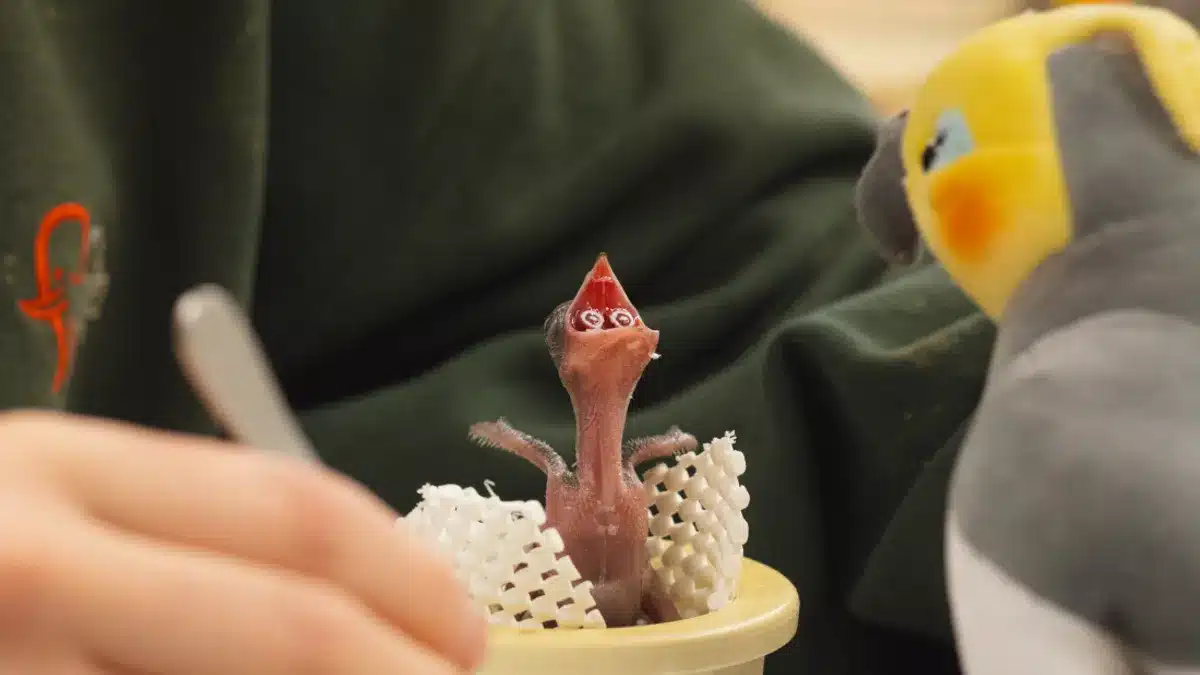
In the wide-open beak of a crested coua chick, strange eye-like marks lock your gaze. It isn’t a coincidence — it’s an unforgeable biological signature. A kind of buccal fingerprint that parents will feed only if it matches exactly their own. The birth of the first crested coua at Fort Worth Zoo in March 2026 allowed close observation of this mechanism.
What you will learn
- How these buccal markings protect couas from nest parasitism
- Why this system is especially remarkable within a bird family famed for its parasites
- What the birth of this chick in Texas means for the species’ conservation
An impossible-to-imitate buccal imprint
Gaze inside the beak of a crested coua chick and you’ll notice something unexpected: colored markings that resemble eyes, arranged with uncanny precision across the palate and tongue.
These patterns are not an aesthetic curiosity. They are biological access codes.
Coua parents feed only the chicks whose buccal markings exactly mirror the pattern of their own species. Any chick lacking these specific marks remains unfed — even if it shares the same nest, even if it calls as loudly.
A defense against one of the animal kingdom’s most cunning strategies
Nest parasitism is one of the most sophisticated evolutionary tactics in the avian realm. A brood parasite lays eggs in another species’ nest, leaving the host to raise chicks that aren’t their own — to the detriment of the host’s offspring.
The consequences can be brutal. Brood parasite chicks sometimes actively eject native eggs from the nest or hog all the food supplied by the adoptive parents.
What makes the coua story particularly fascinating is their belonging to the cuckoo family — the most famous for practicing this parasitism. The couas have, within their very own parasite family, developed a recognition system that renders them immune to this strategy.
Madagascar, American zoos, and a rare birth
All nine species of coua hail from Madagascar. Keeping them in captivity is part of a cooperative program among North American zoos, aimed at maintaining a genetically diverse captive population.
In March 2026, Fort Worth Zoo in Texas welcomed its first crested coua chick — a rare opportunity for keepers to witness this buccal-recognition mechanism in action up close.
“These distinctive markings help combat nest parasitism,” explains Shelly Collinsworth, Associate Curator of Birds at the zoo. “Thanks to them, parents feed only their own chicks that display these specific marks in the beak.”
A chick born in Texas, carrying a defense system shaped by millions of years of evolution in Madagascar. An evolutionary elegance that even the fiercest avian warfare could not overturn.
