
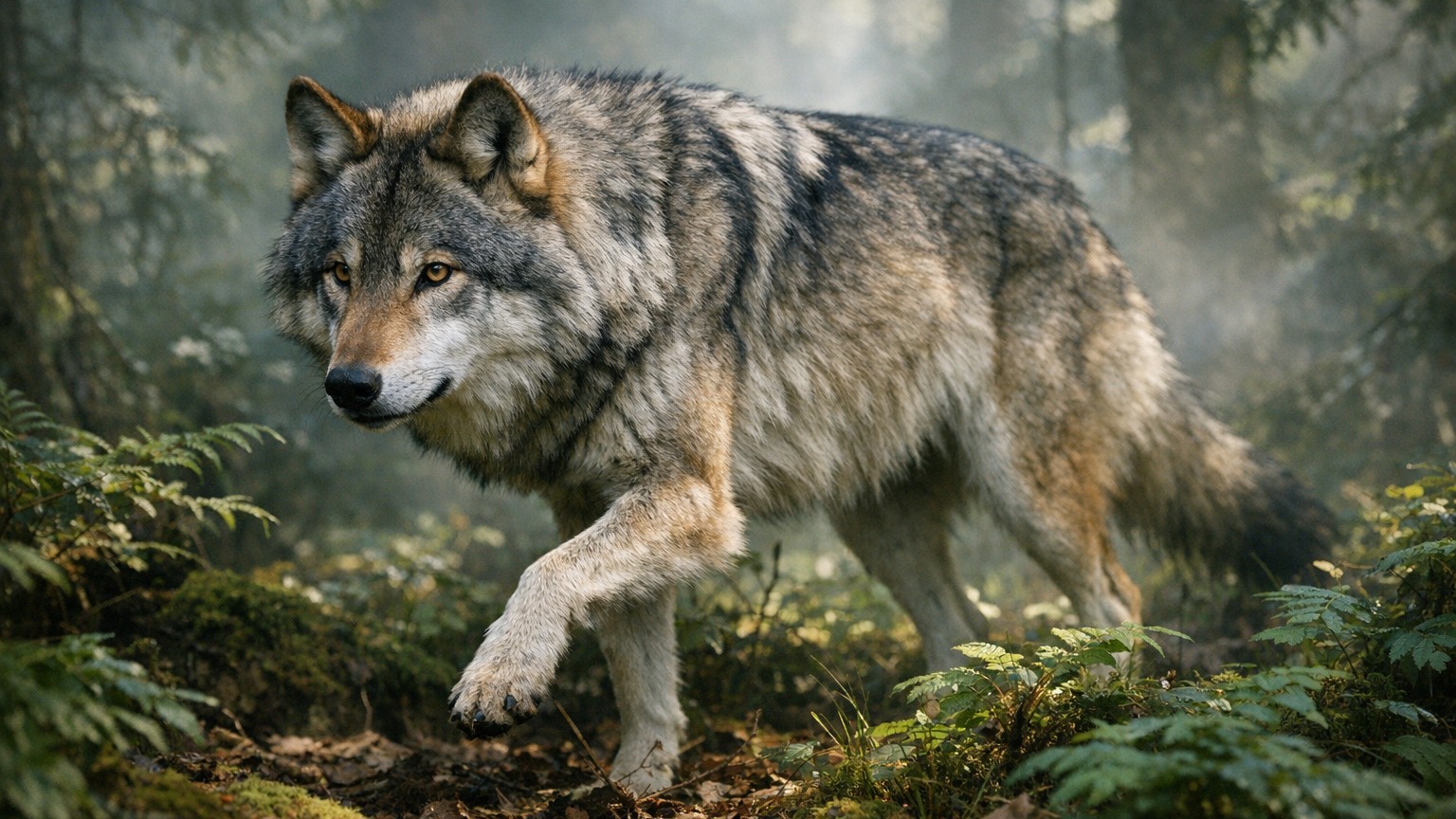
A wolf photographed in the Monts d’Arrée, in the heart of Finistère. May 2022. For the first time in more than a century, a confirmed sighting of the gray wolf had been validated in Brittany. Not in the Alps, not in the Massif Central, not where farmers had learned to be wary for thirty years. On the Breton peninsula, a territory that almost no one had marked on the lupine risk map.
This moment illustrates better than any chart what the records from the French Office for Biodiversity (OFB) now document with precision: the wolf is not recolonizing only its old Alpine strongholds. It is advancing, fast, into areas where it had not been expected for a century.
Key takeaways
- A wolf photographed in Brittany in 2022: the first observation in this region in over a century
- The French wolf population has surged from 25 to 1,100 individuals in under 25 years
- The predator is now advancing well beyond the Alps: who will be the next territory to be surprised?
From 25 individuals to over 1,000 in less than thirty years
The last wolves disappeared from the national territory in the 1930s. The last known wolf in France was shot in 1937, in Limousin. For fifty-five years, silence prevailed. Then, officially on November 5, 1992, the first two wolves were spotted in the Alpes-Maritimes, in Mercantour National Park, forming the Vesubie-Tinée pack, the historic return pack of the wolf to France. Still present in Italy, the canid had crossed the border naturally, without human intervention.
The ensuing demographic surge has been dizzying. According to the French Office for Biodiversity, the population jumped to over 1,100 individuals in 2023, up from only 25 recorded in 1999. The 2025 assessment, published by the OFB in March 2026, refines this figure: the French population stands at 1,082 individuals on average, with a 95% confidence interval between 989 and 1,187 wolves. That is 69 more than in 2024. The number of permanently occupied zones reaches 97, including 80 packs.
However, the pace of growth is slowing. The continued expansion of the species is described by the OFB as “less pronounced than what was observed last year.” A significant nuance, which we will come back to.
The Brittany, the Aisne, the Normandy: the wolf off the beaten tracks
The wolf’s presence is no longer limited to a handful of isolated mountainous areas. This predator is now observed far beyond its Alpine cradle, establishing itself decisively in several departments. Drôme, Haute-Loire, and Deux-Sèvres have become emblematic of this expansion, regularly suffering attacks on livestock.
But the real surprise is happening further north. For the first time in more than 100 years, a verified sighting of the gray wolf occurred in Brittany in May 2022, in the Monts d’Arrée. Since then, reports have multiplied and predations have been regularly documented. The figures are telling: in Finistère since 2022, there have been 141 records classified as “Wolf Not Excluded” affecting 379 animals. While the Monts d’Arrée remains the most impacted area, reports of presence have also been recorded across all departments of Brittany.
In Hauts-de-France, the scenario repeats. For three years, the Prefecture of Aisne has gathered a wolf-watching cell to monitor the wolf’s presence and anticipate its impacts on the territory. The situation observed in Haute-Marne illustrates what Aisne could become: in 2025, more than 200 predation reports were recorded there, for nearly 740 animals compensated. A sharp rise observed within a few years. Occasional reports are now recorded in Normandy and Brittany.
How can an animal travel such distances? The answer lies in an extraordinary biology. The wolf’s expansion is largely explained by its exceptional mobility: it can cover up to 80 km per day. A young individual, expelled from its pack in adulthood, can thus cross several regions in a few weeks, seeking vacant territory and a mate. The Breton wolf identified genetically in 2026 originated from a pack in the Hautes-Fagnes, Belgium. The flows no longer come only from the Italian Alps, but from across Western Europe where the species has reconstituted itself.
A population to monitor, not just to admire
In 2025, regular presence of the wolf is documented over 11% of the French territory, and occasional presence over 12.6%, according to OFB figures. These are not anecdotal numbers. Behind every dot on the map, there is a farmer resuming practices abandoned for generations. This progression compels numerous breeders to rethink their practices, often for the first time in generations.
In 2025, 87% of livestock attacks occurred in areas not protected by electrified fences or guardian dogs. This figure highlights the challenge awaiting newly colonized territories: Brittany or Picardy breeders did not grow up with the wolf. They lack the equipment or reflexes of their Alpine counterparts. Damages rise precisely in the new départements where the majority of herds are not protected.
Political tension climbs in parallel. The 2024-2029 management plan calls for adjusting the hunting quota. A joint report by the Muséum national d’Histoire naturelle, CNRS, and OFB, submitted to the government in September 2025, estimates that increasing authorized destructions up to 23% of the population raises the risk of driving it down by two-thirds. The population, despite appearances, remains fragile: it is stagnant, probably due to illegal killings but also due to shootings authorized by the state. It thus remains fragile.
What this return really reveals
OFb experts attribute this dynamic to the abundance of prey, with roe deer and wild boar on the rise, and to the decreasing human pressure in rural areas. The depopulation of French countryside, often lamented, creates, implicitly, corridors of quiet that the wolf uses without permission. It is an irony of history: rural desertification, a deeply human phenomenon, accelerates the return of the predator that humans had methodically exterminated.
This shift in context, occurring in less than a century, proves highly favorable to the species’ return across French territory, as across Western Europe. The expansion also facilitates the creation of ecological corridors linking different wolf populations, improving genetic exchange. The Breton wolf that came from Belgium is living proof: a European population, not just French, is slowly reconstituting itself, by capillarity, along hedgerows and forests we have ceased to exploit. Monitoring this network now involves more than 5,000 correspondents trained by the OFB, deployed nationwide. A system that, paradoxically, detects presences that no one would have sought to document twenty years ago, because no one expected to have to do so.
Sources: ofb.gouv.fr | hautsdefrance.chambres-agriculture.fr
