
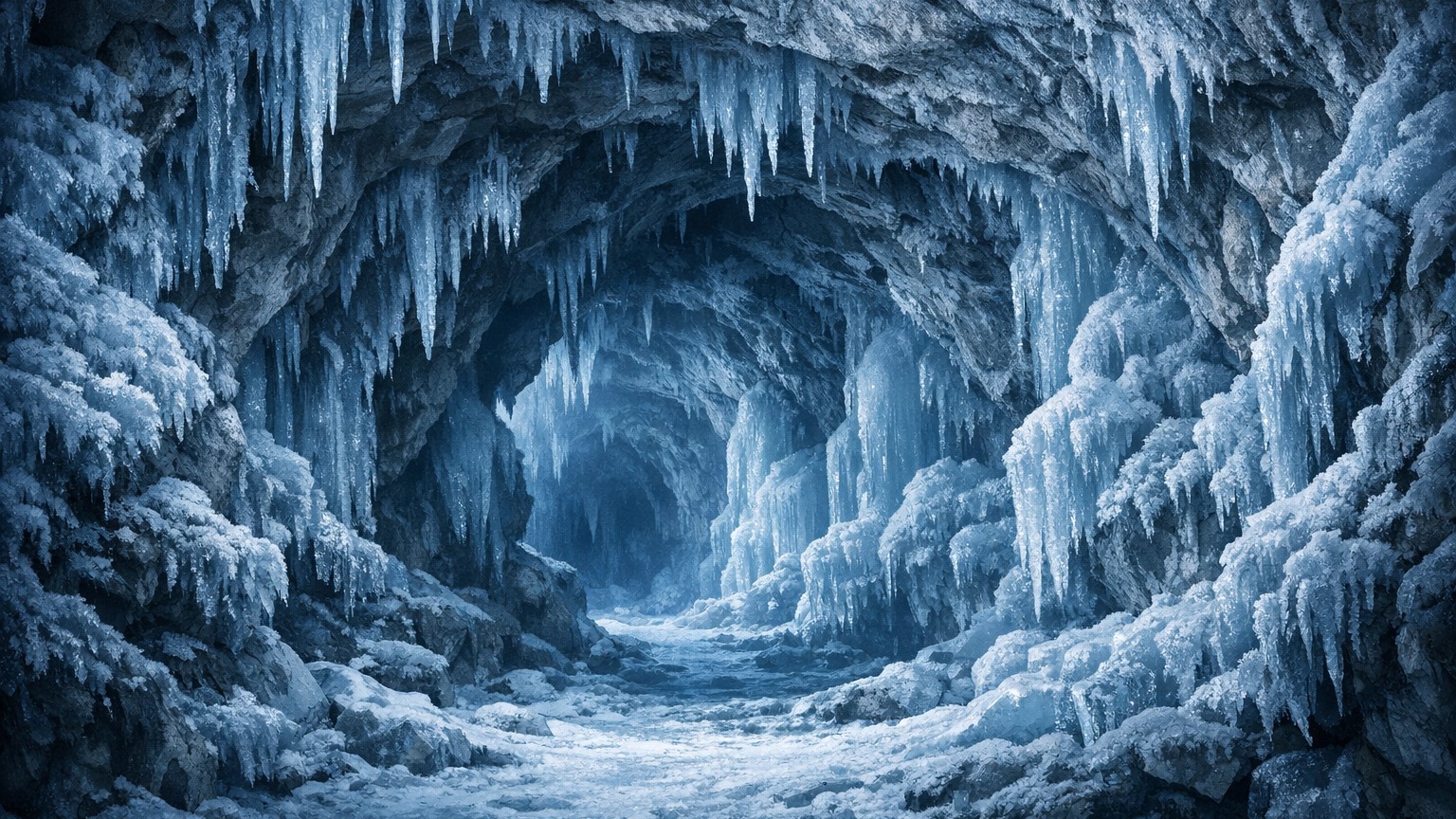
At an altitude of 525 meters in the Doubs department, a cave carved in Jura limestone displays subfreezing temperatures in the heat of August. No artificial air conditioning, no technological gimmicks: just physics, underground architecture, and millions of years of geology. The Glacière de Chaux-lès-Passavant cave is Europe’s lowest natural ice cellar, perched at a mere 525 meters above sea level. A quiet record, tucked away in a region that most vacationers speed through without stopping.
Key takeaways
- A Jura cave preserves ice year-round thanks to a cold-air trapping system dating back millions of years
- In the Middle Ages, monks exploited this ice as a natural anesthetic for surgical operations
- Climate change threatens these underground ice caverns: since 2005, the ice has completely disappeared
The Cold Trap, or How a Cave Beats the Refrigerator
A natural ice cellar is an underground cavity where the temperature remains negative or near zero degrees Celsius year-round, enabling a natural ice storage. The mechanism may seem counterintuitive: how can a cave maintain freezing conditions when 35°C heat smothers the Franche-Comté plains just a few kilometers away?
All of this rests on a basic physical principle long understood by the Geneva-born scholar Deluc in 1822: cold air is heavier than warm air. Certain configurations of cavities in a favorable climate “trap” winter cold due to density differences; ice forms during the cold season from snow accumulation and from the freezing of meltwater. These combined phenomena allow ice to persist in some caverns throughout the year.
Heavy, cold air naturally descends into the cavity. Its sack-like configuration traps this air at the bottom, preventing warming. In winter, the cold air is drawn by the cave’s lower opening toward its upper end where the pressure is lower, a phenomenon known as the chimney or thermosiphon effect. This circulation of cold air, with temperatures below 0°C, freezes all infiltrating water seeping through the rock massif. The water freezing forms little glaciers and ice candles.
Monks’ Freezer, Hospital Fridge
This thermal anomaly did not wait for our tourist cameras to be used to exploit it. The cave was already frequented in the Bronze Age, and studied scientifically as early as 1584. After serving as a natural freezer during the Middle Ages, the ice was harvested by the monks of the Abbey of Grace-Dieu from the 16th century. At the time, locals called it the “Froidière.”
The use was not as romantic as it might appear. From the 16th to the 19th century, ice that accumulated in winter at the cave’s bottom was harvested. At that time, the ice was primarily used by hospitals for its anesthetic properties to numb areas to be operated on. Before the era of modern anesthetics, cold was the only way to numb a limb before amputation. Up to 100 tonnes of ice could be harvested each year. A trade that extended well beyond Franche-Comté: as early as the 16th century, ice was transported to Besançon’s Metropolitan Church by the monks of the Abbey of Grace-Dieu.
The ice was cut into blocks, hauled on men’s shoulders and then raised with a winch. For several decades, residents of the nearby village of Vellerot were even required to bring each year, on August 3rd, a piece of ice weighing 5 to 6 pounds, extracted from the ice cellar to Besançon’s cathedral. An underground offering accompanied by a tale of a canon’s murder and a religious fine. Jura has its mysteries.
By the late 19th century, the invention of machines for artificially producing ice and its industrial manufacture brought this activity to an end and closed the era of natural ice caves. In 1887, the cave’s activity was definitively halted.
When the Heatwave Reaches Underground, Even Underground
For a long time, Jura’s natural ice caves puzzled 19th-century science. Today they present another puzzle, less poetic: the volume of ice in the caves has markedly diminished over the past decades.
Jura’s ice caves lie in natural cavities that trap cold air, often in forests, giving them the advantage of being better shielded from the sun than high-altitude glaciers. But this advantage has its limits. Studies of several glacial caves in Switzerland and across Europe show a clear trend toward a general, more-or-less steady decline in ice volumes in recent decades. This evolution is largely linked to winter changes: milder, less snowy winters particularly affect low- and mid-altitude caves.
For the Chaux-lès-Passavant ice cave, the verdict is in. Climate change has permanently altered the site’s profile: since 2005, permanent ice has disappeared entirely. With winter snow becoming scarcer, the cave no longer had enough water to manufacture ice on its own, and hospitals began sourcing their supply higher up, in Savoy. An early sign of what many still refused to call global warming.
Every human presence, for example, contributes enough energy to melt more than a kilogram of ice per hour of visit. A detail that calls into question the innocence of curiosity tourism. At the current pace, most ice caves—except those at high altitude—will likely melt away entirely within a few decades. These caverns, several of which have been designated as geotopes of national importance, will then be relegated to the status of mere chasms.
The Jura’s remaining ice caves, such as Monlési in the Neuchâtel Jura, still hold about 6,000 m³ of ice, a volume that is steadily decreasing but still permits observation of the phenomenon. The historic heatwave of 2003, however, had almost no effect on the Monlési ice, precisely because it is winter, not summer, that dictates the future of these ice caves. The struggle takes place between December and March, within the depths of the snowpack. If winter falters, summer need not press its case.
Sources: paysages-hautesalpes.fr | geomorphologie-montagne.ch
