
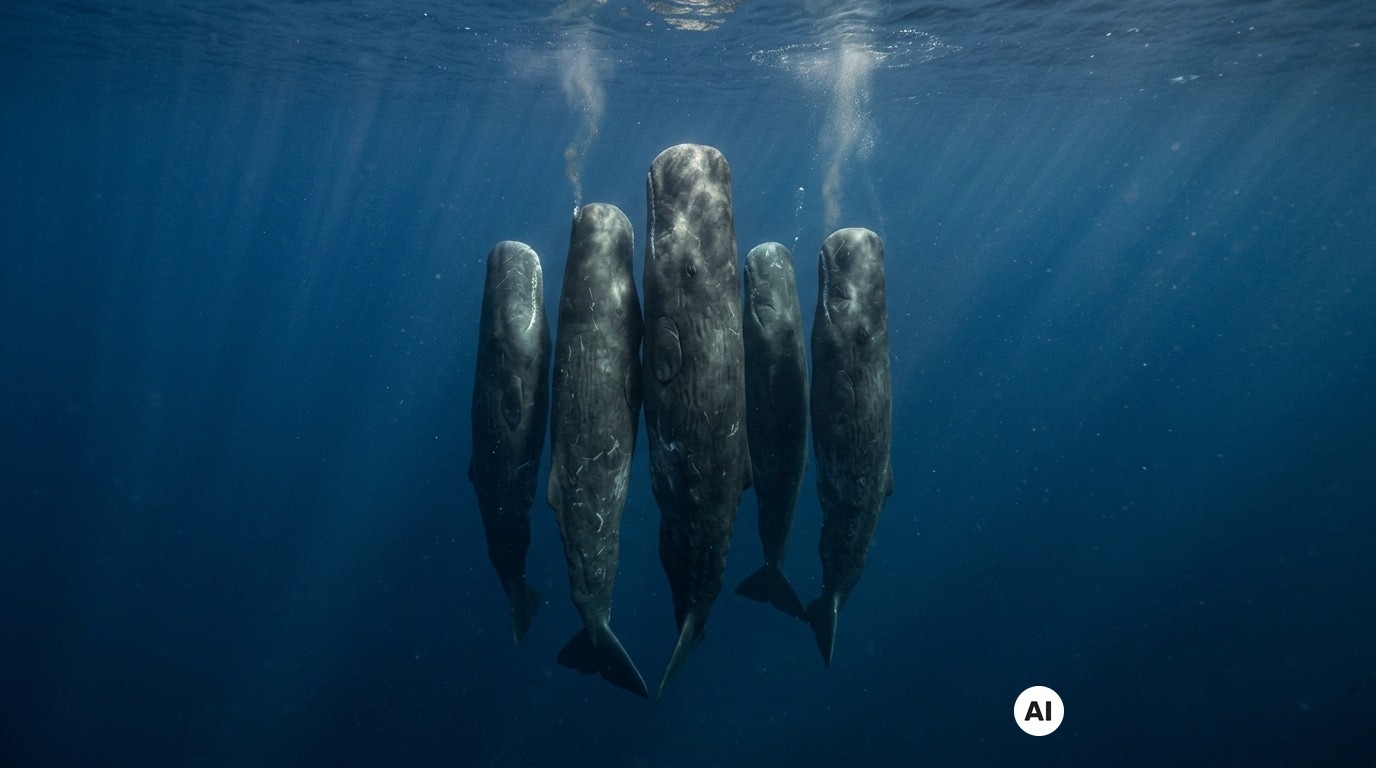
Imagine a giant weighing tens of tons, suspended in the blue, head pointing toward the surface, perfectly still for about twenty minutes. It isn’t a sea-drama creature, but a sperm whale catching a nap. For a long time, people believed these behemoths simply floated passively to sleep. The reality is far more delicate, and it hinges on a detail that modesty might call almost comic: to stay motionless, these giants vent gas, up to eleven times per nap. Sensors mounted on forty-two individuals have just begun to reveal part of the secret, while leaving a deeper riddle untouched.
The vertical posture that puzzled researchers
The first surprise lies in the position itself. When a sperm whale falls asleep, it does not lie down lazily like a swimmer on an inflatable mattress. It takes up an upright position, its head directed toward the surface and its tail dipping toward the depths. A real living column suspended in the gloom. This astonishing behavior was scientifically documented for the first time in 2008, and it is enough to make one ponder.
This posture is not a fluke. It helps minimize muscular effort by balancing the upward and downward forces around the animal’s center of gravity. In other words, the whale finds the perfect balance point to control its depth without wasting a single ounce of energy. Even more remarkably, the members of the same group synchronize: they all adopt this stance at the same moment, forming a floating dormitory that looks almost unreal. Underwater photographer Franco Banfi captured this spectacular scene in 2017, off Dominica in the Caribbean.
The physical trap that could spoil their sleep
Here is where the snag appears. If the vertical posture seems ideal on paper, the physics plays a nasty trick on our sleepers. This head-up orientation is explained by the spermaceti, the oil housed in the whale’s enormous head. Less dense than the rest of the body, it provokes a passive rotation toward the surface, like a buoy that always rises on the same side.
But a more sly problem lurks in the lungs. As soon as the animal rises even slightly, the surrounding pressure drops and the air in its lungs expands. And inflated air increases buoyancy, pushing the whale higher, which further expands the air… A vicious circle that, in theory, should inexorably bring it back to the surface while it sleeps. How can a sleeping being escape this relentless physical trap? That is precisely the question that pushed researchers to equip these giants with sensors.
Eleven gas releases per nap: what the sensors recorded
To unravel this mystery, a team attached suction cups equipped with sensors to forty-two sperm whales roaming off Norway. The aim: record both their slightest movements and the sounds they emit during their resting dives. The data collected revealed a behavior as simple as it is ingenious.
The solution is degassing. Sperm whales vent gas through their blowholes up to eleven times during a single nap. This small, repeated release keeps them neutrally buoyant and lets them gently descend a few meters, countering the buoyant effect of the expanded air. A very pragmatic way to stay still without ever breaking the surface. This gas release could also play a second role: regulating the carbon dioxide accumulated during these long apnea bouts. When the need for air becomes pressing, the animal slowly surfaces to breathe before returning to rest a bit lower. A discreet and perfectly rehearsed ballet.
The brain mystery that remains to be unraveled
One major puzzle remains. Many cetaceans, such as dolphins or porpoises, sleep in what is called unihemispheric sleep: only one half of the brain rests at a time, allowing them to keep swimming and to surface for breaths. The sperm whale, by contrast, seems to play a different score. Clues suggest it might put both hemispheres to rest simultaneously, a true deep sleep out in the open sea.
The catch is that its breathing is voluntary: it must decide when to surface to breathe. How, then, does it manage this vital need while sleeping soundly? To settle this, two avenues present themselves. The first would be to measure brain-wave activity, which would require a real technological breakthrough. The second, more clever, would be to watch the eyes: in unihemispheric sleep, one eye would stay open. If sleep proved truly bihemispheric, it would imply a passive ability to sense their own depth, even while unconscious.
Thus, a curious posture, a physical trap, and smartly timed gas releases sketch one of the strangest sleeps in the animal kingdom. These giants devote only about 7% of their time to rest, in naps lasting six to twenty-four minutes, yet each one hides a mechanism of remarkable precision. The lingering question remains: what is truly going on in the mind of a sleeping sperm whale, suspended between two waters? Until technology pierces this mystery, these giants will keep the secret of their silent dreams to themselves.
The study is published in the Journal of Experimental Biology.
Source: Sperm Whales blow bubbles to achieve restful, vertical sleep (news.st-andrews.ac.uk)
Article prepared with the help of AI · Our method
