
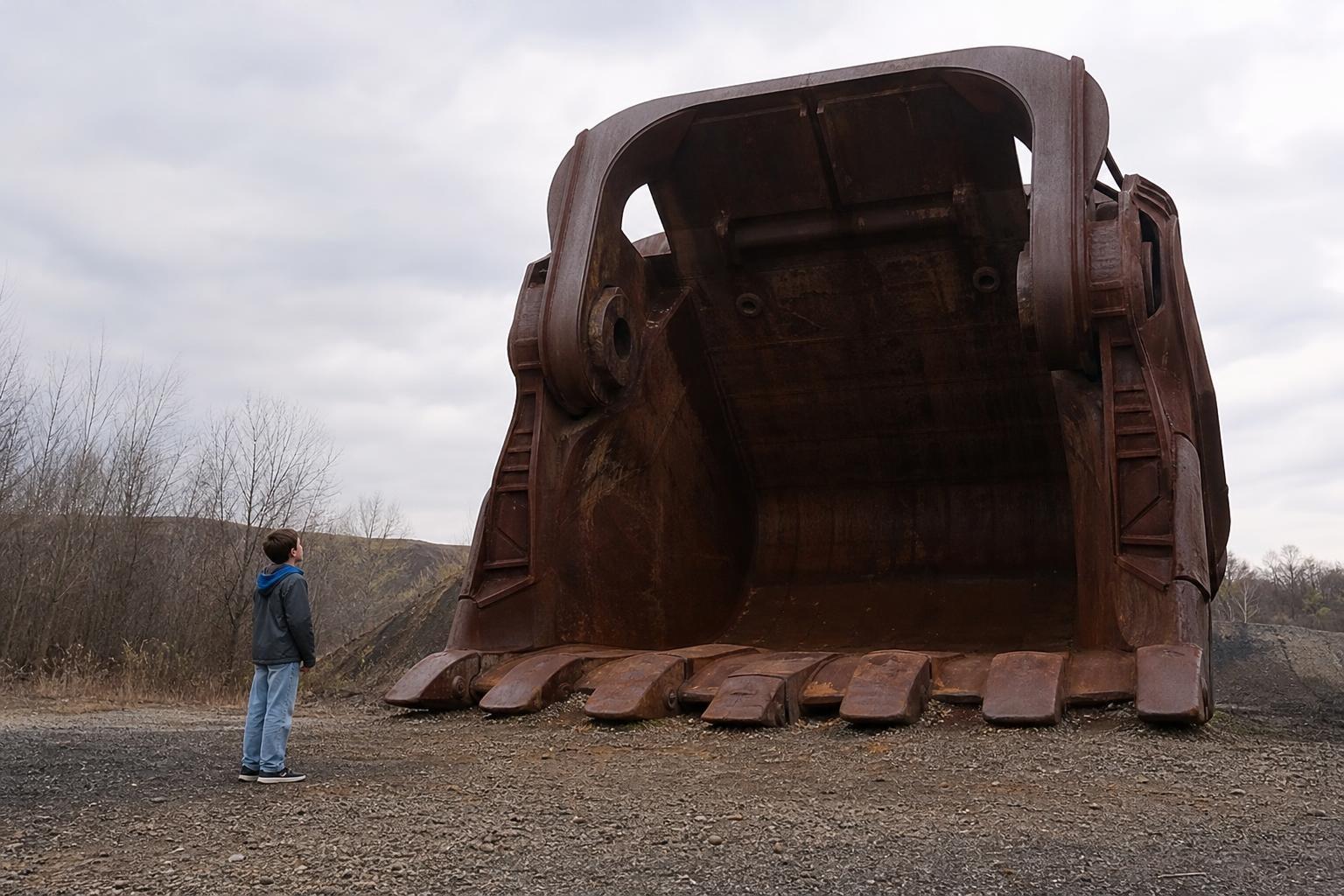
Visitors still stop on quiet Ohio backroads to see a relic that once could move hills. All that remains is a single steel bucket, a jaw of iron big enough to swallow intercity buses and most of your imagination. Stand inside it, look up at the curved teeth, and you feel both very small and oddly awed.
A machine built at the limits
At its peak, this dragline was a leviathan, tipping the scales at about 13,500 tons. Its bucket alone could cradle two Greyhound buses, a practical image that turns abstraction into shared scale.
Engineers stretched a boom more than 300 feet, suspending cables as thick as a person’s wrist. Everything about it was oversized, from the electric feed to the gears that swung its massive arm.
“It was a mountain that moved mountains,” people still say, a line that’s half poetry, half simple truth.
- Bucket capacity: about 220 cubic yards, shaped to skim, scoop, and sling overburden.
How it walked, how it worked
Unlike a truck or a dozer, this giant didn’t roll on wheels. It “walked” on massive steel shoes, inching forward with patient, almost creaturely rhythm.
Each cycle was a study in controlled violence and precision: drag the bucket through earth, heave the load, swing the house, and drop the cut in a deliberate arc. Then repeat, hour after hour.
Power arrived through high-voltage cables, humming with a constant hunger for megawatts. Inside, rows of motors and winches kept time like an iron orchestra, tuned for torque, not melody.
The human scale, reclaimed
Around it worked crews who learned the machine’s moods, the way wind tugged the boom or rain changed the cut. What looks like brute force from afar was, up close, craft, carried in callused hands and quiet judgment.
“It wasn’t just big, it was precise,” a line you still hear from people who remember the night shifts, the radio crackle, the breath of steam on cold mornings.
The land bears their signatures too. After the coal was gone, hills were reshaped again, this time to heal and hold new forests, trails, and ponds.
Then silence, and a single survivor
As markets shifted and regulations tightened, high-sulfur coal lost its edge. The great machine shut down, and years later its house met the torch, plate by plate, until only the bucket remained.
The bucket became a roadside monument, set in a small park that mixes memory with landscape. Children climb the steel lip, families take photos beneath the serrated shadow, and the mind does the easy math of wonder and scale.
Walk around it and you grasp what drawings can’t teach: thickness, weight, and the eerie calm of something built to contend with geology.
Numbers that tell a story
At full tilt, one scoop could move enough earth to bury a modest house. Multiply that by hundreds of cycles per day, and you understand how quickly a ridge can fade.
The boom’s trusswork wasn’t just metal; it was memory in rivets and welds, stress-charted lines where physics and courage met. Maintenance crews crawled those heights with harness and habit, keeping fatigue at bay with grease, gauges, and nerve.
If the bucket feels theatrical, the real drama lived in the unseen tolerances, where a misread bearing or frayed cable could cost time, money, or worse.
What it means to stand there now
You come for the size, but you stay for the questions. What does it mean to build a tool this grand to chase a fuel we’re learning to outgrow? What do we owe the land that paid our bills, and the people who paid with their backs?
“It’s part of us,” someone might say, and the bucket makes that truth hard to argue. It’s neither hero nor villain, just evidence of a time when solving a problem meant scaling up until physics blinked.
In the rust, you see ambition, and in the park, you see an afterlife. One piece endures because stories need anchors, and because communities prefer to remember with something they can touch.
Keep looking up
Stand inside the curve, face the sky, and let your eyes trace the arc the boom once drew. Hear a phantom swing, a cable’s low whine, the soft thud of earth releasing its hold.
Big engineering leaves big echoes, and this one speaks in simple sentences: We were here. We built this. We learned, and now we change.
The bucket doesn’t move anymore, but it still shifts something in the mind. It turns enormity into a shape, and memory into steel you can lean on.
