
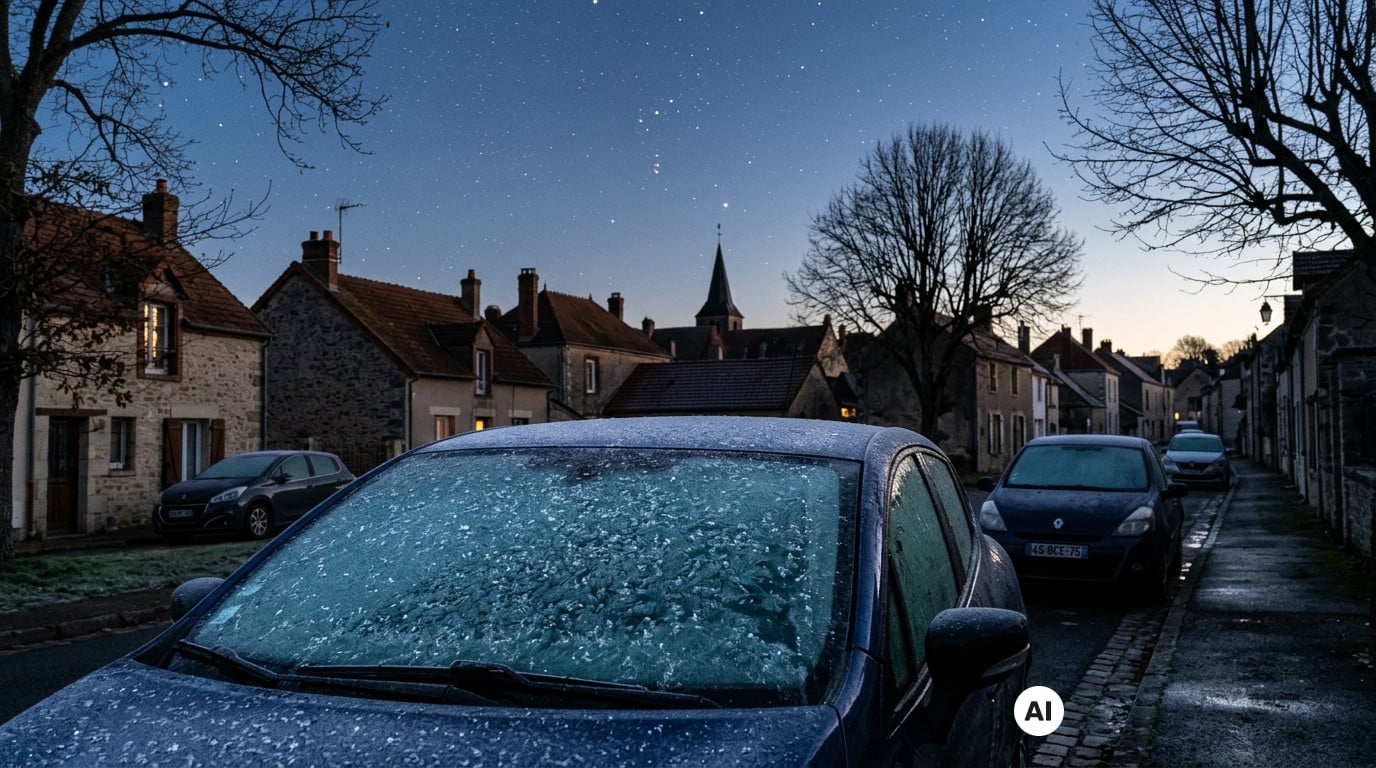
Three degrees on the thermometer, and yet the windshield displays a frost layer that cannot be ignored in the early morning. This contrast repeats every year with the arrival of the first cold nights, especially in this late November period when day-night temperature gaps widen. Many see it as an anomaly, almost a measurement error. In reality, this discrepancy is explained very simply by the physics of radiation, a subtle phenomenon well known to meteorologists. Understanding this mechanism lets us anticipate these tricky mornings and avoid the wrong reflexes when facing a frozen windshield.
A windshield can freeze even when the ambient air stays above zero
The temperature displayed by weather apps corresponds to a measurement taken under shelter, 1.5 meters above the ground, in the shade and sheltered from direct wind. It reflects the air temperature, not that of surfaces exposed to the sky. A windshield, however, is in constant contact with the atmosphere and especially with the night sky. Its surface temperature can therefore drop far below what is reported on the radio or on your smartphone.
This is perfectly normal and explains why frost can be scraped on a morning when the air seems mild. It isn’t a measurement error nor a local oddity; it is a direct consequence of the physical laws governing heat exchange between an object and its environment.
The infrared radiation from glass toward the clear sky accelerates its heat loss
Radiative cooling explains this offset. During a clear night, the glass emits infrared radiation toward the sky and rapidly loses its heat, causing the surface temperature to drop below 0 °C, which freezes the moisture on contact while the surrounding air, measured under shelter 1.5 meters above the ground, still shows values of +1 to +3 °C. Concretely, every surface naturally emits heat in the form of infrared radiation.
Normally, clouds reflect part of this radiation back toward the ground, which limits the losses. But when the sky is completely clear, nothing slows this exchange: the windshield empties of its heat continuously, with no barrier to retain it. This is exactly the same principle that explains why nights without clouds are often the coldest, even during apparent thaws. Glass, a poorly insulating and very exposed material, is particularly sensitive to this phenomenon.
Humidity turns into frost as soon as the glass surface drops below 0 °C
Once the surface of the windshield falls below the zero-degree threshold, the humidity present in the air deposits directly as ice, without passing through the liquid stage. This is frost, quite different from dew, which forms at positive temperatures. This phenomenon is more pronounced when the air is slightly humid, which is common in autumn and winter. Here are some essential points to remember to limit the morning inconveniences :
- Never pour hot water on a frozen windshield, the thermal shock can crack the glass.
- Use a suitable defroster or a simple scraper for quick and risk-free action.
- Anticipate a few minutes before leaving, the time for defrosting to operate naturally with the cabin heating.
- Avoid parking your vehicle in the line of sight of the clear sky if shelter, even partial, is available.
These simple actions help avoid the common mistakes that damage the windshield or waste precious time before hitting the road.
What this temperature offset reveals about clear, windless nights
This phenomenon says a lot about the weather conditions that favor strong nocturnal cooling. The nights most conducive to morning frost combine three precise ingredients: a clear sky, calm air, and sufficient humidity. Without wind to mix air masses, the cold settles directly on exposed surfaces, without being diluted by atmospheric movements.
That is why clear autumn and winter nights are particularly sensitive periods for this type of localized frost, even when forecasts anticipate broadly mild temperatures. This contrast between the official measurement and the ground reality nicely illustrates how local weather can vary depending on surfaces and their exposure to the sky.
Article prepared with the help of AI · Our method
