
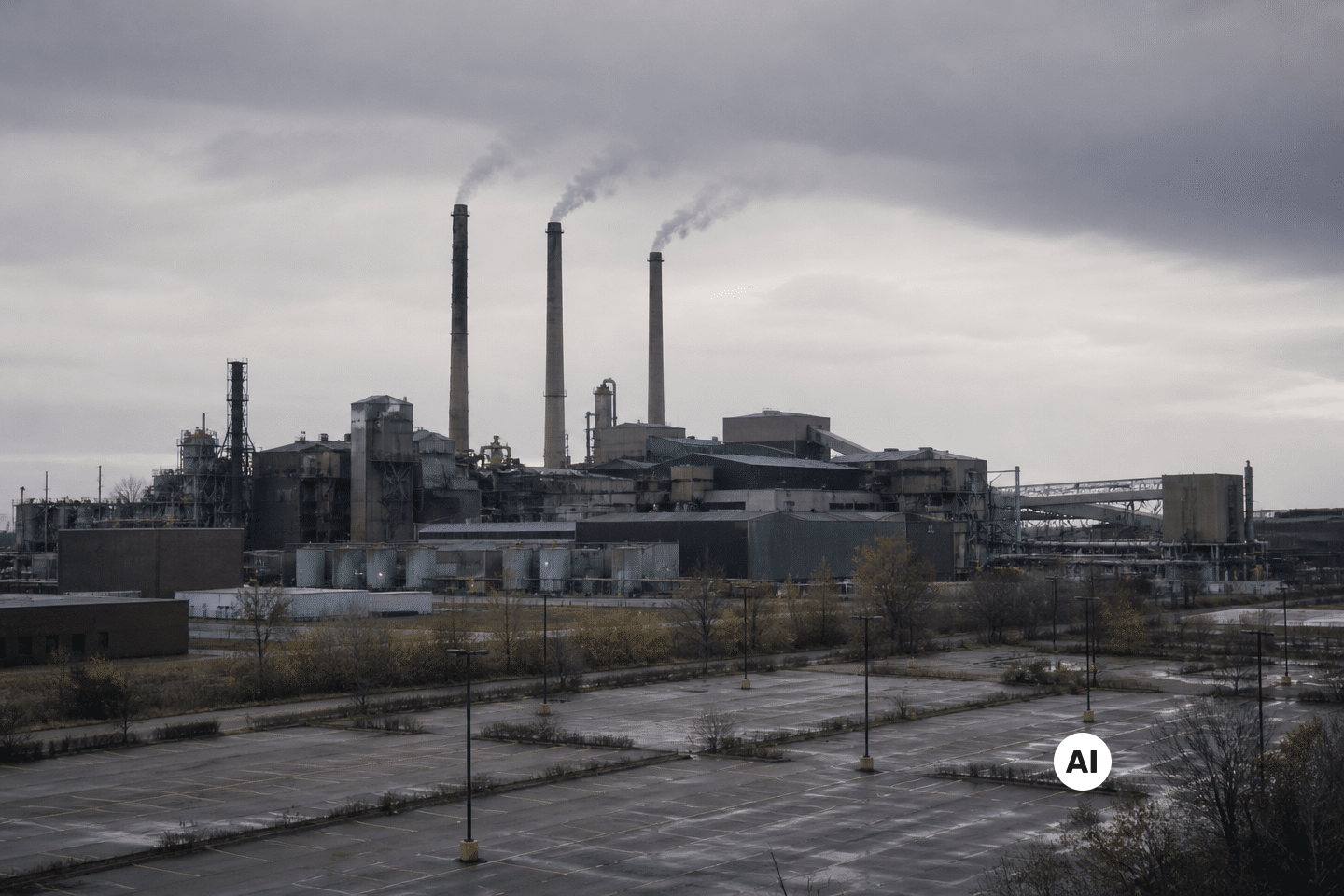
Global fossil CO₂ emissions are expected to decline by 0.4% this year. Is that something to celebrate? Not really. Behind this optimistic figure lies in part a military conflict that has sent oil prices surging, rather than a deliberate ecological shift.
A 0.4% decline that is no climate victory
On paper, the figure is surprising. According to a new study by the Global Carbon Project, fossil-fuel-related carbon emissions are expected to fall by 0.4% this year. A modest number, but one that starkly contrasts with the trend observed from 2019 to 2025, a period during which global emissions rose by an average of 0.8% per year.
Some countries clearly stand out. The report identifies 59 nations, including South Africa, Thailand, Colombia, and Mexico, that show emissions below their 2019 levels, while their economies continue to grow. Evidence that, in theory, wealth and pollution can be decoupled.
Among the major powers, the trend also holds. The United States, which accounts for 13% of global emissions, should see theirs fall by 1.3%. Even China, the world’s largest emitter, is projected to see a 0.9% drop in 2026. These signals seem positive, provided one does not stop at the surface.
Because these figures do not mean emissions have peaked, nor that the planet is about to experience a durable decline in carbon pollution. To understand what is really at stake, one must look to the Strait of Hormuz.
The Strait of Hormuz, a hidden player in this carbon lull
One of the drivers behind this decrease is not the name of a technological breakthrough but that of a conflict. Since February, the war in Iran has severely disrupted shipping through the Strait of Hormuz, the narrow passage between the Persian Gulf and the Gulf of Oman through which nearly a fifth of the world’s oil transits.
Result: a partial interruption of global oil supply, followed by a surge in prices. Facing pricier oil, consumers and businesses have mechanically reduced their consumption. Not out of ecological conviction, but out of economic necessity.
Glen Peters, a research professor at the CICERO Center for International Climate Research, warns against premature interpretations. “A decline in emissions in a single year does not constitute a peak unless it results from a structural change,” he explains in a statement.
Yet he acknowledges real progress in the energy transition. “The accelerated deployment of solar and wind power, batteries, and electric vehicles is helping to reduce emissions in dozens of countries,” he notes, adding that these changes are not yet enough to guarantee a sustained global decline.
Recent history is full of similar episodes. The COVID-19 pandemic, the 2008 financial crisis, or the energy crisis of the 1970s—also linked to Middle East tensions—triggered comparably temporary declines. Each time, once the crisis subsided, emissions curves rose again.
427 ppm in the air: why the respite could be only a mirage
The 2026 Global Carbon Budget offers a figure that puts things in perspective. The burning of fossil fuels is expected to emit 38.2 billion tonnes of carbon dioxide this year, a slight drop from 2025. A real decline, but far from enough to reverse the climate trajectory.
Global energy demand, meanwhile, continues to rise. Low-carbon sources account for nearly two-thirds of this growth, which is far from negligible. The problem is that these cleaner sources are not growing quickly enough to offset the global appetite for energy.
Another indicator that does not lie: atmospheric CO₂ concentration is expected to reach 427.7 ppm this year, about 54% higher than pre-industrial levels. A threshold that continues to climb, whether emissions dip temporarily or not. It is also projected that about 500 million tonnes of emissions will be added due to land-use changes, such as deforestation, compared with the previous year.
James Renwick, a physical geography professor at Te Herenga Waka—Victoria University of Wellington, does not mince words. “The modest drop in total emissions is driven as much by the war in Iran as by any other factor, and thus does not constitute a structural response to the climate change problem,” he says. He also notes that when land-use changes are taken into account, global emissions should actually rise this year.
His assessment is both frank and urgent. “Despite some encouraging progress this year, there is still no serious global response to climate change,” he adds, urging governments to turn these modest gains into a genuine long-term strategy.
One simple, yet daunting, question remains: what will happen once the Iranian conflict is resolved, one way or another? If history is any guide, fossil fuel burning is likely to rebound strongly, as it has each time oil prices return to normal. This 2026 dip is therefore not a sign of a collective rebound, but a symptom of a world still hostage to fossil energy markets.
The study is published in the journal Nature Climate Change.
Sources: Fossil CO2 emissions decrease in 2026, according to the Global Carbon Budget (icos-cp.eu) | Fossil CO2 emissions decline in 2026, finds Global Carbon Budget (ncas.ac.uk)
Article prepared with the help of AI · Our method
