
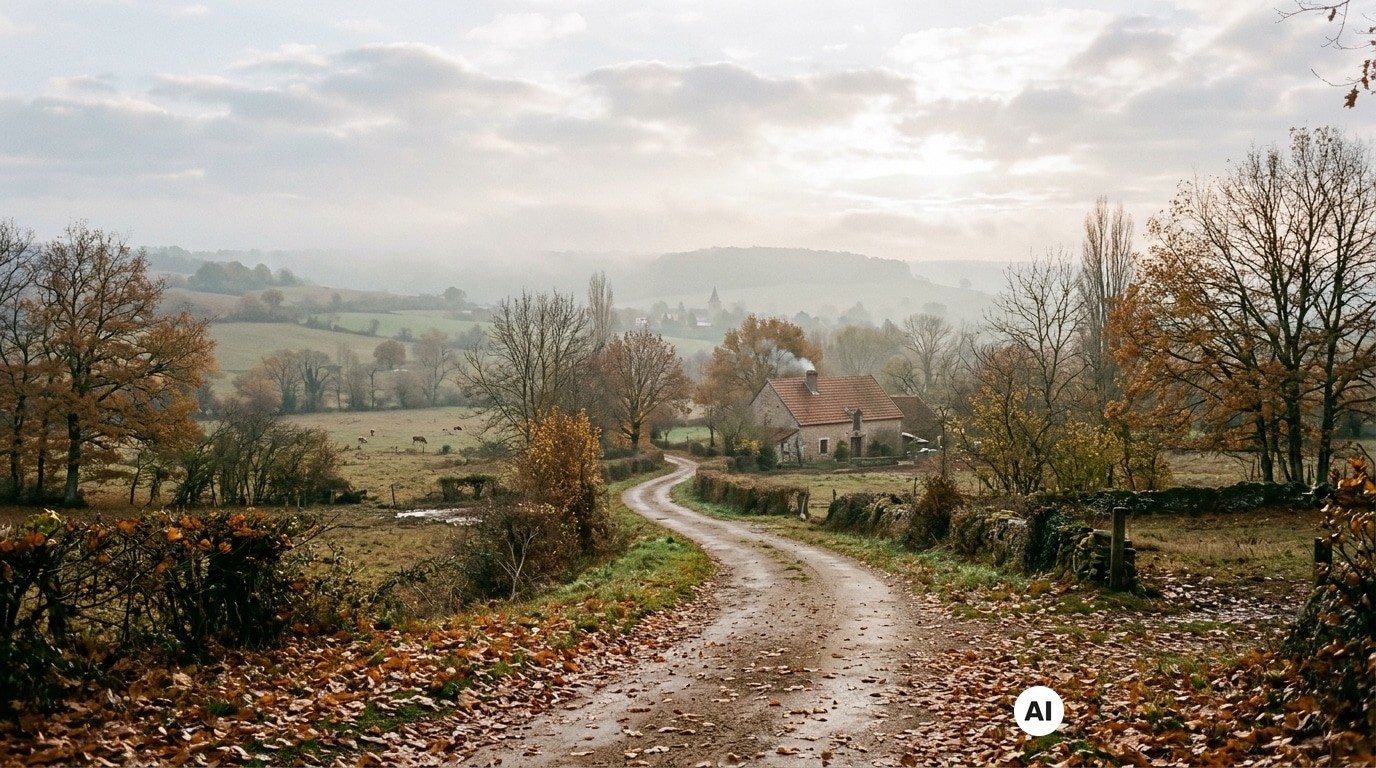
Why do we expect each year a small grace period of mild weather around November 11? This popular belief, passed down through generations, links Saint Martin to an almost systematic improvement after the first autumn frosts. Yet when we compare this tradition with recent weather records, the picture is more nuanced. Between a record-breaking summer 2026, a surprisingly mild early autumn, and a November forecast to be under high pressure, it’s a good opportunity to examine what the sky truly reveals, far from folk sayings.
A deeply rooted popular belief around November 11
The expression “Saint Martin’s summer” traditionally denotes a spell of mild weather and fine days that would magically occur around November 11. This image of an ultimate summer-like reprieve before winter is part of French meteorological folklore, on par with the “saints de glace” in spring. In its analysis published on October 12, 2026, Meteo Consult highlights an essential nuance: it is a popular label, not a phenomenon that necessarily recurs every year on a fixed date. In other words, the old calendar fixes a symbolic date, but the atmosphere has never signed that contract. This distinction is important to avoid projecting weather expectations onto a tradition that rests more on ancient empirical observation than on a verified climate law.
What the recent weather records really reveal
This year’s figures perfectly illustrate this gap between tradition and reality. Summer was the hottest measured in France since 1900, with an average temperature of 24.0°C, i.e., 3.6°C above the 1991-2020 normal. The season featured 53 heatwave days spread across three episodes, a record far surpassing the 33 days of summer 2022. September followed with the second warmest September and the third driest since 1958, showing a 3.1°C anomaly and a rainfall deficit of 70%. The first half of October continued this trend, with a 2.2°C anomaly and an average of 17.11°C, the fourth warmest half-month on record.
On October 15, the thermometer even climbed to 32.2°C in Navarrenx and 30.6°C in Pau, temperatures of intense heat totally unusual for this time of year. Then October tipped into heavy rains, including an exceptionally Mediterranean episode in Solenzara, Corsica, where more than 600 millimeters fell in 24 hours. This downpour contributed to an early improvement in soil dryness, though it did not erase it completely. These sharp swings between extreme heat and torrential rain show that the current climate no longer follows regular, predictable patterns, making even more fragile the idea of a spell of improvement tied to a fixed date.
How to interpret this tradition without relying on the calendar
For the end of the year, Météo-France favors a scenario warmer than normal for the October-November-December quarter, with an estimated 70% probability that the period November 2026-January 2027 will also be warmer than normal, according to the bulletin published on October 29. The same bulletin also mentions a quarter warmer in the northern half of France, with no scenario clearly standing out for precipitation elsewhere. Practically, early November settled under a high-pressure system guaranteeing dry weather almost everywhere, with blue skies in the South and surprisingly mild temperatures, such as the 19°C recorded in Nice on November 2.
But beware, this improvement comes with a week generally about 2°C below normal elsewhere in France, due to an east to northeast flow. This is exactly the kind of situation that can lead to believing in a Saint Martin’s Summer when it is simply a classic seasonal anticyclonic setup. The right stance is to look at short-term forecasts rather than rely on a proverb, no matter how poetic. It is important to avoid the common mistake of packing away warm clothes too soon on the pretext that a brief spell of warmth is announced around November 11, because temperature swings can be rapid and localized. It is better to check weather bulletins regularly and adjust outings, hikes, or outdoor activities according to the real trends, not a date carved into the popular calendar.
In the end, Saint Martin’s summer remains a charming image, inherited from old observations, but it should never replace a careful reading of current weather data. This year again, the data reveal atmospheric dynamics marked by extremes: record heat and persistent drought, followed by an autumn that alternates between warmth and cooler spells depending on the region. Keeping an eye on Météo-France bulletins remains the most reliable habit to anticipate genuine periods of warmth, wherever they fall in the calendar.
Sources: “Saint Martin’s Summer”: what exactly is it? (meteonews.ch) | Saint Martin’s Summer (vitrinelinguistique.oqlf.gouv.qc.ca)
Article prepared with the help of AI · Our method
