
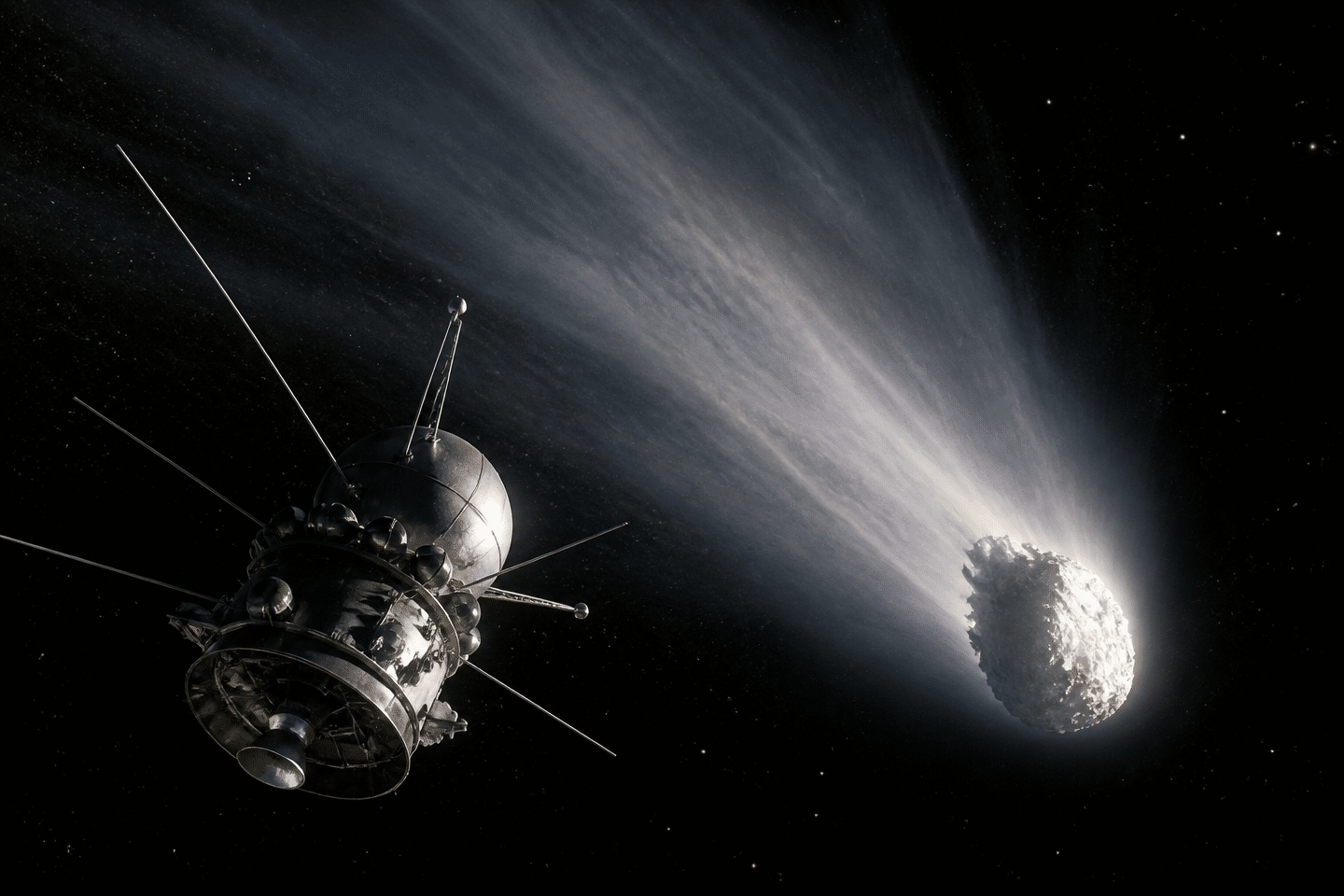
In March 1986, Halley’s Comet was visited by a small fleet of probes. The first two, Vega 1 and Vega 2, were Soviet and passed about 8,000 to 9,000 kilometers from the nucleus. A few days later, the European probe Giotto was required to come within roughly 500 kilometers, a navigation challenge. To achieve this, three agencies—Soviet, American, and European—shared their measurements. The result: Giotto comes within 596 kilometers of the nucleus and returns the first close-up images.
Two Soviet probes acting as scouts
Vega 1 and Vega 2 carry a programmatic name: a contraction of “Venus-Halley” in Cyrillic. Launched in December 1984, they first flew by Venus in June 1985 before continuing toward the comet.
Vega 1 passes at 8,889 km from the nucleus on March 6, 1986, Vega 2 at 8,030 km on March 9. At these distances, the cometary dust is a genuine danger. Near the peak approach, Vega 1 was struck by up to 4,000 particles per second, while Vega 2 lost several instruments, wholly or partly, and 80% of the power from its solar panels.
Nevertheless, the two probes continued to transmit. Vega 1 sent back its first images of Halley as early as March 4, the very first of its nucleus. Vega 2 traversed a less obstructed portion of the coma, and its images clearly show a peanut-shaped nucleus about 16 by 8 kilometers.
These images serve not only science. Since Vega arrives several days before Giotto, they also help locate the nucleus and guide the European probe.
Pathfinder: three agencies for a single targeting
Giotto was to pass by the comet at around 500 km on the sunward side. Yet the comet’s position was too uncertain to achieve with Earth-based observations alone. The idea was to use Vega as scouts, because they would arrive before Giotto.
This project, named Pathfinder, brought together Intercosmos (USSR), NASA, and ESA. Each had a precise role.
The Soviet probes supplied the optical images of the nucleus, from which pointing angles were drawn. NASA handled the trajectory tracking: its Deep Space Network measured Vega’s orbits via VLBI and Doppler effects. VLBI is a radio technique that compares signals captured by widely separated antennas. The ESA finally used these data: Giotto’s final targeting maneuver, two days before the encounter, relied on the comet’s position as determined.
The result is clear: a flyby aimed at 600 km with only ±40 km of uncertainty.
Giotto at its closest: 596 kilometers
On March 14, 1986, Giotto passes within 596 km of the nucleus, almost fifteen times closer than the Vega craft. It is the last one in the flotilla to fly by the comet.
The approach comes at a cost. Fourteen seconds before the closest point, a large dust grain strikes the spacecraft, tilting its axis by 0.9 degrees and disrupting data reception for 32 minutes. The camera proves unusable. It had, however, captured images of the nucleus before being destroyed, and the spacecraft survives.
Its images reveal a dark, peanut-shaped nucleus, about 15 km long with a width on the order of 7 to 8 km: Vega 2’s images had given roughly 16 by 8 km.
This success rested on the combination of Soviet images, American measurements, and European calculations. None of the three agencies could have aimed so accurately on their own.
Sources :
- Pathfinder: accuracy improvement of comet Halley trajectory for Giotto navigation – Nature (1986)
- VEGA Pathfinder navigation for Giotto Halley encounter – NASA/JPL (1986)
- Pathfinder – TDA Progress Report 42-87 – NASA/JPL
- Giotto (spacecraft) – Wikipedia
- Spacecraft exploration of comets – Britannica

Sindre Halvorsen
I write about space exploration, frontier science and the technologies that are quietly shaping the future. From Norway, I follow the missions, discoveries and ideas that connect life on Earth with what lies beyond it. My goal is to make complex subjects clear, useful and worth paying attention to.