
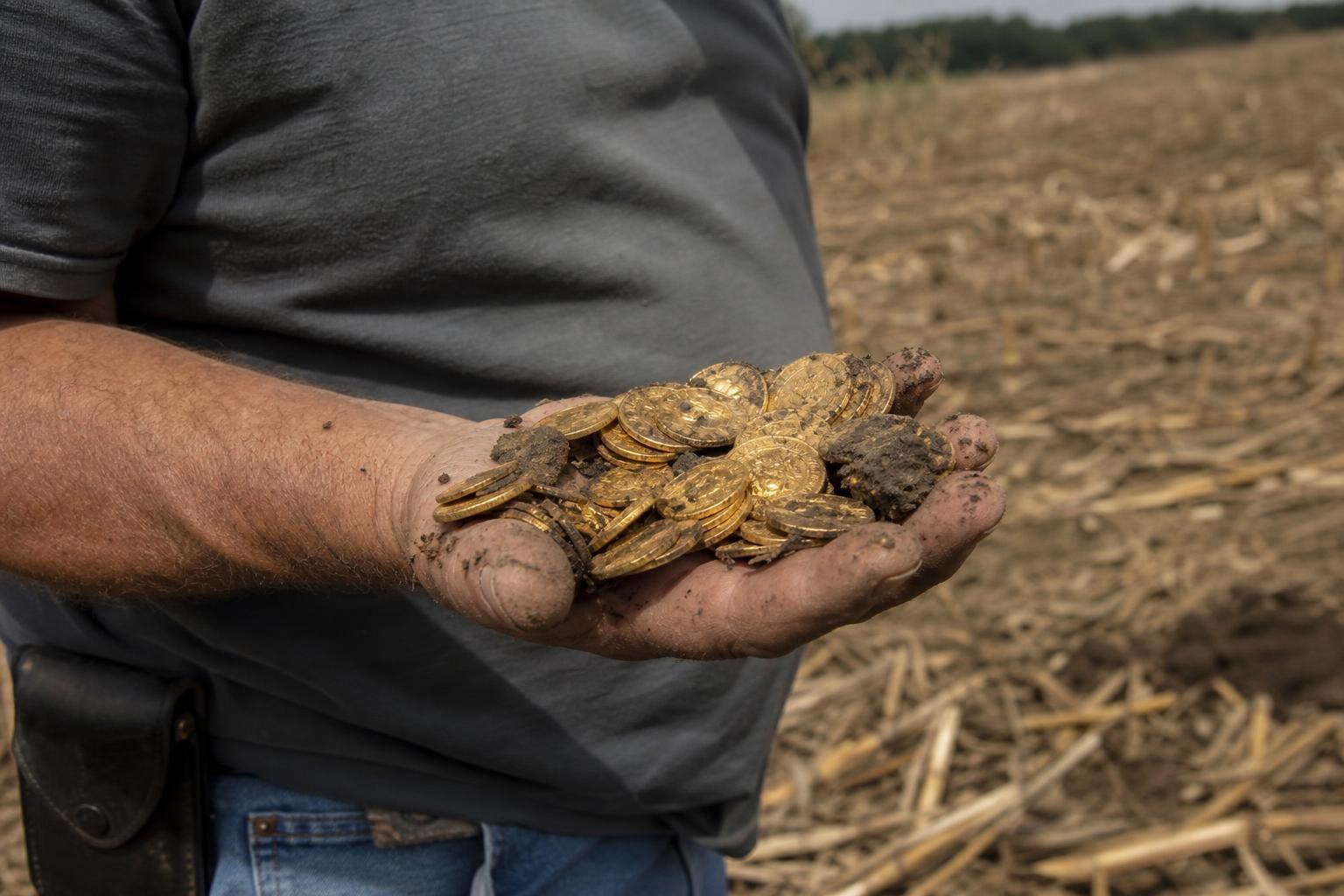
The discovery began with a clink in the soil and a puzzled pause. A Kentucky farmer, walking the furrows of his late-spring cornfield, uncovered the rim of a small disc that didn’t look like any farm junk he’d seen. Minutes later, he was holding not one, but a handful of gold, bright against the dark earth.
By day’s end, the shallow trench gave up more than seven hundred Civil War–era coins, a find so dense and so intact it felt less like good luck and more like a message from the past. “I thought it was an old washer,” he said, laughing through a shock that hasn’t yet left.
The morning that changed a harvest
He had stepped out to check a drainage rut after an overnight storm. The field was quiet, the sky still wet, and the tractors were at rest. He scraped at a hard edge with a pocket knife, and a gold face blinked up like a small, stubborn sun.
“I called my wife, then my brother,” he recalled, still slightly breathless. “I kept saying, ‘There’s more, there’s more.’ It felt like the ground was speaking.”
Neighbors soon stood at the fence in awe, trading whispers over the rustle of young corn. Word moved faster than farm machines, and by afternoon a local historian arrived with a velvet pad, his hands steady but his eyes wide.
What the coins are, and why they matter
Early counts suggest a mix of denominations, likely including gold dollars, $10 eagles, and the coveted $20 double eagles common to mid-19th-century American commerce. Dates cluster in the 1840s to early 1860s, many in remarkably sharp relief despite their long burial.
A numismatist who examined initial photos called the cache “a once-in-a-generation hoard,” adding that several pieces appear “exceptionally clean,” with minimal wear and crisp devices. If confirmed, select coins could grade at levels that push individual values into the high five or even low six figures.
A few edges show mint marks tied to Philadelphia and possibly New Orleans, linking these coins to the era’s fractured economy and the perilous trade routes of a nation at war. For collectors, the mix of dates, mints, and surface quality could reshape price guides and spark intense bidding.
A border state’s buried fear
Kentucky sat on a contested faultline, where rail lines, river routes, and loyalties often split. Cash was scarce, banks were shaky, and rumors of raids traveled faster than a telegram. Families who feared confiscation or theft sometimes buried their wealth, intending to return when the gunfire faded.
“Imagine hearing cavalry on the road, knowing what could be taken in a single night,” said a regional historian. “You’d put your life and savings where no torch could find them—under your very feet.”
That the cache stayed hidden suggests a story cut short, a family line broken, or a map lost. The field became a vault, sealed by seasons of rain, frost, and measured rows.
Law, land, and the ethics of digging
Because the find was on private property, state law generally favors the landowner. Still, archaeologists urge careful documentation, noting that context—soil layering, container fragments, and precise placement—tells as much as the coins themselves.
The farmer has paused any further excavation, pending expert guidance. “I don’t want to mess this up,” he said. “It’s not just about money. It’s about doing it right.”
Tax professionals warn of future assessments, as declared values and eventual sales can trigger complex reporting and unexpected liabilities. Transparent recordkeeping now could prevent a tangle of later questions.
How a hoard like this moves
Next come careful photographs, stabilization, and certification by a third-party grader such as PCGS or NGC. Specialists will note surface luster, contact marks, die varieties, and historical anomalies. Auction houses will court the consignment, while museums and universities may ask for limited public display.
The farmer, for now, is thinking about the next season. “I plant in straight lines. Life rarely follows them,” he said with a tired smile. “This changes things, but I want to keep it steady.”
Why people can’t look away
Hoard finds trigger a deep instinct—the blend of luck, history, and the quiet thrill of something lost returning to the light. The coins carry the weight of anxious hands, of choices made in smoke and uncertainty, of futures postponed in the name of immediate survival.
- A rare concentration of Civil War–era gold, preserved by soil and silence, surfacing in the most ordinary of places
Collectors will debate scarcity and grades, scholars will parse the surrounding story, and neighbors will tell their children how the past rose out of a working field on an ordinary day.
“I keep thinking about the first glint,” the farmer said, turning one small circle of metal between his fingers like a quiet clock. “You chase yield and worry about weather, and then the ground hands you a century and a half of someone else’s hope.”
As the field dries and the corn lifts toward late summer, the rows now share a second harvest—one measured not in bushels but in breathless moments, in careful gloves, and the soft, unmistakable ring of old American gold.
