
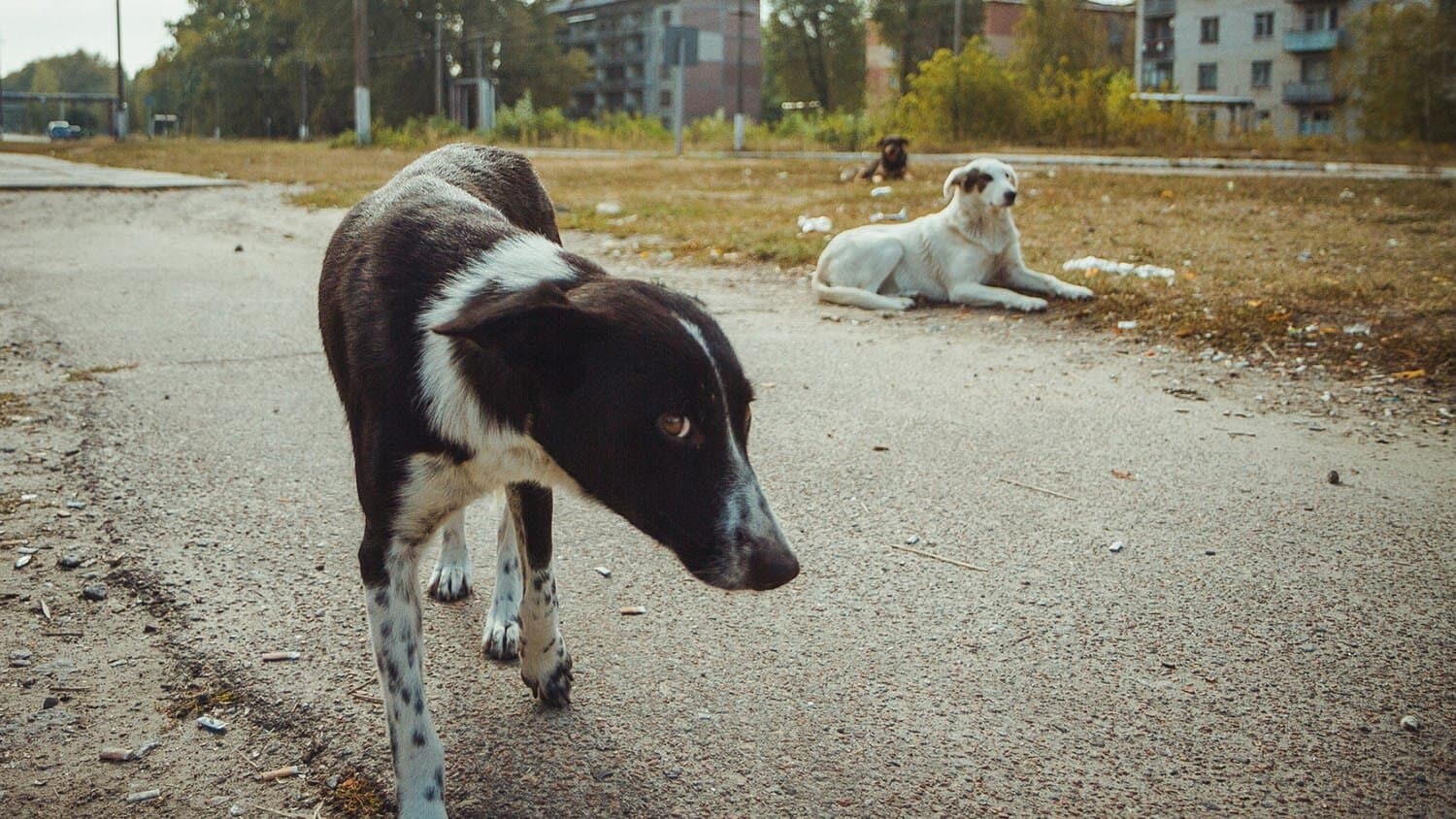
Two populations of dogs separated by only sixteen kilometers, yet genetically worlds apart. The cause? Not an accidental mutation triggered by radiation, as one might spontaneously think, but a far subtler evolutionary mechanism that American researchers have finally identified with precision.
Sixteen kilometers that change everything in their DNA
On one side, dogs roaming the ruins of the Chernobyl nuclear power plant. On the other, their cousins living in the city bearing the same name, separated by a mere sixteen kilometers. On a map the distance seems trivial; genetically, it divides two worlds.
Researchers found that the genetic heritage of the Chernobyl city dogs closely resembles that of canine populations in Russia, Poland, and neighboring regions.
The dogs at the nuclear power plant tell a completely different story. Their genome shows notable differences, especially in regions linked to DNA repair. A detail that, in hindsight, turned out to be the central piece of the investigation.
Mutation or selection: the puzzle the researchers finally wanted to settle
Megan Dillon, a postdoctoral researcher at North Carolina State University, aptly summarizes the starting point of these new studies. A prior paper had already shown that these two dog groups, despite their geographic proximity, displayed a high degree of genetic difference, not caused by a mutation.
The task was to decide between two competing hypotheses. On one hand, natural selection, which over time favors genes offering an adaptive advantage. On the other, genetic drift, the more random phenomenon where variations spread through a small isolated population simply because chance carried them.
To untangle these lines of inquiry, the team compared the genomes of the Chernobyl dogs with those of stray dogs in Eastern Europe and with an isolated population from the Galapagos Islands. A detour to the Galapagos that proved decisive.
Result: the effective population size at the nuclear plant, though reduced, did not differ significantly from that of the nearby town. More importantly, there was no sign of reduced genetic variation compatible with drift. Isolation alone thus did not suffice to explain what the researchers observed.
When radioactivity becomes a driver of evolution rather than a mere danger
Genomic analysis of the plant dogs revealed signatures of directional selection at more than a hundred locations across the genome. This form of selection pushes an entire population toward a small number of advantageous traits, typically in response to pronounced environmental shifts.
The affected genes are not trivial. They are linked to cancer development, DNA replication and repair, cell cycle regulation, and immunity. In other words, precisely the biological systems you’d expect to be called upon in response to an environment laden with toxic substances.
Dillon remains cautious about the interpretation. She says these genomic signatures suggest natural selection, without claiming it with absolute certainty. Yet the genes appear involved in biological pathways that could help dogs cope with exposure to toxic substances.
Dillon, the study’s lead author, offers a nuanced reading of the facts. To her, the toxic environment may not have altered the dogs’ genome to enable later adaptation. It could be that the animals who survived the initial exposures already possessed, even before the catastrophe, underlying genetic diversity and variants granting them an advantage. Matthew Breen, a co-author, nonetheless emphasizes the speculative nature of this explanation, while highlighting the rigor of the analysis conducted and the biological relevance of the regions identified.
This distinction shifts the perspective. Instead of imagining radiation-forged mutant dogs, perhaps they are the descendants of individuals who already carried the right genetic tools to endure from the start. A nuance that sheds fresh light on how life clings, at times, to places we once believed were the least hospitable.
Article prepared with the help of AI · Our method
