
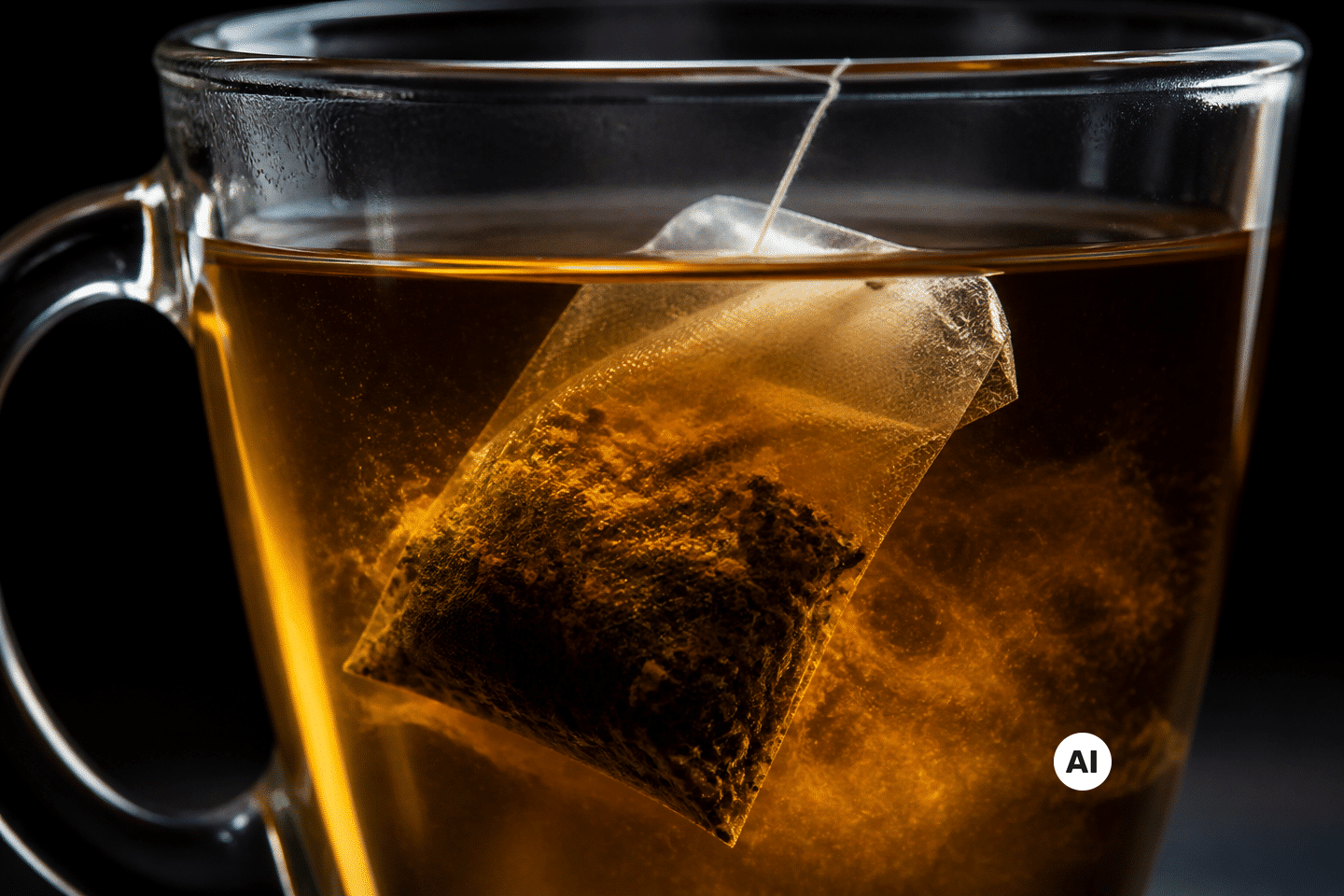
A motion as ordinary as dipping a tea bag into hot water could have unforeseen consequences. The reason: some tea bags are made of plastic, a material that degrades when exposed to heat. As a result, if your cup of tea was brewed with a plastic tea bag, you may also ingest thousands of microplastics. Researchers set out to quantify the extent of this phenomenon, bag by bag.
Up to 2,498 plastic particles in a single cup
Scientists at Recep Tayyip Erdogan University decided to compare two worlds that share the same supermarket shelf: bagged tea and loose-leaf tea. They selected 14 brands of tea bags and 14 brands of loose tea, black and green alike, all purchased in Turkey.
Of the 14 bag samples tested, only four were made of polyamide, a form of nylon. The other ten relied on paper or cellulose, more traditional materials. This difference in composition would prove pivotal.
To mimic what happens in your kitchen, the researchers immersed each bag in boiling water for three minutes, the duration of a typical infusion. Then they counted, under a microscope, the particles released into the water.
The numbers speak for themselves. Plastic bags release between 555 and 2,498 particles per cup. Loose-leaf tea contains only 0.3 to 2.4, probably originating from the environment, farming, or production machinery. The gap is so wide that there is little doubt about the source of the problem.
This finding is not trivial. A growing body of research suggests microplastics are not the harmless passengers once imagined. In laboratory settings, they have been linked to inflammatory phenomena and increased exposure to free radicals, as well as to BPA and phthalates.
The chemical cocktail hidden behind the tea bag glue
Microplastics are only the visible part of the problem. By analyzing the chemical composition of the plastic bags, the researchers detected traces of bisphenol A (BPA) and phthalates in all the samples tested.
One brand, whose name was not disclosed in the study, showed a BPA peak distinctly higher than the others. The researchers suspect the adhesive used to seal the bag may be at the origin of this anomaly, a detail that underscores that the packaging itself is not the only point of vigilance.
BPA and phthalates are not strangers. These synthetic substances are added to plastics to make them more flexible, more transparent, or more durable over time. They are described as ubiquitous pollutants, because they are found in the bodies of dolphins as well as seabirds, and in humans.
Their most concerning shared trait concerns the endocrine system, the network of glands that orchestrates the production of hormones. Metabolism, sexual function, reproduction, sleep, mood: a delicate hormonal balance can be disrupted by these molecules.
There is, however, a nuance to note. According to the thresholds set by the European Food Safety Authority, a cup of tea contributed only 4.5 to 21.7% of the tolerable daily BPA intake. The levels thus remain under safety standards, even if the authors emphasize the importance of this figure for children, pregnant women, and heavy tea drinkers.
Billions of nanoparticles that current analyses cannot even see
This new study is not the first to examine plastic tea bags. A 2019 article had already raised the alarm, arguing that a single synthetic bag could release billions of microplastics and plastic nanoparticles into a cup.
The figures of the new study, ranging from a few hundred to a few thousand particles per cup, seem markedly more modest by comparison. But this difference mainly reflects the method used, rather than a reality less concerning.
Indeed, the team used a technique incapable of detecting nanoplastics, those fragments invisible to the naked eye and much smaller than microplastics. Only particles larger than 100 micrometers could be identified as plastic. The true number of particles ingested could therefore be much higher than reported.
This technical limitation underscores a reality often underestimated in science: what we can measure is sometimes only a fraction of what actually exists. Instruments advance, but for now they remain blind to a whole part of the puzzle.
Ultimately, the study has the merit of putting concrete figures on a phenomenon that had long remained unclear. Between nylon bags and those made of paper or cellulose, the gap is substantial enough to guide a simple choice at the grocery store. A detail that, scaled to a daily cup of tea, begins to matter.
Source : Microplastic release from plastic tea bags versus bulk tea and migration of bisphenol A and plasticizer esters (nature.com)
Article prepared with the help of AI · Our method
