
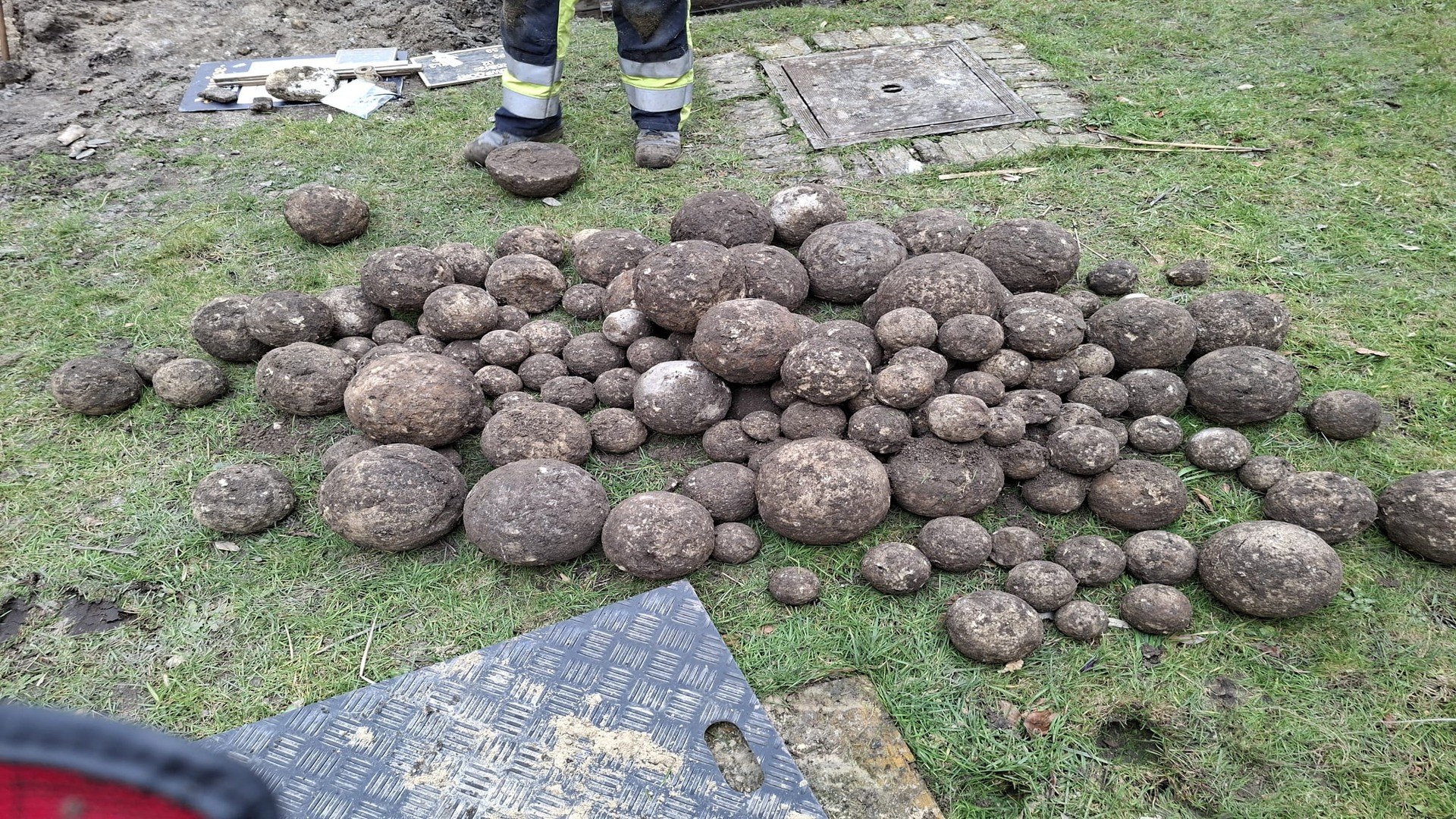
In the peaceful municipality of Nieuwpoort, Belgium, the construction of a modest administrative hub has just transformed into a genuine time machine. While the excavators prepared the ground for the future foundations, archaeologists unveiled a vertigo-inducing discovery: 500 cannonballs. Beneath this forthcoming civil building lay an impressive military arsenal, unexpectedly linking the remnants of a well-equipped Middle Ages with the deadly scars of World War I.
What you will learn:
-
Why the site of the future town hall revealed a strategic location dating back several centuries.
-
The secret of the 500 stone cannonballs: what they tell us about the technological transition in siege warfare.
-
The terrifying historical collision with the discovery of an unexploded shell from 1914 in the same trench.
A dig under tight archaeological supervision
The urban project planned the construction of a brand-new government center, with the groundbreaking scheduled for the end of 2026. But in Nieuwpoort, digging the ground is not done without consequences. The chosen site sits at a highly strategic location, wedged precisely between the current town hall and the city’s ancient defensive ramparts.
The Van Vooren archaeologist team, commissioned by the city to secure the site, naturally expected to uncover a few medieval foundations. They did indeed discover old walls and cobbled floors bearing witness to the administrative life and daily routines of the era. Yet this routine dig quickly took a far more spectacular turn.
The South Wall’s intact arsenal
Delving a little deeper, the team stumbled upon a staggering stock: 500 medieval cannonballs perfectly preserved. Carved from natural stone with an exceptional finish, these projectiles date from a pivotal period roughly between 1350 and 1600.
What surprised researchers most was that these 500 cannonballs are not all the same size: some are small, others are enormous blocks. Why such a disparity? Simply because the town was undergoing a technological transition.
This cache of munitions served to feed two generations of weapons that were entirely different. On one side, projectiles for the old wooden war machines (such as catapults and trebuchets that swung stones mechanically). On the other, perfectly shaped cannonballs for the era’s new technology: the first black powder cannons.
There is even a historical clue in image form: a very old map of the town, drawn in 1641, shows precisely the presence of a giant cannon planted right next to this dig area. Carefully stacked along the defensive rampart, these cannonballs were never fired. They waited there, like a spare stock for a city preparing to endure a siege.
When the Middle Ages collide with the Great War
The soil of Nieuwpoort proved to be a veritable tragic stratigraphy. While experts meticulously cleaned this late medieval arsenal, they unearthed a death device far more recent and infinitely more unstable: a large unexploded shell dating from World War I. The Belgian ordnance disposal team (DOVO) had to intervene with utmost urgency to secure and evacuate the century-old munition.
This temporal collision starkly recalls local history. Located on the infamous Yser front, the town of Nieuwpoort was literally erased from the map and pulverized by artillery between 1914 and 1918. For the city’s mayor, Kris Vandecasteele, uncovering a thousand years of military strategy and destruction in the same trench is a powerful symbol. The upcoming administrative center will thus be built on the very foundations of those who defended the city fiercely, century after century.
Source: Archaeologists uncover 500 medieval cannonballs in Nieuwpoort (vrt.be)
Article prepared with the help of AI · Our method
