
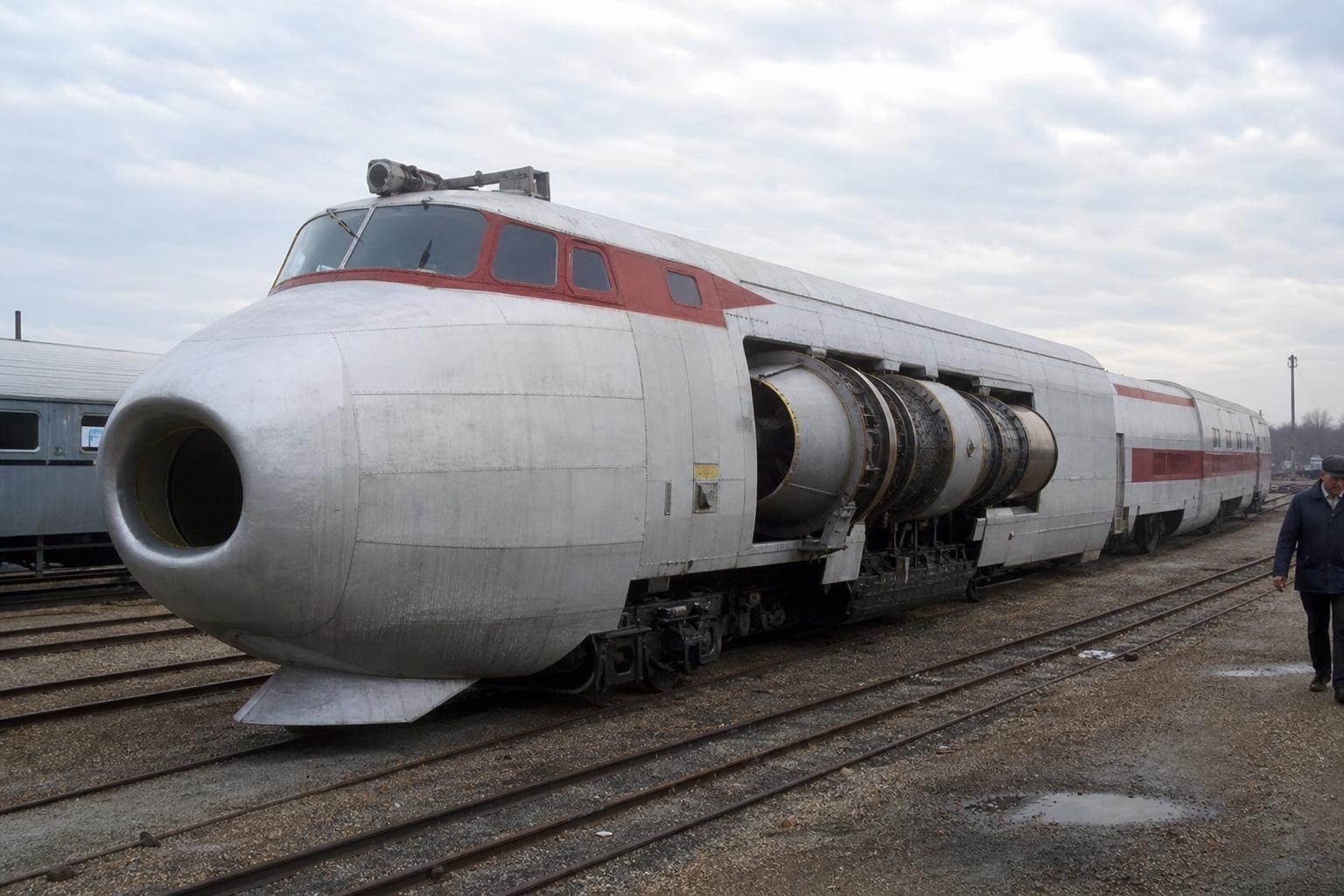
At the height of the jet age, American railroading took a wild detour into the future. In the summer of 1966, engineers strapped two bomber engines to a humble railcar, rolled it onto an Ohio straightaway, and opened the throttles. What followed was part moonshot, part publicity stunt, and entirely audacious: a shrieking steel experiment that proved U.S. tracks could handle truly dizzying speed—if only for a few glorious miles.
A spark from the space-age mindset
The mid-60s were soaked in speed. Airliners were getting faster, rockets were getting bolder, and highways stretched like promises across the map. Railroads, pressured by cars and planes, needed a headline, not a memo. So a team at New York Central asked a simple question: “What if we add thrust where wheels fall short?”
That question birthed an experiment that sounded almost impossible, and therefore irresistible: a railcar with jet engines, chasing proof that American track could handle real high-speed runs without dedicated infrastructure.
Building a bullet from a box
The platform was a modest Budd RDC-3, a stainless-steel diesel railcar turned kinetic canvas. Engineers mounted two General Electric J47 turbojets—veterans originally designed for the B-36 bomber—on a reinforced pylon up top. Below, the running gear stayed essentially conventional, right down to steel wheels on steel rails.
Up front, an improvised aerodynamic nose cleaned up the air. Out back, heat and noise control became an all-consuming puzzle. The result looked part commuter car, part laboratory animal, and wholly menacing. Crew nicknames followed: “bug,” “beetle,” “the jetcar.” The vibe was equal parts “don’t try this at home” and “watch this thing fly.”
The Ohio straight shot
On July 23, 1966, the jetcar lined up on a ruler-straight stretch between Butler, Indiana, and Stryker, Ohio. Thrust came on with a metallic howl that swallowed the countryside. “Like a storm on rails,” one observer said, watching ballast and brush recoil from the blast.
Moments later, the needle knifed past the U.S. benchmark. Top speed: 183.68 mph, roughly 296 km/h—still the fastest on American rails for a wheel-on-rail vehicle. No overhead wires. No banked curves. Just jets, steel, and a notion that “fast enough” could be faster still.
Numbers that mattered
Amid the spectacle, the team collected data: ride behavior, track deflection, signal interaction, and how noise and shock waves behaved at highway-crossing speeds never meant for jets.
Key figures often cited:
- Top speed: 183.68 mph (about 296 km/h), over standard, non-electrified U.S. mainline track
- Power: twin GE J47 turbojets mounted above the car’s roof
- Vehicle: modified New York Central RDC-3, later dubbed M-497
- Test site: straight trackage near Stryker, Ohio
The verdict: at speed, the car felt surprisingly stable on good track, but the margins for error grew razor-thin. Braking was long, grade crossings were problematic, and noise bordered on apocalyptic.
Why no passengers ever boarded
The jetcar’s triumph was also its undoing. Thrust solved wheel-slip and acceleration with brute force, but it introduced new headaches: fuel burn that laughed at economy, maintenance that devoured budgets, and heat signatures that nobody wanted near daily operations.
Most of all, there was the sound. “Like living under a runway,” one test aide joked, and the line wasn’t far from truth. Add in safety concerns at crossings and the operational awkwardness of a jet-powered commuter, and the concept quickly slid from “pilot project” to “record-setter—and done.” The car never carried so much as a single passenger in jet trim.
Back to earth, but not forgotten
After the tests, the engines were stripped, the railcar returned to ordinary duty, and the files went to storage. The headline lingered, though: rails in the U.S. could support serious speed on existing rights-of-way—if you were willing to pay for perfection in track, signaling, and protection of every crossing.
Critics called it a shiny detour, a “speed-at-any-cost” exhibit with no future. Admirers saw a bold probe: a deliberately extreme case that told planners where conventional practice would break. Both views carry weight.
What the record still whispers
Today, that number—183.68—sits like a bright pin on the map of American rail ambition. Amtrak’s fastest services have brushed the neighborhood but not the peak, confined by shared track, old curves, and the everyday gravity of mixed traffic.
What the jetcar ultimately proved is oddly modest, and absolutely vital: speed doesn’t belong to any one technology, it belongs to the total system. Stronger track. Cleaner aerodynamics. Better crossings. Smarter signals. The jet engines were the loudest part of the story, but the lesson was quieter—and more useful.
“Build the path,” the data effectively said, “and the speed will follow.” For one roaring morning in Ohio, the path was just good enough, and the speed—well, the speed was spectacular.
