
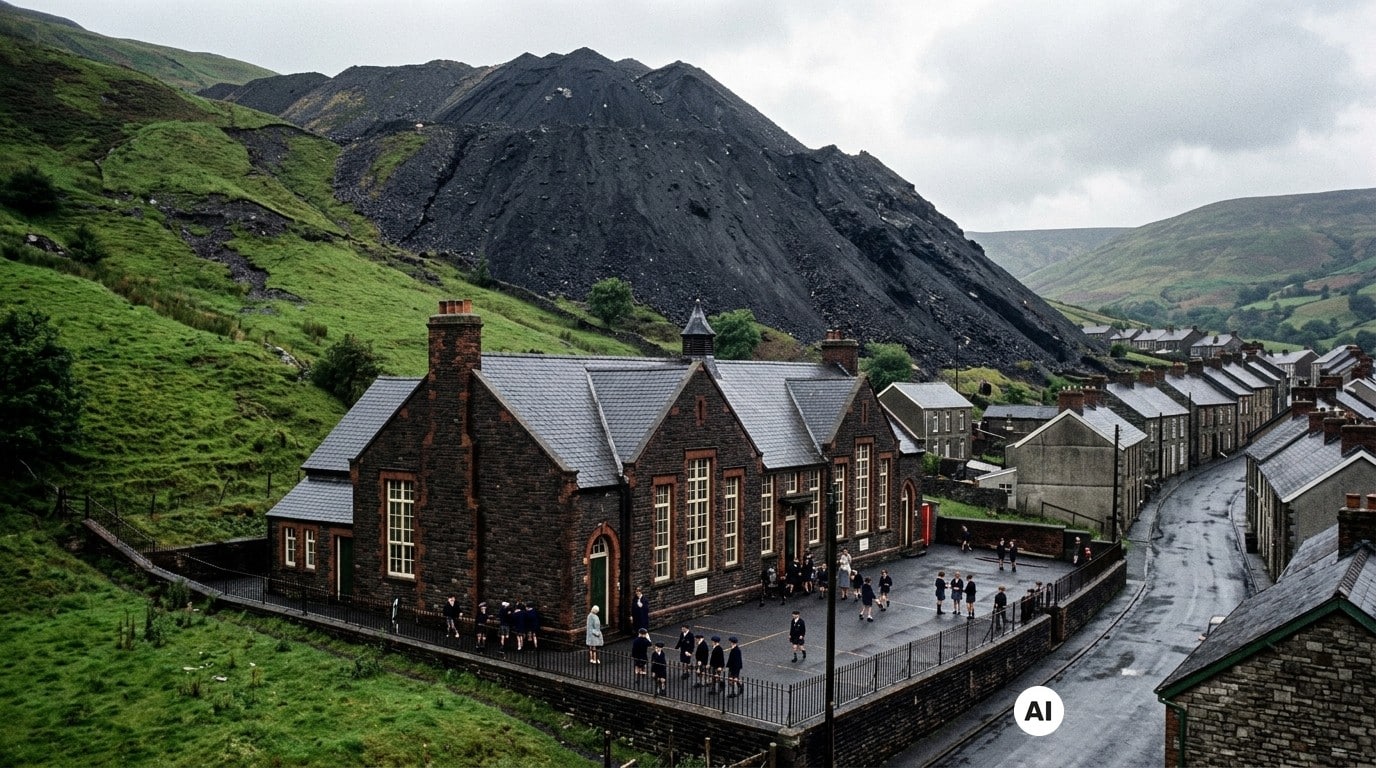
One autumn morning like any other, Welsh children settled onto the benches of their school. A few minutes later, the hillside above their village began to move and left them with no chance. This kind of tragedy, one would like to believe, is the product of fate, a whim of nature impossible to predict. Yet in Aberfan, nothing was really unpredictable. The exact spot where that mountain of mining waste had been piled carried within it, for years, the seeds of the disaster yet to come.
A Welsh hillside collapses in seconds and swallows an entire school
October 21, 1966 would be etched in Britain’s collective memory forever. On that day, around 150,000 tonnes of mining waste tore away from the hill above the small village of Aberfan in southern Wales. The black mass tumbled down the slope and crashed directly onto Pantglas Primary School, as well as onto several nearby houses. The toll was heartrending: 144 people died, including 116 children, cut down in the middle of class as they had just begun their day.
What strikes most when one examines the circumstances of this tragedy is that it bore none of the hallmarks of a purely natural accident. Pit heap No. 7, the one that collapsed that day, had been built in a location that was anything but trivial. It rested above groundwater sources that had already been identified years earlier. In other words, the catastrophe unfolded on terrain already laden with danger, literally.
Underground streams ignored for decades
According to analyses conducted after the fact by the British Geological Survey, Pit Heap No. 7 had been stacked directly above an active underground water source. This detail, far from being secondary, helps explain why this artificial heap of coal and shale proved so unstable compared with other mounds in the area. The water circulating beneath the mass degraded its structure, a bit like a wall whose foundations rested on quicksand rather than solid rock.
This phenomenon was not a last-minute discovery. Older geological maps already noted the presence of these underground watercourses at that exact location. But in the bustle of coal extraction, these data had been sidelined, or simply ignored when choosing where to store the waste. The hillock ended up perched atop a genuine hydrological time bomb, with no one truly grasping the risk being run.
The warnings the National Coal Board swept aside
The most troubling aspect of this affair is that the local population did not stay silent about the danger. Residents and elected officials of Aberfan had repeatedly voiced their concerns about the stability of this hill, dangerously perched above the village and its school. These warnings, far from being trivial, had been raised well before the catastrophe.
Unfortunately, these alarm signals found no receptive response from the mining authorities. The National Coal Board, the public body charged with managing coal mining in the United Kingdom, took no concrete steps to secure the site. The official inquiry tribunal, convened after the tragedy, was unequivocal on this point: the disaster’s responsibility lay squarely with that body, which had failed in its duty of vigilance despite clear warning signs that were plainly identifiable.
Autumn rain, a ten-metre-per-second slide
That morning in October, weather conditions played a triggering role. Heavy rains in the preceding days saturated the already-fragile spoil heap, which rested atop a network of underground water. This moisture buildup transformed the mining waste, initially solid, into a slurry that was unstable and moving.
It was this transformation that precipitated the sudden slide of the hill toward the village. The flow, with devastating force, would have attained an astonishing speed, sweeping everything in its path in mere seconds. The Pantglas School, situated downhill, had no chance against this moving mass. By the time residents understood what was happening, the worst had already occurred.
Aberfan, the disaster that changed mining-safety rules in the United Kingdom
This tragedy left an enduring mark on British legislation governing the management of mining sites. In the years that followed, the coal industry was compelled to overhaul its practices, with a renewed emphasis on environmental and social responsibility. The rules governing the siting, construction, and monitoring of spoil heaps were substantially strengthened.
But danger has not vanished entirely from the Welsh landscape. To this day, the country still has about 4,000 coal waste tips, some of which bear similarities to Aberfan’s. In 2020, a landslide near Tylorstown, following heavy rains and storms, revived concerns about the reliability of these old sites. In response, the Welsh government published a map identifying 350 particularly dangerous spoil heaps and carried out nearly 2,000 safety inspections in recent years, at a cost approaching 60 million pounds.
As for the site of Pantglas’s former school, it has been transformed into a garden of remembrance, where annual commemorations bring together the Aberfan community and the nation as a whole. A place of quiet reflection that reminds us, in silence, how visible signals can be ignored and the consequences can be irreversible.
Aberfan thus remains a stark example of what happens when the warnings of local people are systematically set aside in favor of industrial considerations. Sixty years later, while thousands of similar spoil heaps still dot the Welsh hills, the question endures: have we truly learned all the lessons of this tragedy, or do some risks still sleep, silent, beneath our feet?
Sources : The Aberfan disaster, 1966 – British Geological Survey (bgs.ac.uk) | The Tribunal of Inquiry into the Aberfan Disaster (nuffield.ox.ac.uk)
Article prepared with the help of AI · Our method
