
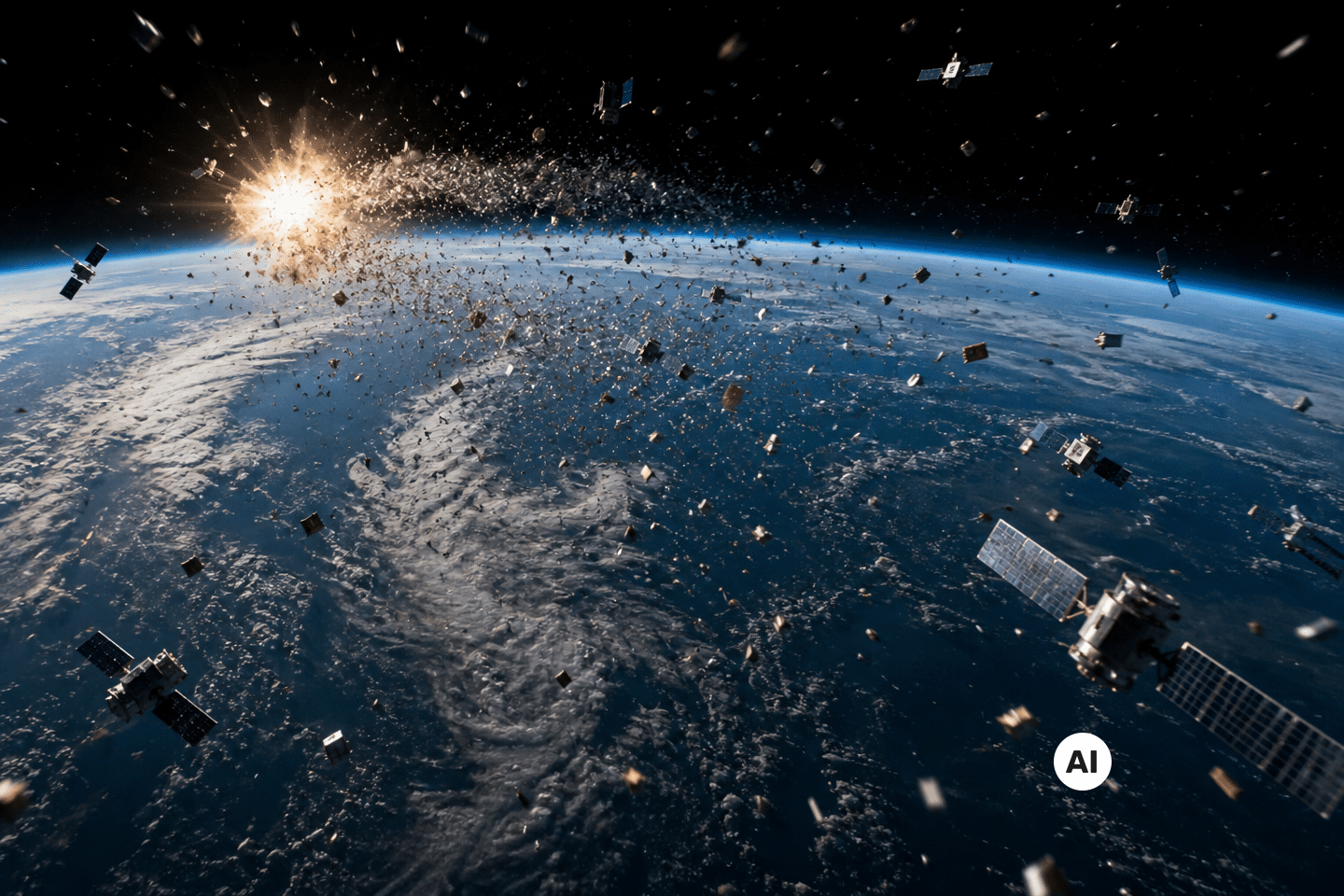
A new study warns that a single nuclear explosion at a sufficiently high altitude could disable almost all satellites in low Earth orbit, effectively neutralizing nearly all of them in space within a month.
A Magnetic Field Flaw Could Serve as a Giant Radioactive Weapon
Researchers at the University of Wisconsin–Madison and Princeton have carried out a simulation that sends a chill down the spine. Their study, not yet peer-reviewed, rests on a census of more than 13,300 active satellites in low Earth orbit. It is this entire fleet that provides the basis for their calculations.
The scenario they envisage is precise. A one-megaton nuclear explosion would occur at an altitude of 500 kilometers, above the South Atlantic. Not just anywhere: right near the South Atlantic Anomaly, a region where the Earth’s magnetic field is known to be weak.
This fragile zone acts a bit like a funnel. Rather than dispersing into space, the radioactive particles released by the explosion would become trapped there. They would form a veritable artificial radiation belt—invisible but terrifyingly effective.
Every satellite crossing this belt would absorb a radiation dose on each pass. Repeated orbit after orbit, this exposure would eventually fry the onboard electronics. The Earth’s magnetic fault would thus become, effectively, a large-scale radioactive weapon.
Fifteen Days Would Be Enough to Annihilate 99% of Active Satellites
The numbers produced by the simulation are dizzyingly rapid. On day one, 25% of satellites would already be disabled. By day three, this rate would climb to 78%.
The sequence would follow almost mechanically thereafter. After seven days, 98% of satellites would be out of service. It would take roughly fifteen days to reach 99.4%, i.e., nearly the entire global fleet in low Earth orbit.
Even the most radiation-hardened craft would not hold out much longer. Over a month, 99.3% of them would still end up failing, according to the projections. A smaller blast, of 100 kilotones, would spread this process over about a year, but without changing the final outcome.
The danger does not stop at electronic failures. As soon as the first satellites lose control, the collision risk increases sharply. The study estimates around twenty collisions in the first two years, followed by roughly 3,900 new space debris fragments generated over a decade.
Behind these statistics lie very concrete consequences. Weather services, telecommunications, satellite-based internet access—much of the infrastructure that relies on low Earth orbit would be paralyzed within just a few weeks.
Starfish Prime, the 1962 Test That Already Foreshadowed This Catastrophic Scenario
This scenario does not arise from nowhere. It echoes a real Cold War episode, known as Starfish Prime. In 1962, a 1.4-megaton bomb exploded at an altitude of 400 kilometers above the Pacific Ocean.
Several satellites in orbit were damaged by the explosion, long before the era of the digital technologies we depend on today. The event also weighed heavily in shaping the Partial Test Ban Treaty of 1963.
Starfish Prime was not an isolated incident. During the Cold War, the United States and the Soviet Union conducted a total of 18 high-altitude or space-based nuclear tests.
The lead author of the new study, Zach Petersen, a student of astronomy-physics at UW–Madison, places himself in this continuum. His work updates a risk identified for more than sixty years, applying it to a low-Earth orbit today crowded with active satellites, far more numerous than during the era of the first tests.
The preprint of the article is available on arXiv.
Article prepared with the help of AI · Our method
