
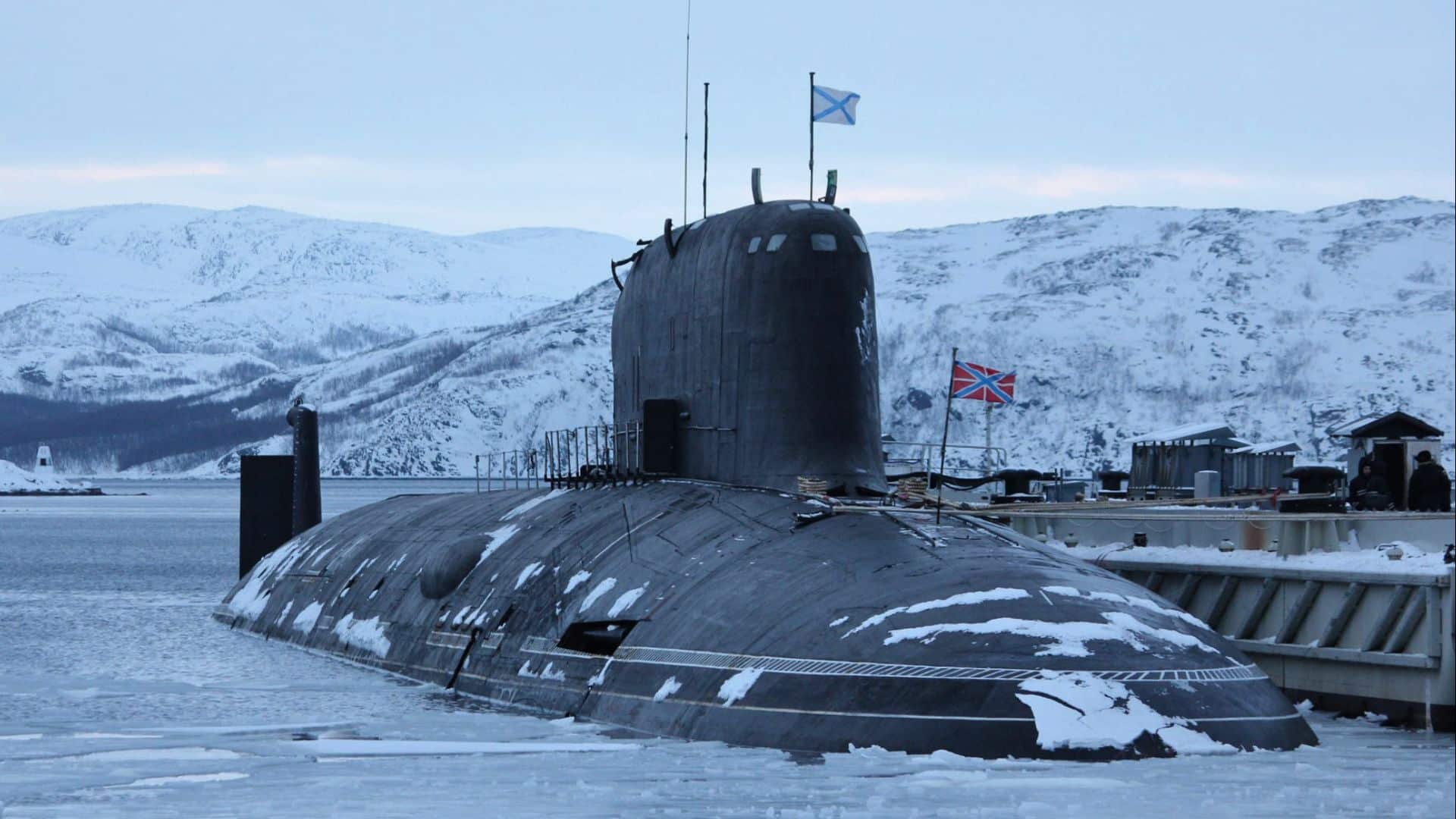
None of the three surpasses the others on every criterion. Based on public and verifiable data, the American Virginia leads in firepower and fleet size; the Russian Yasen-M shows the highest stated speed; and the French Suffren relies on stealth and versatility with the most compact hull. An additional methodological obstacle: only the US and French navies publish detailed datasheets, while Russian figures are estimates that vary.
What the Technical Datasheets Really Say
On the American side, the US Navy datasheet lists a length of 114.8 meters, a submerged displacement of about 7,800 tons, and a speed exceeding 25 knots. The crew numbers 135 individuals, including 15 officers, and the lead vessel, the USS Virginia, was commissioned on October 23, 2004.
For the Suffren, the Ministry of the Armed Forces lists a length of 99 meters, a beam of 8.8 meters, and a surfaced displacement of 4,700 tons. The announced speed reaches 25 knots submerged, with a diving depth exceeding 300 meters. Construction began on December 19, 2007, and the submarine entered active service only on June 3, 2022.
For the Yasen-M, no such level of datasheet is publicly accessible.
Public estimates diverge widely: displacement from 8,600 to 13,800 tons according to various tallies, a gap of more than 60%. A length of 130 meters for the Kazan, about nine meters shorter than the lead Severodvinsk, is consistently cited. Kazan was launched on March 31, 2017, and joined the Russian fleet in 2021. Its crew is estimated at 64 sailors, versus 135 on a Virginia.
Firepower: Virginia Holds the Edge
The Virginia is an evolving platform. Early models carry 12 vertical launch tubes, later ones add two payload tubes with six missiles each, and the Block V equipped with the Virginia Payload Module adds four tubes with seven missiles each, i.e., 28 additional Tomahawks. The total rises to 40 missiles, at the cost of an elongated hull at 140.5 meters and a displacement of 10,200 tons according to the US Navy.
The first of these modules, intended for the USS Arizona, was shown by the constructor in September 2026. It will equip a total of 19 hulls, 12 Block V and 7 Block VI, over the next two decades.
The Yasen-M takes another approach: ten 533 mm torpedo tubes, augmented by a vertical UKSK launcher system consisting of eight modules. Kalibr cruise missiles and Oniks anti-ship missiles fit into this system, and trials of the hypersonic Tsirkon missile were announced on the Severodvinsk. The actual number of missiles aboard remains uncertain: public inventories range from 32 anti-ship missiles to 40 Kalibrs, with no official confirmation. If the latter figure is accurate, the Yasen-M would be on par with a Virginia Block V.
The Suffren carries fewer weapons: four tubes and about twenty storage slots.
Its strength lies in the diversity of its systems: a heavy torpedo F21, a naval cruise missile, a modernized Exocet SM39 anti-ship missile, and combat divers with their equipment. The Ministry of the Armed Forces highlights low acoustic emissions, effective undersea detection, and long endurance. Endurance reaches 70 days for a crew of around 65 sailors, compared with 45 days for the Rubis-class it replaces.
Stealth, Endurance and Production Cadence
Kazan would be equipped with a shaped sonar antenna rather than Severodvinsk’s sphere, as well as a next-generation reactor expected to reduce noise and operate 25 to 30 years without refueling. These points remain announcements, impossible to verify independently.
The De Grasse, the fourth Suffren, was delivered on June 24, 2026.
The numbers matter as much as the datasheet. The US Navy lists at least 24 Virginia submarines commissioned, while France plans six by 2030, of which three are in active service to date: Suffren in June 2022, Duguay-Trouin in April 2024, and Tourville in July 2025. Virginia submarines also carry a lateral sonar antenna introduced with the Block V and two photonic masts instead of periscopes.
So, which is the most capable?
For striking power, Virginia leads, especially in the Block V version with its 40 missiles. For speed, the Yasen-M is credited with 35 knots underwater, versus 25 knots and higher officially claimed for the other two. For stealth, no serious ranking exists, since noise levels remain classified. The remaining criterion is versatility: the Suffren combines a naval cruise missile and combat divers, a dual capability that few nations can assemble, according to the Ministry of the Armed Forces.
The Suffren weighs roughly 5,300 tons submerged, versus 7,800 for a base Virginia and 10,200 with the module. This size gap largely explains the difference in onboard armament.
Source: The Barracuda attack submarine (defense.gouv.fr)
Article prepared with the help of AI · Our method
