
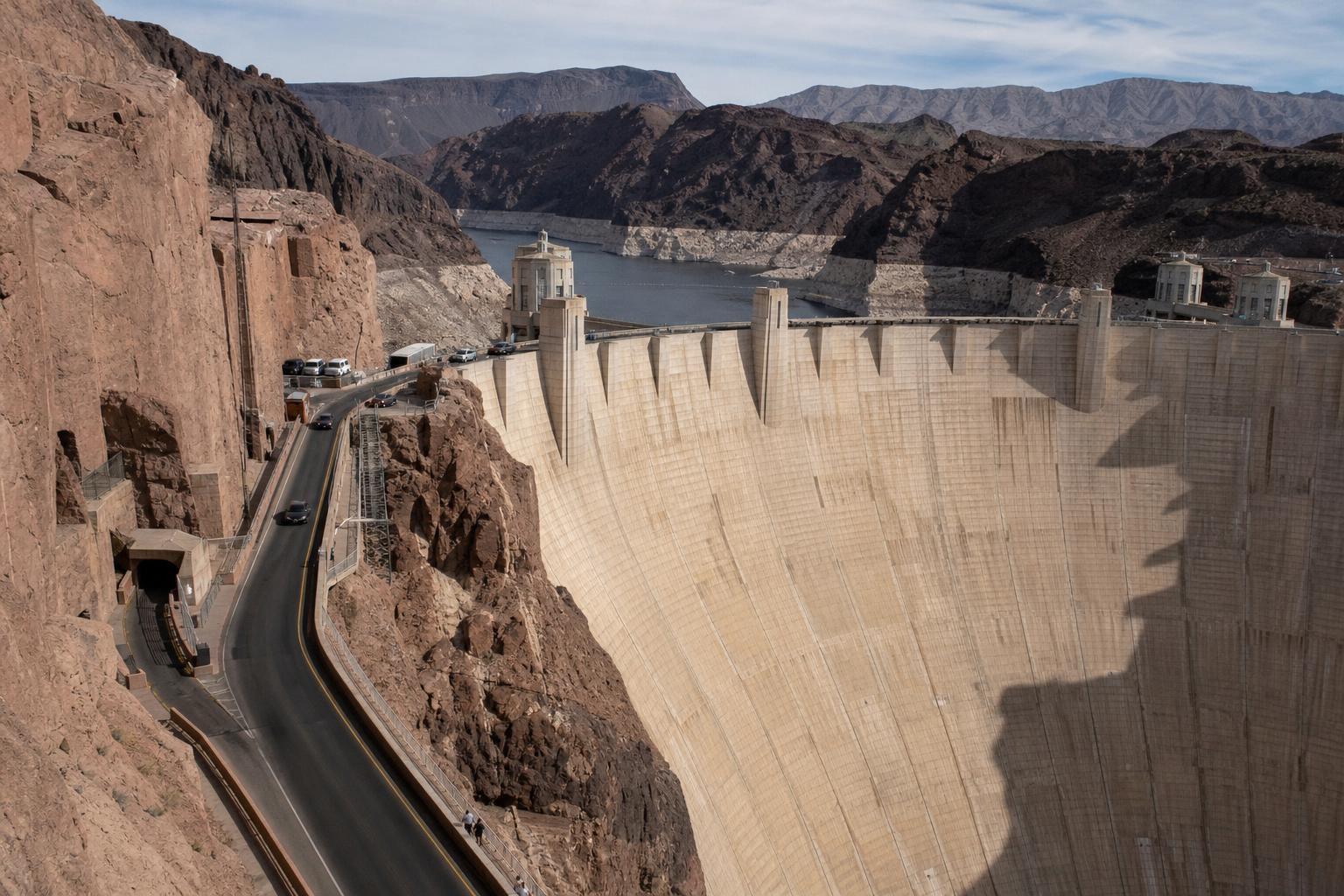
The claim sounds almost unreal, but it captures something profound about scale. A single structure in the desert holds a quantity of concrete so vast it can be compared to an entire cross-country highway. That’s more than a curiosity; it’s a window into twentieth-century ambition and the raw logistics that reshaped the American West. As one engineer might say, “When numbers get this big, they turn into landscapes, not just digits.”
The math that turns heads
Big feats invite big comparisons, and this one is rooted in simple geometry. A standard two-lane highway is roughly 24 feet wide, while concrete road slabs often range from 4 to 6 inches thick. Stretch that ribbon of pavement from one ocean to the other, and you’re talking millions of cubic yards, stacked into a single figure.
“Call it highway math,” people joke, but the estimate isn’t just a slogan. The dam’s structure contains about 3.25 million cubic yards of concrete, and the entire project—power plant, spillways, and tunnels—pushes that total above 4 million cubic yards. If you assume a thinner slab and a route that traces a more direct path, the numbers land strikingly close to a coast-to-coast pavement.
- A two-lane road is about 24 feet wide; a thin slab might be 4 inches thick.
- A cross-country distance spans roughly 2,600 to 2,900 miles, depending on the route.
- Multiply width by length by thickness and you approach 4 to 5 million cubic yards, which is right in the project’s ballpark.
That’s why the line endures: it’s a vivid, if simplified, way to translate abstraction into asphalt, and spreadsheet rows into a journey you can picture.
Pouring a monument, one block at a time
The structure wasn’t poured in one monolithic mass; it rose in interlocking blocks, each relatively small, then bound into a single arch-gravity wall. Fresh concrete releases heat as it cures, and in the desert that heat could have cracked a solid pour. So crews laced the structure with hundreds of miles of cooling pipes, pumped chilled water through the grid, and coaxed the mass to set at an even, predictable pace.
Work unfolded in a choreography of buckets, cableways, and forms, with crews moving material day and night. “It was a race against heat and time,” one worker later recalled, “and the river didn’t care about our deadlines.” The scale wasn’t just physical; it was organizational, a symphony of schedules, safety, supply, and skill.
Behind every bucket was a chain of decisions: where to quarry, how to mix, when to place, and how to cool. Behind every cured block stood crews who had learned, week by week, how to outmaneuver desert sun, steep canyon walls, and the relentless tick of contracts and calendars.
What that volume really feels like
Comparisons help, but it’s the tangible feel that sticks. Imagine every sidewalk in a dense city, rebuilt end to end for miles—then stack those miles until they trespass past your inner map. Picture a fleet of mixers pouring day after day, a drumbeat of aggregate and cement echoing up canyon stone.
Or think in terms of time as a material: how many shifts, how many meals, how many nights of exhausted sleep it took to turn drawings into a concrete reality. “Numbers are polite liars,” a project manager once quipped, “because they hide the aches in your back.”
The “pave-a-highway” line doesn’t ask you to memorize figures. It invites you to imagine a ribbon of manmade rock laid across an entire continent—a thought-experiment that shrinks nothing, yet makes the magnitude graspable.
Why the comparison endures
Great infrastructure comes with more than steel and stone; it brings metaphors that anchor our public memory. This dam bottled a wild river, lit cities, and watered fields, but it also taught a lesson about collective will. The highway metaphor keeps that lesson alive, linking a single canyon to a national horizon.
It reminds us that materials are stories in disguise. Cement is powdered mountain; aggregate is the river’s ancient bed; water is time caught in a different shape. Combine them under pressure, with patience and craft, and you don’t just build a wall—you cast a chapter of history.
Today, the comparison still does its work, nudging us to ask what kinds of monuments we choose to build with our pooled effort. Could we channel the same scale toward resilient grids, restored watersheds, and cooler, greener streets? “Ambition is just logistics with a soul,” someone once said, and you can almost hear that line echo between canyon walls.
In the end, the highway image endures because it joins precision with poetry. It measures in miles, yet it speaks in feelings. It turns a desert of figures into a road your mind can drive, mile after mile, from one horizon to the other.
