
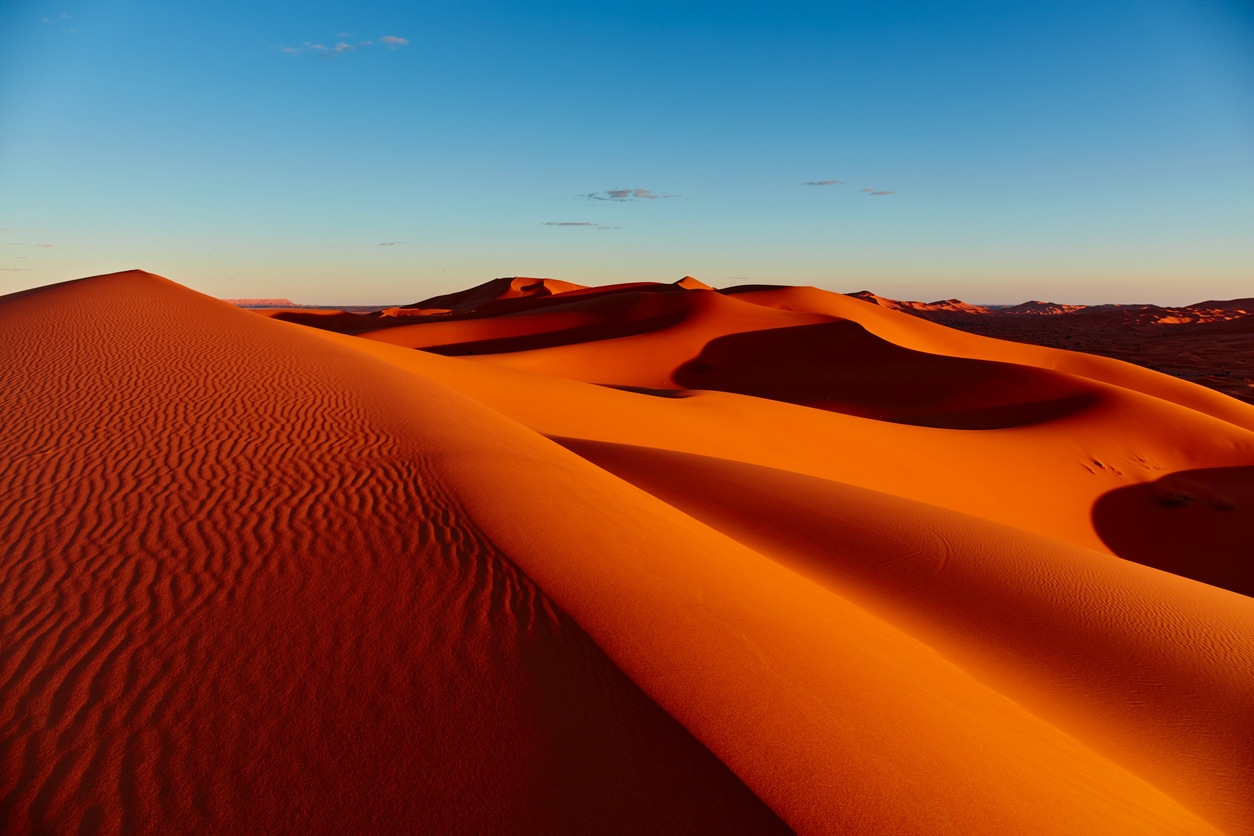
Present on every continent, deserts are mainly characterized by extremely low precipitation. A recent infographic lists the ten largest deserts on our planet.
What is a desert?
Before exploring the world’s largest deserts, it is important to provide a definition of the term “desert.” In broad terms, deserts are environments where extreme aridity prevails. Precipitation is very low, typically less than 250 mm of rain per year. Moreover, evapotranspiration—the amount of water that evaporates into the air and the scarce plants release—is significantly higher than the water coming from precipitation. In other words, the soil is never really able to store moisture at the surface.
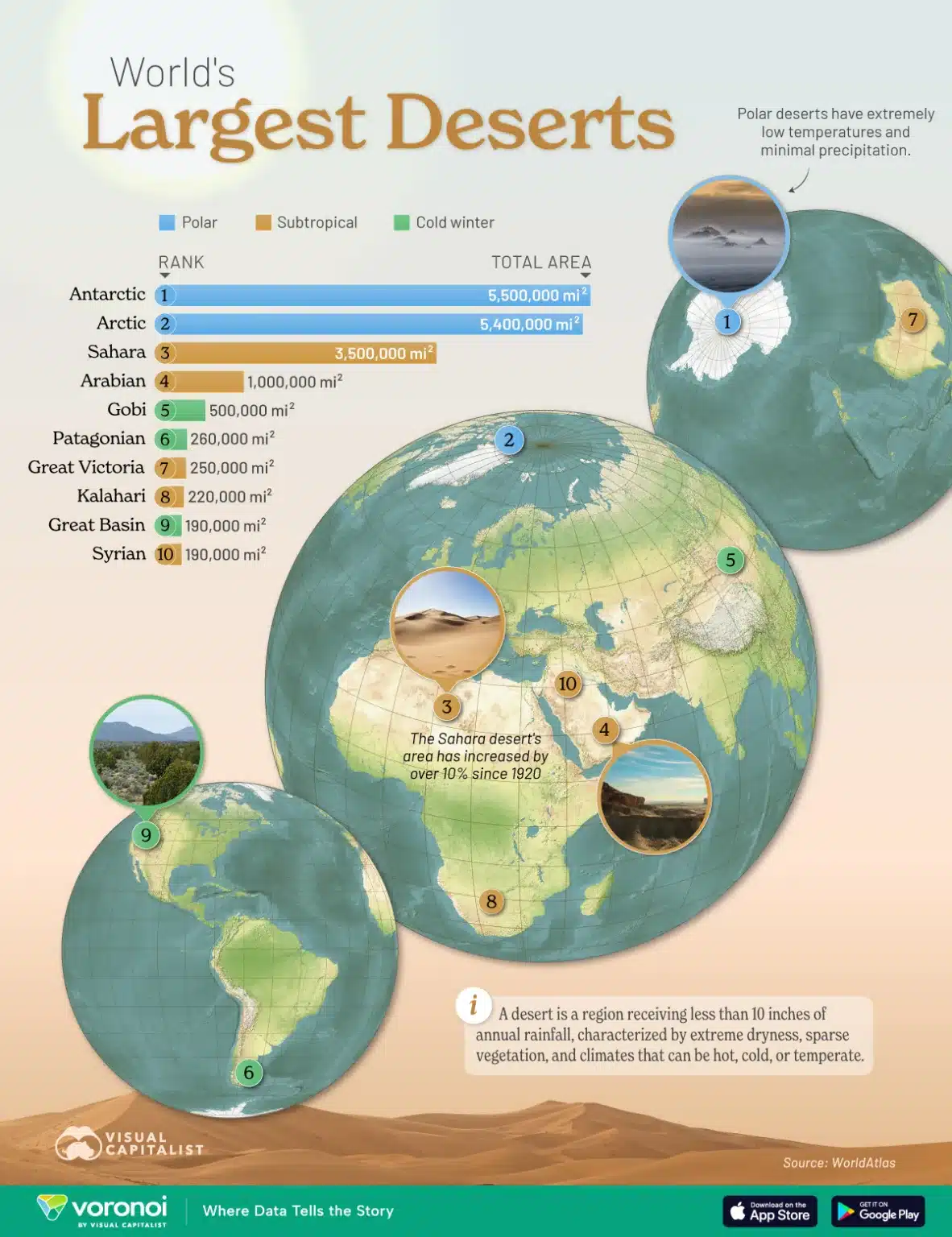
On May 16, 2026, the media Visual Capitalist published an infographic listing the ten largest deserts on Earth (see at the end of the article). The document is based on data from WorldAtlas, one of the oldest and most important educational websites addressing geography, cartography and demography, among other topics.
Antarctica and the Arctic at the top of the ranking
While the Sahara is undoubtedly the world’s most famous desert, it is not the largest on the globe. In fact, the top spot goes to Antarctica, spanning an area of more than 14.2 million square kilometers. In reality, the region covers not only the continent but also attached islands and the vast floating ice shelves extending this continent. Note that in winter, the freezing of the Southern Ocean (forming sea ice) doubles the frozen surface, temporarily reaching nearly 30 million square kilometers.
Next comes the Arctic, with an area of 13.9 million square kilometers. This is a zone encompassing all lands and marine spaces located mainly above the Arctic Circle. The Arctic desert differs from the Antarctic in that it is primarily a frozen ocean (sea ice) surrounded by pieces of continents. These “pieces” include: the Canadian Arctic Archipelago, Greenland, the coasts of northern Siberia and the archipelago of Novaya Zemlya and Franz Josef Land, North Alaska, as well as part of Europe – the archipelago of Svalbard and the northern extents of Sweden, Finland and Iceland.
The Sahara, the third-largest desert
Resembling the public’s image of a desert, the Sahara ranks third. It covers an area of about 9 million square kilometers, spanning more than a dozen countries including Algeria, Egypt, Mali, Mauritania, and Chad. It is, of course, the largest hot desert in the world.
In fourth place is the Arabian Desert with 2.6 million square kilometers. It lies in the Middle East, including countries such as Saudi Arabia, Jordan, Iraq and Yemen. Next comes the Gobi Desert (5th), half as large with 1.3 million square kilometers, straddling China and Mongolia.
Finally, the deserts completing the global Top 10 have surfaces ranging between 500,000 and 700,000 km². Notable examples include the Patagonia Desert (Argentina), the Great Victoria Desert (Australia), the Kalahari Desert (South Africa, Botswana and Namibia), the Great Basin Desert (United States) and the Syrian Desert.
Here is the infographic published by Visual Capitalist :
Article prepared with the help of AI · Our method
