
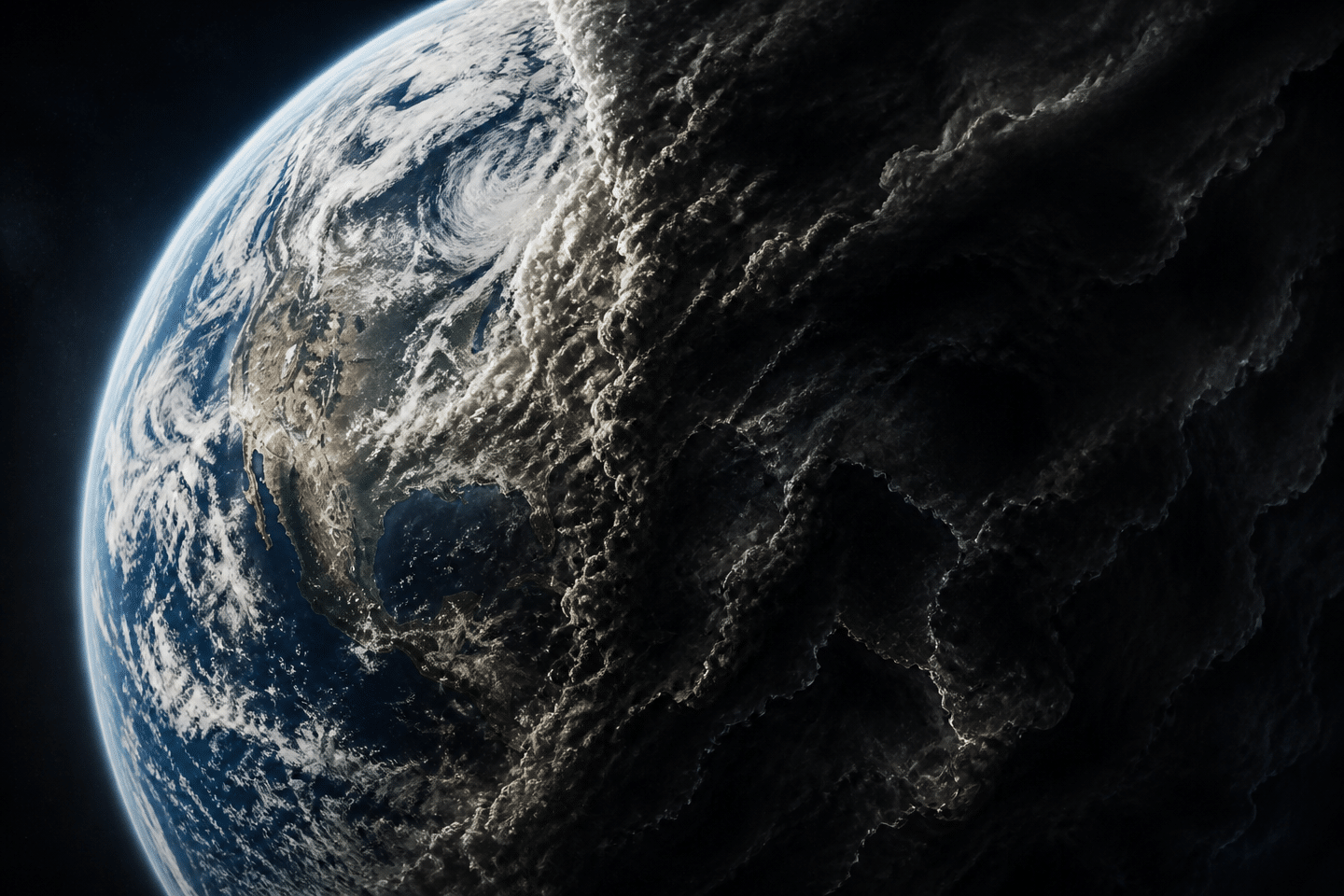
Two scenarios among the seventeen studied could, in theory, wipe humanity off the map. An international commission has just compiled the inventory of the most serious health threats facing our species, with a horizon set for 2100. A piece of work that warrants serious attention. The study is published in The Lancet.
.
- A 37‑member international commission identified 17 catastrophic health threats by 2100, of which two could cause human extinction: nuclear war and the malicious use of artificial intelligence
- these threats are interconnected (climate, pandemics, antimicrobial resistance) and must be tackled together, potentially generating one billion disability-adjusted life years (DALYs) by 2100 if nothing is done
- the commission proposes a three-pronged plan: strengthen global preparedness capabilities, support innovations in science accessible to all, and continuously monitor these risks
- A 37-expert council has sifted 17 scenarios capable of tipping humanity
- Nuclear war and uncontrolled AI: the two exit doors to extinction
- 2100 in sight: why these risks must be fought together rather than separately
A panel of 37 experts has screened 17 scenarios capable of tipping humanity
We are living through a complex era for the human species. Perhaps not the harshest in history, a question for future historians to debate. Yet amid an endless stream of information and an infinite scroll of content, it is hard to distinguish real threats from background noise.
That is precisely the task undertaken by an international commission bringing together 37 experts. Their mission: to sift through hundreds of potential risks to global health, and to isolate those that pose a catastrophic threat. The result is a list of 17 threats, described in terms of their nature, their severity, and the avenues for addressing them.
Significantly, the analysis casts its conclusions across a 75-year horizon, extending to 2100. A horizon that may feel distant, yet it structurally guides the commission’s approach. “Most of all, the 17 threats are interlinked, which is why they must be tackled together rather than in isolation,” summarized Professor Christopher JL Murray, co‑chair of the commission and director of the Institute for Health Metrics and Evaluation at the University of Washington.
Dr. Richard Horton, editor-in-chief of the medical journal The Lancet, which publishes the study, shares the same view. According to him, this work invites a broadened perspective: shift from addressing isolated problems toward a landscape of threats that requires a level of coordination commensurate with its complexity.
Nuclear war and uncontrolled AI: the two exit doors to extinction
Among the 17 threats identified, two stand out clearly. The first is no surprise: the threat of nuclear conflict. The second, more unexpected in a health-focused context, concerns the risks associated with the malicious use of artificial intelligence. The experts do not rate these scenarios as highly probable, but they acknowledge that, in the worst case, they could drive the human species to extinction.
The nuclear threat is old news in essence. Specialists had already warned that the general public was no longer sufficiently frightened by this weapon, something unimaginable a few generations ago when the world lived under the shadow of the Cold War. Fear may have faded, but the danger has not.
Artificial intelligence, by contrast, embodies a distinctly modern problem. Experts continue to debate whether this technology poses a true existential threat, and some hypotheses about the topic are genuinely chilling. The impact of widespread AI adoption on the human psyche and on society remains an open question, far from settled.
To organize this panorama, the authors built a pyramid. At the top sit these two extinction threats. Just beneath lie 15 other major threats, and further down, 314 additional risks compose what the commission calls the broad threat landscape.
2100 in sight: why these risks must be fought together and not separately
Climate instability is a vivid illustration of this logic of interconnection. Its effects on physical and mental health extend beyond deaths caused by extreme heat. Extreme weather disrupts blood supply systems, floodwaters carry deadly bacteria, and disease-carrying insects are moving into new territories as temperatures shift.
The record-breaking “super El Niño” currently set in meteorological history could, on its own, lead to roughly 451,000 deaths by early 2027, according to a forecast. Air pollution, already responsible for tens of thousands of additional deaths each year, remains inseparable from climate change. In this context, the decision by the Trump administration to roll back emissions limits on coal- and gas-fired plants raises important questions.
Human activities that amplify climate disruption—such as deforestation—also bring human populations into closer contact with wild animals. This contact increases the likelihood of zoonotic spillover and the emergence of new pandemics. And where an infectious disease circulates, antimicrobial resistance advances: within 25 years, millions of lives could be threatened by bacteria and fungi that have grown resistant to current treatments.
Tallying these 17 threats together, they should collectively produce about one billion disability-adjusted life years by 2100, a public-health benchmark corresponding to a year of healthy life lost. But this figure is not a foregone conclusion: it holds only if no action is taken.
To prevent this outcome, the commission proposes a three-part plan. First, strengthen capacities: rally world leaders around preparedness and provide financial support to communities most in need. Next, back scientific advances—ranging from vaccines to climate technologies—ensuring equitable access. Lastly, monitor these risks continuously, because effective response to a threat requires reliable measurement.
The co-chair of the commission, Dr. Natalia Kanem, frames the challenge this way: “Recent global events show how quickly stability can pivot to crisis, and how costly it is to respond only after catastrophe.” She notes that these threats risk amplifying existing inequalities, striking first at the most vulnerable communities.
This list of 17 threats is not a fixed ranking. The situation will evolve, new data will emerge, and scientific breakthroughs could alter the balance. The year 2100 remains distant, but as the authors remind us regarding climate, a risk that today seems non-apocalyptic could, over centuries, evolve into an extinction-level threat if nothing changes. The future, Kanem insists, is not inevitable; action now is essential to avoid a harsher fate later.
