
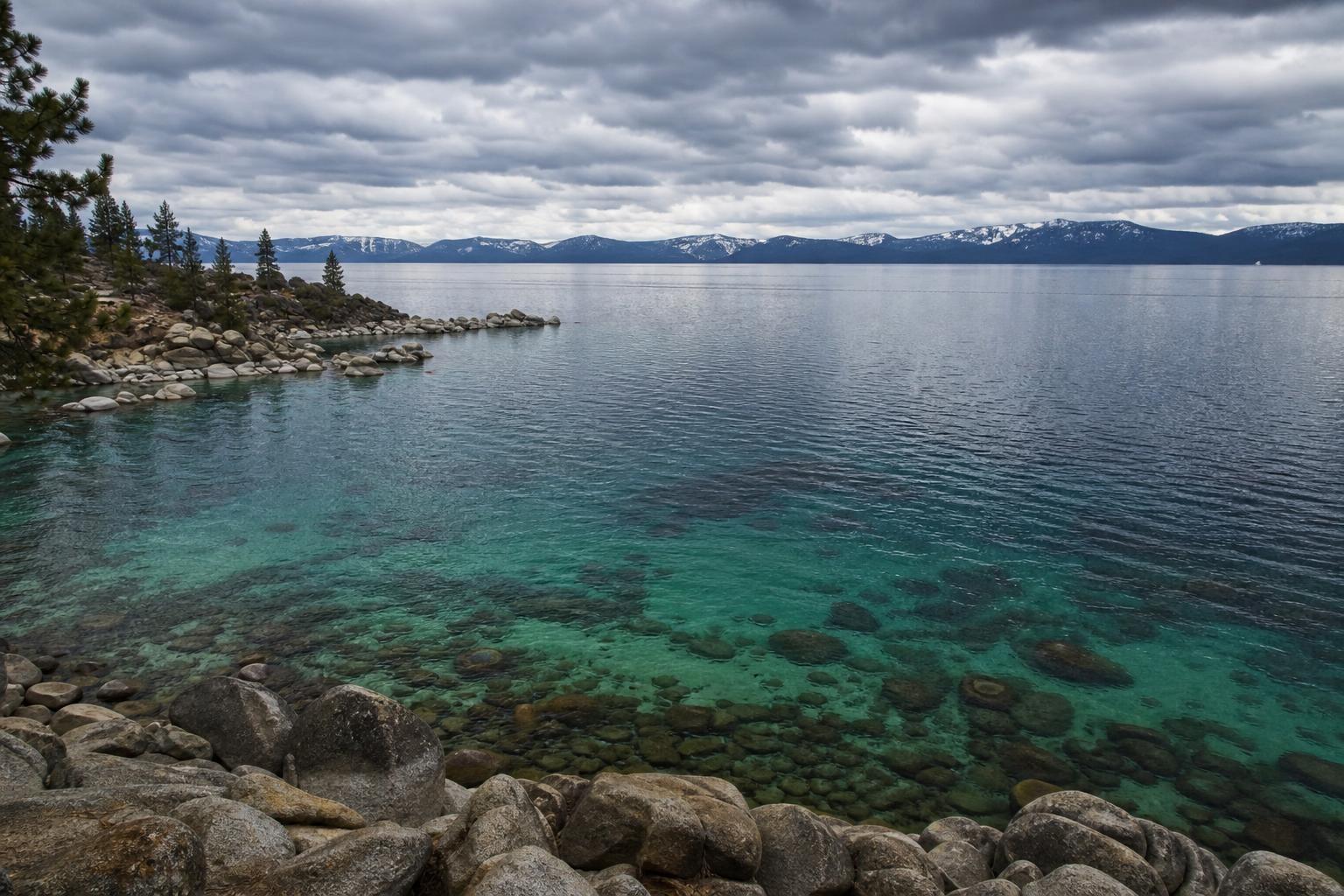
Draped across the Sierra Nevada, this alpine basin feels ancient and electric at once. The water is clear, the air is thin, and the scale is quietly audacious. If you’re tempted to measure it by shoreline selfies, you’ll miss its deeper story—a story of staggering volume, slow motion time, and blue that seems to keep its own counsel.
A scale that scrambles intuition
Stand on a granitic promontory and try to hold the lake in your head. It won’t fit. This basin stores such immense volume that, spread evenly, its water could blanket an entire state in a shallow sheet. Imagine the whole Central Valley and every coastal city wearing a sheen of mountain-cold freshwater. The mind balks, but the numbers are real.
Here are a few anchors for your imagination:
- Surface area: about 191 square miles of mirror
- Maximum depth: over 1,600 feet of blue distance
- Average depth: roughly 1,000 feet of quiet weight
- Elevation: 6,225 feet above sea level
- Volume: more than 39 trillion gallons of liquid memory
“Big” doesn’t capture it, because “big” is flat. This is depth, which carries a different psychological gravity—cold, stable, and resistant to quick change.
Why a raindrop lingers for centuries
Drop a bead of rain into this bowl today and it becomes a tiny citizen of a long republic. Scientists call it “residence time,” the wait between entry and exit. In this case, it’s on the order of many centuries, because this high basin has only one major outlet—the Truckee River—and an enormous reservoir underneath the glittering surface.
Water arrives by snowfall, snowmelt, and small streams, then circulates through temperature-driven layers. The upper band mixes with sun, wind, and storms. The deeper water moves in slow arcs, locked by density and cold. Most of what falls today won’t see daylight again for many human lifetimes.
“As a rule,” one hydrologist likes to say, “fast lakes forget you; slow lakes remember.” The Sierra’s blue eye is a prodigious rememberer, archiving seasons, sediments, and the faint chemical handwriting of the watershed.
Blue made by restraint
That famous color isn’t a trick of saturated filters. It’s clarity—water with so few suspended particles that sunlight penetrates deep, scatters selectively, and returns as fierce azure. Clarity, in turn, is a function of restraint: low nutrients, controlled erosion, and careful shoreline practices.
For decades, researchers have watched the water’s transparency pulse with droughts, wildfires, road dust, and storm runoff. Some years the Secchi disk—the classic white plate used to gauge clarity—dives deeper; other years it falters. The long mean is still impressive, but pressure is mounting.
“Blue is a verb here,” a field technician once quipped. “It’s what happens when a lot of things go right at the same time.”
A future balanced on a ridgeline
Climate is tilting the table. Warmer winters raise the snow line, turning powder into rain, which speeds off the slopes carrying fines and nutrients. Summer heat strengthens thermal stratification, keeping surface waters warmer and deeper waters isolated. Invasive species exploit small advantages. After big fires, ash and loosened soils ride the first heavy downpours straight to the shore.
Resilience here is both natural and made. Land managers terrace and revegetate disturbed slopes. Crews vacuum aquatic invaders from marinas and shallows. Stormwater projects capture the first flush of dirty runoff before it hits the lake. Each effort is small and practical, and together they buy time for a long memory to keep doing its quiet work.
What changes, most of all, is our sense of time. A century to a raindrop is a long errand; to a mother lode of cold water, it’s a blink. Planning that respects both clocks feels like the right ethic.
How to meet the lake on its terms
You can love a place loudly, or you can love it well. Up here, loving it well is a choreography of small choices: park on stable ground so tires don’t chew sediment, shake grit from your boots away from storm drains, and keep soaps and sunscreens away from rocky shallows. Paddle early when winds are gentle, and give feeding birds and spawning fish a wide, quiet berth. Trails are not fences; they’re agreements.
If you swim, feel how the cold sharpens attention. If you hike, note how granite holds and releases light. If you linger at dusk, watch the wind lay down its last wrinkles and the lake become a perfect, indifferent mirror. You don’t have to explain it to anyone. You only have to notice.
The basin will keep its counsel long after we leave the shore. That fact is not an excuse to look away; it’s a reason to look more closely. We are brief, but we are useful. A raindrop will take centuries to move on. We can, in the short meantime, make its journey a little more beautiful.
