
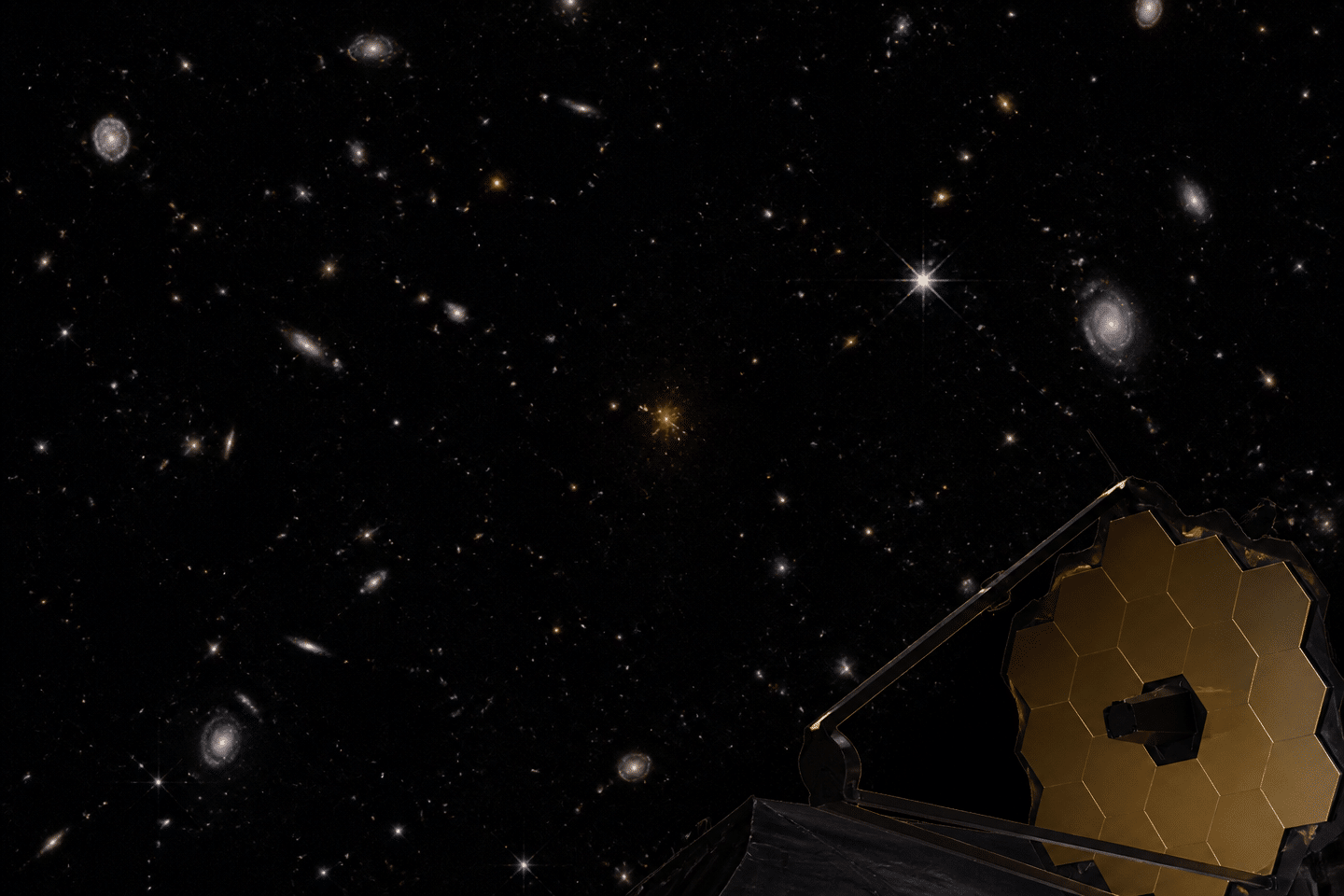
A point of light spotted by the James Webb Space Telescope initially seemed to reach back to the very first moments of the universe, well before the oldest known galaxies today. Named Capotauro, this object had astronomers dreaming, until a fresh analysis seriously reshuffled the cards.
- Capotauro, spotted by the JWST, was initially interpreted as an extremely ancient galaxy, dating to roughly 100 million years after the Big Bang.
- By comparing images taken between 2022 and 2026, a team led by F.-YF Liu detected a shift of 0.13 arcseconds, incompatible with a galaxy so distant.
- Capotauro would actually be a cold brown dwarf of about 350 kelvin, located around 2,400 light-years away, in our own galaxy.
- A cosmic calendar disrupted by a light point on January 4
- A star that moves where a galaxy should remain still
- The Capotauro mystery rekindles the debate on the origins of the universe
A cosmic calendar disrupted by a light point on January 4
Credit: © Giuseppe Capriotti and Giovanni Gandolfi. NASA / ESA / CSA / JWST / CEERS (PI: Steven Finkelstein)
The JWST continues to upend our notions of the primordial universe. Since its commissioning, it has already revealed galaxies that are unusually massive for their age, as well as the enigmatic “tiny red dots” that still intrigue researchers. Capotauro, discovered as part of the CEERS program, fit into this same lineage of puzzling objects.
To measure the scope of the announced discovery, astronomers like to use the “cosmic calendar.” In this representation, the entire history of the universe fits into a single year: the Big Bang happens at exactly midnight on January 1, the Milky Way forms on March 1, and Earth appears on September 14. Humans themselves only arrive on December 31 at 11:52 PM.
On this scale, the very first known galaxies would have formed after January 7, with the oldest current candidate dating to January 8. Capotauro, if confirmed as a galaxy, would have emitted its light in the early hours of January 4. A difference that might seem minor on a calendar, but would constitute a genuine puzzle for astronomers.
According to the team that proposed this hypothesis, Capotauro’s light would have been emitted about 100 million years after the Big Bang. That would make it potentially the oldest galaxy ever observed, far ahead of all other objects cataloged so far.
A star that moves where a galaxy should stay put
To understand why such a discovery remains fragile, one must return to a classic problem in astronomy, one that researchers sometimes joke about: figuring out whether certain cows are small or simply very distant. In other words, distinguishing an object’s true size from its distance is far from obvious when viewed from Earth.
For Capotauro, the object only appeared in JWST images captured at long wavelengths, remaining invisible at shorter wavelengths. This sharp cutoff was initially interpreted as the signature of primordial hydrogen absorbing the light, a classic indicator of a very large distance. But the entire age estimation of the object rested on the assumption that it was truly a galaxy.
A team led by F.-YF Liu, from the University of Edinburgh, chose to test this hypothesis differently. They compared JWST observations taken over several years, the earliest dating to December 2022 and the latest to June 2026. The result: Capotauro moved slightly, by 0.13 arcseconds, a tiny but perfectly measurable motion.
Yet a genuinely distant galaxy, located at the edge of the observable universe, should exhibit no perceptible movement from our vantage point. This motion thus betrays the presence of an object much closer to us, belonging to our own galaxy.
The Capotauro mystery rekindles the debate on the origins of the universe
If Capotauro is therefore unlikely to be the oldest galaxy ever observed, the discovery remains far from inconsequential. Liu and his colleagues propose a new identity for this object: a very cold brown dwarf, located roughly 2,400 light-years from Earth, which would still rank among the most distant brown dwarfs ever detected.
According to the scientific paper, the best estimate puts Capotauro’s temperature at about 350 kelvin, i.e., 77 degrees Celsius. The authors do not entirely rule out the possibility that it is even colder, which would bring it even closer to us.
The explanation partly lies in the striking similarity between the two classes of objects. Brown dwarfs also absorb a wide range of wavelengths, producing a cutoff similar to what would be expected for a very distant galaxy. The previous team had already considered this possibility, evidence that the initial work was not negligent, only confronted with an ambiguity that is difficult to resolve without additional data.
In the conclusion of their study, published in Monthly Notices of the Royal Astronomical Society, the researchers stress a broader methodological lesson: any selection of high-redshift candidates should systematically include models of cold brown dwarfs, in addition to galaxy models, and verify relative astrometry whenever imaging from multiple epochs exists.
The tale of Capotauro nicely illustrates the traps that accompany the exploration of the primordial universe. Between an extraordinarily early galaxy and a nearby cold brown dwarf, the boundary can seem razor-thin until time and repeated observations decide. Further surveys will be needed to precisely determine this object’s properties, but one thing now appears certain: Capotauro belongs to our own galaxy, not to the dawn of the universe.
