
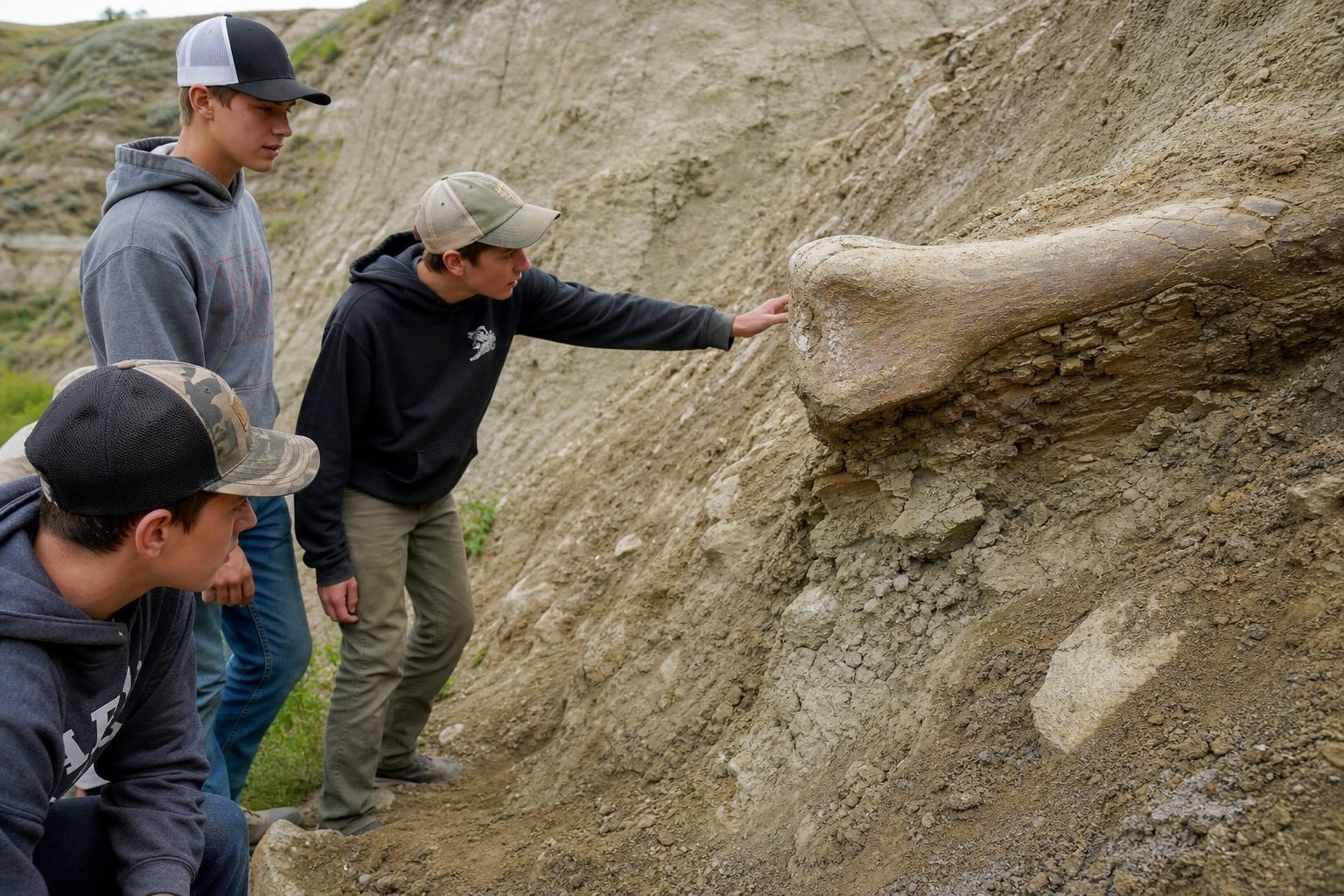
The wind was sharp, the kind that skims across prairie grass and rattles shale like loose teeth. Three kids paused on a slope, sun on their backs, backpacks dusty and light from a morning of wandering.
One of them saw it first: a pale arc in the dirt, oddly smooth, oddly still. Not wood, not a rock. A bone, where no living thing had fallen in a very long time.
A find that bent time
They brushed the surface with careful fingers and measured their excitement in hushed breaths. Inches gave way to edges, and edges to structure—signs of something enormous, something once alive under an ancient sky.
“Everything felt quiet, even with the wind,” one of them said later. “I remember thinking, this is old, like way-older-than-people old.”
News traveled from a hillside to a local museum, and from there to the careful choreography of paleontology. Within hours, the scene changed from backpacks and snacks to flags and field notebooks.
From hillside to science
Experts arrived with plaster, brushes, and the kind of focus that comes from years in the badlands. They logged positions, photographed layers, and traced the bone’s geometry like cartographers mapping a hidden coast.
Under the dirt, more surfaces appeared—teeth with serrations like saws, limb fragments built for torque, vertebrae that promised speed and a posture like coiled intent. The early verdict: a tyrannosaur, not yet fully grown.
“Juveniles are the missing chapters,” a paleontologist on the team explained. “Adults tell us how the story ends. The teenagers tell us how it changes.”
Why a young tyrant matters
A not-quite-grown apex predator sits in a scientific sweet spot—old enough to be fierce, young enough to be different. That difference can rewrite what we think about growth, hunting, and ecology.
- Juvenile bones capture growth spurts, shifting proportions, and metabolic signals that adults no longer show.
- Tooth wear and bite patterns reveal diet, social behavior, and prey choices across life stages.
- Bone texture and microstructure act like tree rings, preserving annual rhythms of stress, climate, and food.
Rock, bone, and timing
North Dakota’s layered badlands are patient, and patience is a preserver. Fine sediments blanket bone, sealing out water, tamping down oxygen, letting time do a quiet job that feels almost impossible.
The hillside that held the fossil wasn’t dramatic—no cliff, no obvious marker. Just a bend in a trail, a smear of loose shale, and a pale curve at the right angle in the right light.
“People expect dinosaur bones to look like movie bones,” the field lead said, half-smiling. “But the real thing is subtle, easy to miss unless you’re looking.”
Teenage design: built for speed
A younger tyrannosaur likely ran lighter, with legs tuned for acceleration, a skull narrower and more flexible, and a bite geared for precision over sheer crush. Think pursuit more than ambush.
As it aged, bone thickened, jaw muscles bloomed, and the bite shifted from slice to shatter. The skeleton tells that story in increments: scar lines, sutures, and microscopic signatures laid down year by year.
The day it changed
Back on the slope, the boys stood just far enough away to watch their discovery become a process, not just a thrill. Field jackets hardened around the fossils like cast shells, ready for the careful journey out.
“I kept thinking, we almost walked past it,” one said. “One more step and it would still be there, and we would never know.”
They didn’t pose much, and no one whooped. The moment felt more like a library than a touchdown—hushed, precise, somehow larger than their own voices.
What happens next
In the lab, air scribes will free bone from stone, flake by flake, hour by hour. CT scans will peer through sockets and canals, measuring cavities where nerves and blood once ran.
Analyses will chase questions that spill forward: How fast did it grow? What did it eat? How did it hunt when it weighed a quarter-ton, not a giant two-ton monarch?
The museum will give it a number first—something dry and formal—before nicknames blossom, because humans nickname wonders, and this one grew up under ancient storms.
How ordinary eyes make rare discoveries
The line between tourist and scientist is thinner than it looks. Curiosity is the bridge, and respect is the toll. Look closely, step lightly, and report what doesn’t fit the everyday picture.
Field workers repeat the same three rules in a kind of mantra: notice, photograph, and notify. The land keeps its secrets, but it shares them with the patient and the careful.
“Half our best finds start with someone paying attention,” the paleontologist added. “The other half start with someone admitting they don’t know—and asking, what is this?”
A hillside gave up a life paused for millions of years, and three young hikers widened the door between past and present. In the sweep of that prairie wind, the earth felt older, and the future of a fossil suddenly felt new.
