
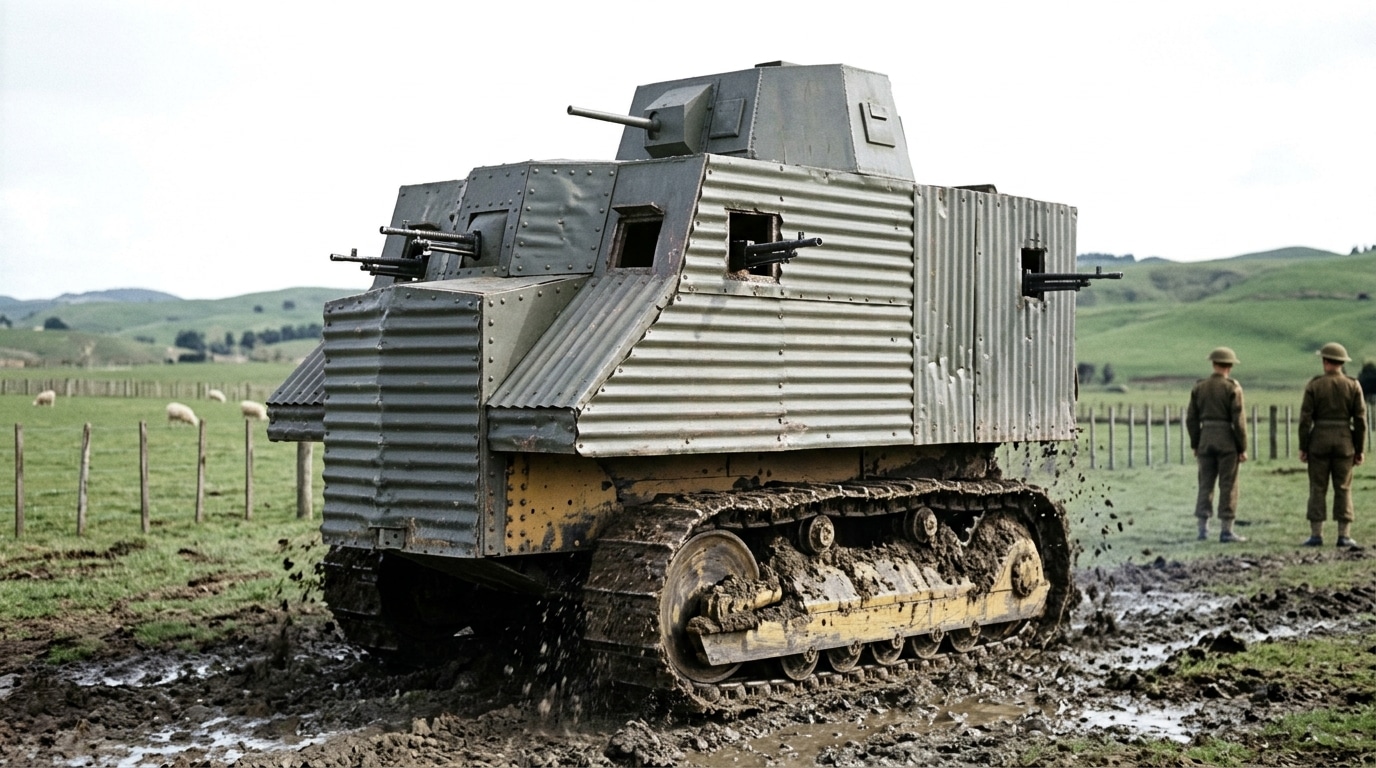
A battle tank and an agricultural tractor wrapped in corrugated steel have, in theory, little in common. Yet in 1941, New Zealand blurred that boundary with a surprising contraption: six machine guns mounted on an improvised hull. Its story, as brief as it is intriguing, deserves a closer look.
- In 1941, fearing a Japanese invasion, New Zealand’s Public Works Minister Bob Semple commissioned an improvised tank built from farm tractors clad in corrugated iron, inspired by a single American postcard.
- The vehicle, nicknamed the Bob Semple Tank, weighed 25.4 tonnes, carried six Bren light machine guns, but suffered from insufficient armor, dangerous instability, and a tractor-grade gearbox unsuited for combat.
- Three units were built, later deemed unusable by the army, dismantled, and the tractors returned to public works, with none ever firing a real shot.
- When New Zealand tinkers with a tank built from agricultural tractors
- Six Bren machine guns for a corrugated steel hull: a risky bet
- Too heavy, too unstable: the swift end of an improvised tank
When New Zealand Crafts a Tank from Agricultural Tractors
During World War II, the New Zealand archipelago feared a Japanese invasion. The country was woefully short of armored vehicles, and there was little chance of receiving them quickly from Britain or the United States. In response to this urgency, Bob Semple, then Minister of Public Works, decided to take matters into his own hands.
His inspiration was almost anecdotal: a simple American postcard showing a tractor converted into a tank. No detailed plans, no proper design office, just this image as a starting point to imagine a combat vehicle.
Semple teamed up with TG Beck, an engineer from the Christchurch district, to bring this idea to life in the local workshops. The official construction was then entrusted to the Public Works Department in Temuka. A Ministry of Public Works that builds a tank — that sums up the resourceful spirit behind this initiative.
Six Bren Machine Guns for a Corrugated Steel Hull: A Risky Bet
On paper, the figures sound almost impressive. The machine was projected to weigh 25.4 tonnes, be 4.20 meters long, 3.30 meters wide, and 3.65 meters tall. A crew of six to eight men would operate it, a sizable number for a vehicle of this scale.
Regarding protection, the armor was modest, between 11 and 13 millimeters of steel. The armament, however, was abundant: six Bren light machine guns in .303 inch (7.7 mm), distributed around the hull. It created the illusion of an intimidating firepower capacity.
Under the hood, a six-cylinder diesel delivering 108 horsepower propelled the vehicle. The top speed was limited to 12 kilometers per hour, with an advertised range of 160 kilometers. These are respectable figures for a tractor, but far more debatable for a tank intended to face the enemy.
Too Heavy, Too Unstable: The Swift Demise of an Improvised Tank
In practice, the flaws piled up quickly. The armor proved insufficient, the weight bore down, and the overall instability posed a real safety risk for the crew. Worse still, the gearbox remained the tractor’s own: there was no way to change gear while moving; you had to come to a complete stop to shift gears.
Vibrations from the engine and the overall tractor-derived shape also made firing difficult. Aiming with precision from this rickety hull was almost an achievement, drastically reducing the value of the six machine guns aboard.
Three units were eventually completed, built from manganese steel corrugated armor and armed with six Bren guns each. They were judged too heavy and too unstable for serious military use, yet they were assigned serial numbers, NZ6292 at Papakura, and NZ3494 and NZ3495 at Burnham, before being sidelined by the army.
The machines were dismantled, and the tractors used as the public works workhorses they were originally destined to be. Only one unit met a different fate, sent to the Pacific in 1944, but stripped of its armor for the voyage. Radio New Zealand even aired an episode of its Hidden History series about Bob Semple, presenting him as the man behind one of the worst combat tanks ever built.
What remains of this venture is a fascinating artifact, more a symbol of improvisation than military prowess. The Bob Semple Tank never fired a shot in actual combat, but it tells, in its own way, how a nation isolated and threatened sought to turn everyday tools into instruments of defense. A lesson in ingenuity, even when it fails, that still holds a certain historical charm.
👉 A small gesture for Space Group? Follow us on Google, add us to your favorites, and find us on Google News so you don’t miss any discoveries.
