
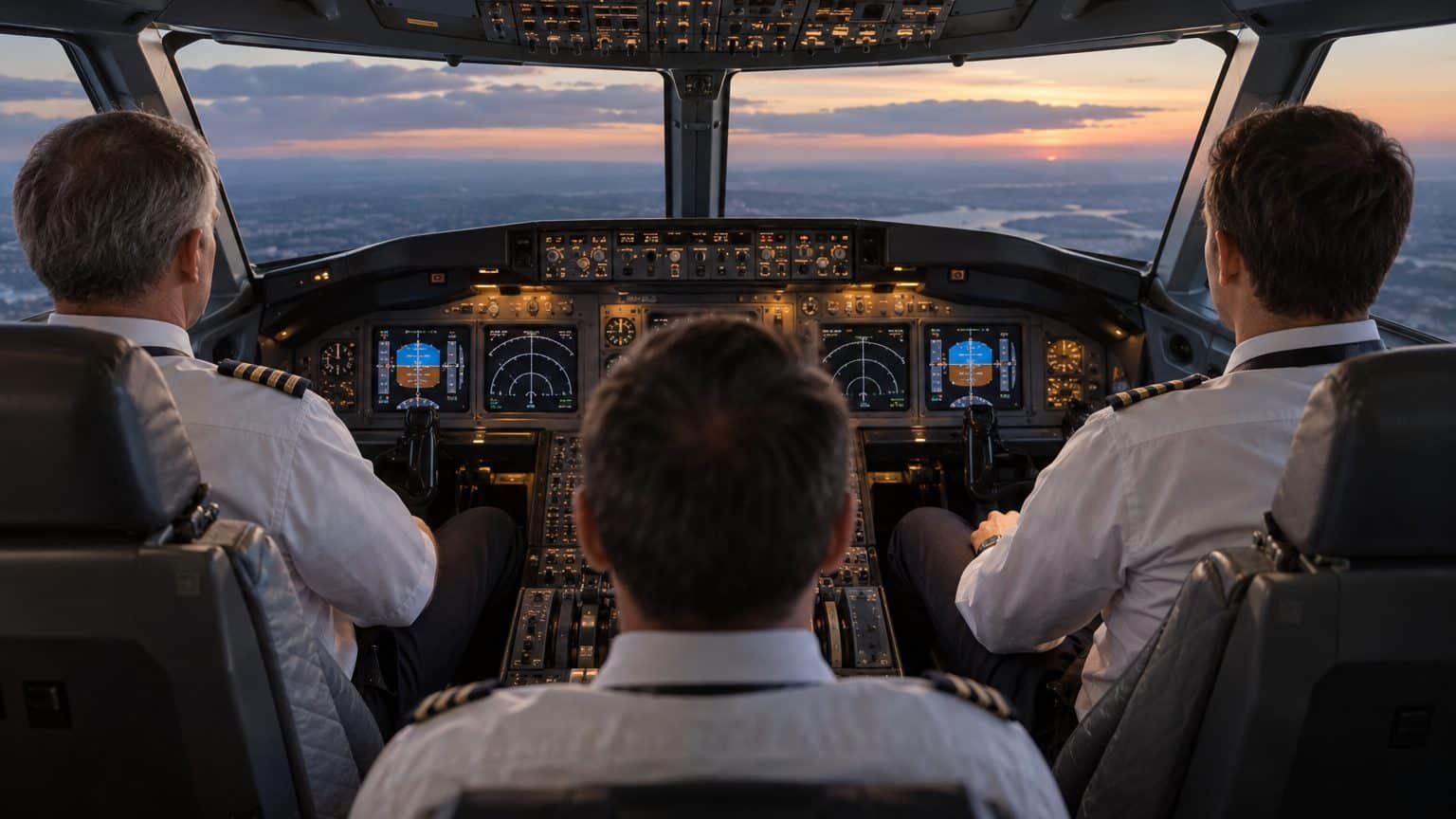
- A surface-to-air missile struck the left wing of an A300 cargo at roughly 2,440 meters altitude.
- The strike destroyed all three hydraulic circuits, leaving the flight controls inoperative.
- The crew returned the aircraft to Baghdad by flying solely with the two remaining engines, with no injuries.
A missile at 2,440 meters altitude
On November 22, 2003, an Airbus A300B4-203F freighter, registered OO-DLL, taxied out from Baghdad airport. During the initial climb, around 8,000 feet (about 2,440 meters), a surface-to-air missile struck its left wing. The aircraft lost all three hydraulic circuits, leaving the three crew members with only two engines to control the airplane.
Three circuits out of three, wiped out in a single strike.
For a commercial airliner, redundancy is designed precisely to prevent such a scenario. Flight controls (ailerons, rudders, flaps) are actuated by hydraulic pressure, and the circuits are duplicated so that a failure in one does not disable the others. In this instance, the missile annihilated the hydraulic system entirely. The control column and the rudder pedals remained in the pilots’ hands, but they commanded nothing.
Disagreement persists about the exact point of impact. Some accounts point to the wingtip, others to the rear portion of the wing, and some even to the left main fuel tank and the outer fire. The missile is most often identified as an SA-14, a Soviet-designed portable weapon. One account even mentions a second shot that reportedly missed its target, while other reports cite only a single missile, at minimum.
Piloting by thrust: thrust as the only control
What remains for an aircrew when the airplane stops responding to the controls? Two thrust levers, one for each engine. The concept is simple on paper: tilt more power to one engine to induce a yaw, and adjust the overall thrust to affect the airplane’s attitude.
In practice, it is a high-wire act. The airplane responds with a delay, it wobbles, and each correction is paid for with a delay of several seconds. For a captain who is used to steering with aerodynamic surfaces, learning to govern an A300 on the basis of engine thrust—under the stress of an emergency and with a damaged wing—amounts to precise improvisation at the limit.
The most famous precedent dates back to 1989. That year, the crew of a United Airlines DC-10 attempted the same maneuver over Iowa after an engine failure that severed the hydraulics. The airplane broke apart during landing at Sioux City. That episode underscores how precarious the method is: even when executed flawlessly, it does not guarantee success.
In Baghdad, the outcome was different. The crew managed to bring the airplane back to the airport from which it had departed.
An off-runway landing, but without injuries
The A300 touched down in Baghdad, but could not remain on the paved surface. It departed the runway and came to rest on a sandy shoulder. All three crew members escaped unharmed. The event is described as the first landing without an accident by a large commercial aircraft after a complete hydraulic loss.
This phrasing requires careful reading. “Without an accident” does not mean “without damage”: the airplane left the runway, and the wing sustained serious damage. But aboard, no one was injured, and that is what distinguishes this flight from the 1989 incident.
There is also a nuance in sourcing. One account notes that no authority publicly confirmed the landing. Other reports treat it as an established fact, with very detailed particulars and even recognition awarded to the crew. The basic elements (strike, hydraulic loss, Baghdad landing, crew unharmed) are consistent across versions. The finer details, however, remain to be treated with caution.
We must also consider the human dimension. The span from impact to return to the ground occurred without the usual automatisms of flight. Without hydraulics and without normal controls, with engines needing constant attention, every decision directly affected what followed. None of the three aboard could rely on anything other than their own judgment.
What becomes of an airplane that survived that?
One might imagine a career cut short. That was not the case here: the A300 was repaired and then sold in 2005. It remained at Baghdad airport until its airworthiness certificate was withdrawn in 2017. It was then scrapped.
Between the impact and the scrap, fourteen years elapsed, including twelve years since its sale. A missile-damaged aircraft that was returned to service and ended its life at the same airport where it had made its emergency landing: OO-DLL’s journey is succinct in outline, yet it reminds us that this event did not spell the end of the aircraft, only the end of its first life.
This flight remains a benchmark for aviation safety. A total hydraulic loss on a large transport—a failure designers strive to render nearly impossible—was overcome solely by thrust-based flight control. To this day, the November 22, 2003 episode remains one of the rare, well-documented cases in which such a failure concluded without casualties.
👉 A small gesture for Space Group? Follow us on Google, add us to your favorites, and find us on Google News so you never miss a discovery.
Sources: 1001crash.com | samchui.com
