
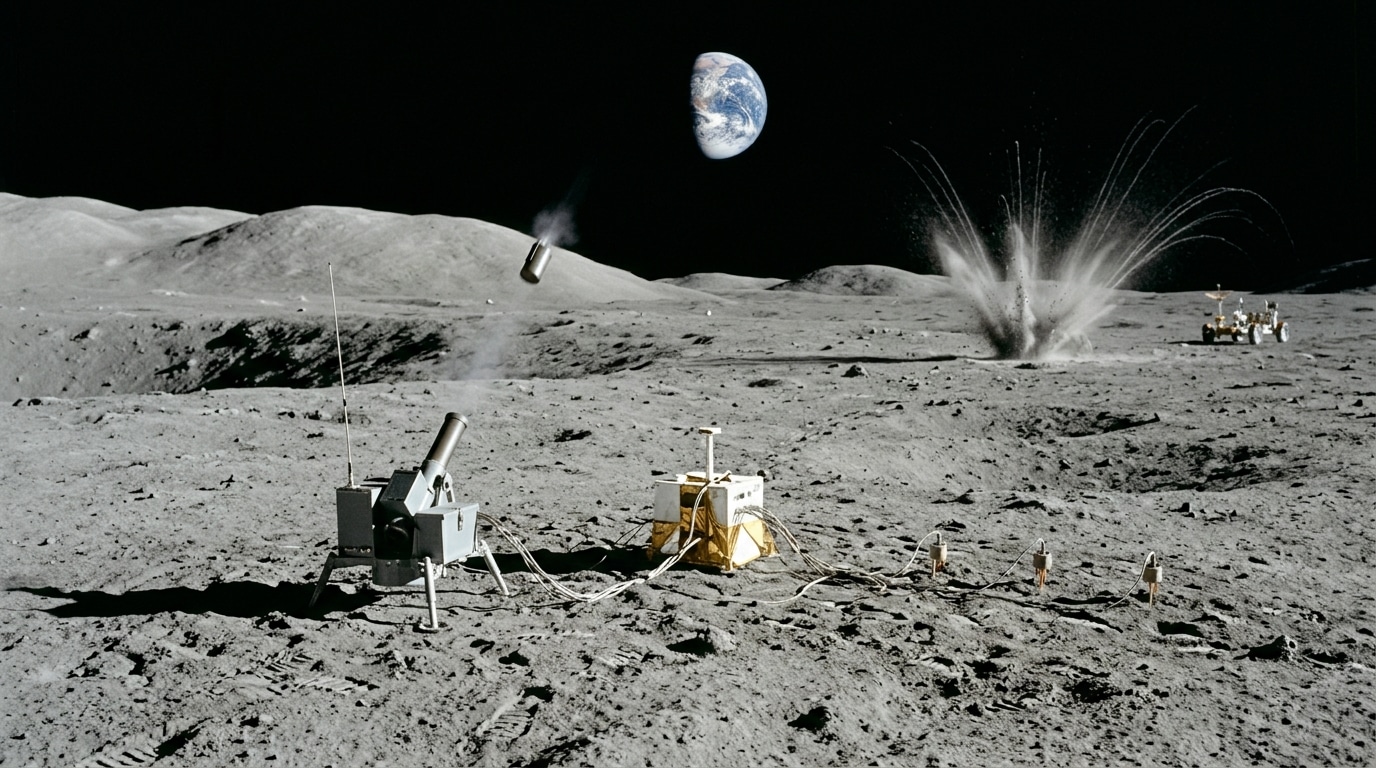
On the Descartes site, where Apollo 16 astronauts set foot, a peculiar device still awaits its orders. A mortar capable of firing explosive grenades up to 1,500 meters, controlled from Earth long after the crew’s departure. Its story blends ingenuity, technical contingencies, and lunar seismology.
- Among the four planned grenades (at 150, 300, 900 and 1,500 m), only three were fired successfully from Earth, the farthest shot failing due to a pitch-angle sensor that went off-scale.
- This active seismic experiment (S-033), led by Robert Kovach of Stanford, aimed to probe the structure of the lunar regolith using an 11.2 kg mortar paired with 21 explosive initiators.
- Unlike Apollo 14, whose shot could never be triggered, NASA’s lunar seismology is expected to resume with the Farside Seismic Suite, anticipated between 2026 and 2027 according to sources.
- A mortar forgotten on the Moon for more than 50 years
- Four firings planned to probe the depths of the regolith
- A silent detonation triggered after the astronauts departed
A mortar forgotten on the Moon for more than 50 years
When one thinks of the equipment left by the Apollo missions on the Moon, rovers, flags, or seismometers naturally come to mind. One hardly imagines a grenade launcher. Yet this is precisely the kind of instrument Apollo 16 deployed at Descartes, a mountainous region chosen for its distinctive geological features.
This mortar was part of the active seismic experiment, designated S-033 in NASA nomenclature. Its role was far from anecdotal: it aimed to trigger small, controlled explosions to study the deep structure of the lunar soil, in a manner akin to tapping a piece to guess its contents.
The assembly, coupled with a device called the thumper and equipped with 21 explosive initiators, weighed 11.2 kilograms and drew 9.75 watts. Modest numbers, nearly trifling in the face of the project’s ambition, scientifically overseen by Robert Kovach of Stanford University.
Four firings planned to probe the depths of the regolith
The principle behind NASA’s active seismic experiment rested on a precise mechanical plan. Four grenades were to be launched at defined distances from the seismometer—150, 300, 900, and 1,500 meters—to measure how seismic waves traveled through the regolith, that fine mantle of dust and rocky debris covering the lunar surface.
Each grenade carried a different mass according to the intended range. The lightest, 695 grams, was for the nearest shot, while the heaviest, 1,261 grams, was meant to reach the farthest distance of 1,500 meters. A straightforward yet effective logic, designed to yield a deep image of what lay beneath the surface.
The mortar had been properly leveled and armed to fire on command. But the Moon, quiet and seemingly motionless, can still yield technical surprises, and this device would learn that lesson quickly.
A silent detonation triggered after the astronauts departed
The firings took place after the crew had left, entirely commanded from Earth. ALSEP, the network of scientific instruments left behind, had been switched to high-data mode for the occasion, from 05:20 to 06:44 GMT. Not a single human stood on the lunar surface to witness these remotely triggered explosions.
Three grenades were fired successfully, in this order: the 900-meter one, then the 150-meter, and finally the 300-meter. The largest, intended for the 1,500-meter range cited in some popular accounts, never left the mortar. The pitch-angle sensor went off-scale, making that shot impossible.
Even so, the most powerful shot produced a measurable effect: it tilted the passive seismic experiment’s sensor by 3 arcseconds toward the south, a tiny but revealing shift of the force unleashed. The two smaller shots left no detectable trace.
The deployment was not flawless from the outset. Of the four stakes meant to secure the mortar, only one could be driven properly, its pin bent and jammed. A technical detail reminding us that even the best-prepared missions must contend with the unforeseen.
By comparison, Apollo 14 did not enjoy such an opportunity. A firing attempt had been considered late in the ALSEP’s life, but uplinks were lost and the arming capacitors did not recharge after a long stay on the surface. The central command capacity was finally lost in March 1975.
Since then, NASA’s lunar seismology has slept. But it may soon awaken with the Farside Seismic Suite, delivered through the CLPS initiative into Schrödinger Basin. It is slated to provide the agency’s first lunar seismic data since Apollo, nearly 50 years later, though timelines vary by source—from June 2026 for CNES to 2027 for JPL.
Meanwhile, Apollo 16’s mortar remains in its motionless slumber at the Descartes site. Three grenades fired, one more silent, and a small chapter of space history that testifies to both the ingenuity of ground teams and the real limits of 1970s technology.
👉 A small gesture for Space Group? Follow us on Google, add us to your bookmarks and find us on Google News so you don’t miss any discoveries.
