
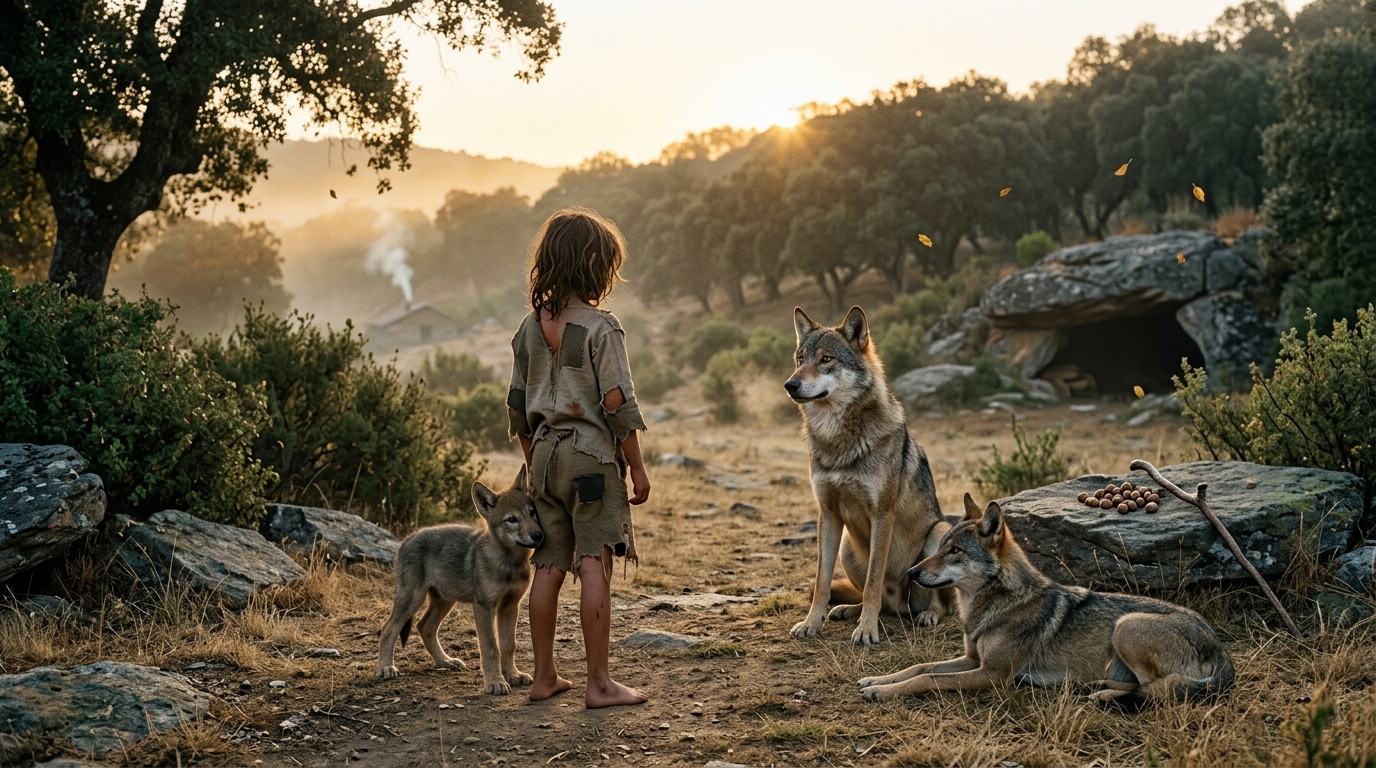
We often think that children raised by wild animals belong to folklore, not to reality. Yet Marcos Rodríguez Pantoja, abandoned at seven in the Sierra Morena, did indeed survive twelve years among the wolves before being found by the Civil Guard. Today, it is his packmates who have disappeared.
- Marcos Rodríguez Pantoja survived twelve years among wolves in the Sierra Morena before being found by the Civil Guard in 1965
- His story inspired a doctoral thesis and the book “He jugado con lobos” by Gabriel Janer Manila
- The 2021–2024 national census confirms the extinction of the wolf in Sierra Morena, a disappearance researchers place around 2017
- Abandoned at seven, found twelve years later by the Civil Guard
- A wild childhood that shaped his relationship with the world
- The man survived, but his pack companions disappeared from the Sierra Morena
Abandoned at seven, found twelve years later by the Civil Guard
The story begins in the province of Córdoba, where Marcos Rodríguez Pantoja grows up in a poor family. His father entrusts him, or sells him depending on the version, to a landowner in the region. This transfer, of a brutality that today seems hard to imagine, would upend his entire trajectory.
The boy then ends up with a solitary goatherd, settled in a cave in the heart of the Sierra Morena, this mountain range in southern Spain. It is in this harsh environment, far from any traditional family structure, that Marcos would spend most of his childhood and adolescence.
It would take until 1965 for the Civil Guard to finally locate him, as he approached his twenties. More than a decade without stable human contact: that is what his journey reveals, a case sufficiently rare to attract the attention of humanities researchers.
A Wild Childhood that Shaped His Relationship with the World
Marcos’s case did not stop at his discovery by authorities. It became the subject of a doctoral thesis by Gabriel Janer Manila, who examined what it means to grow up on the margins of any organized human society.
These works later gave birth to a book, “He jugado con lobos,” which recounts a childhood spent in contact with the elements and animals rather than with adults. A title that encapsulates the uniqueness of this existence.
This type of journey particularly interests specialists in human development. It raises questions about how language, social cues, and the perception of the world are formed, or are not formed, when early human interactions are missing for such a long period.
The Man Survived, but His Pack Companions Disappeared from the Sierra Morena
Sixty years after the Civil Guard brought Marcos back to civilization, a return to the place of his childhood yields a stark finding. The national wolf census, conducted by the autonomous communities and the Ministry for Ecological Transition, counts 333 packs across the country for 2021–2024. None were detected in Sierra Morena.
This figure contrasts strongly with the previous census, which counted 297 packs nationwide between 2012 and 2014. According to an analysis for WWF by Juan Carlos Blanco and José Vicente López-Bao, it was precisely that earlier census that had already certified the wolf’s disappearance from this massif.
A study published in the journal Biological Conservation, co-authored by José María Gil-Sánchez and Luis Llaneza, details the decline of what was Europe’s southernmost wolf population. The extinction was officially confirmed in 2024, although researchers place the actual occurrence around 2017, seven years earlier.
The decline followed an unyielding trajectory. In the mid-1990s there were two to four packs, then only one pack into the mid-2000s. Thereafter only a few solitary individuals remained, who eventually disappeared in the mid-2010s. A wolf found dead after a car collision in 2003 already illustrated the scale of the problem: about one-third of its genome came from domestic dogs, indicating extreme inbreeding in a population that was too isolated and too small to sustain itself.
More recently, an amendment by the Popular Party to a food-waste law removed the wolf from the list of wild species under special protection north of the Duero River, making its hunting again possible in those territories. In Cantabria, 43 wolves have already been killed in the latest hunting season, a regional quota now exhausted. The Sierra Morena situation is thus not an isolated case, but a symptom of pressure on the species that extends well beyond southern Spain.
There is something striking about this double fate. The abandoned child, raised among wolves, has endured through the decades to today. The wolves that took him in did not survive human pressure on their territory. What remains is a story that continues to question our relationship with the great predators, between fascination and conflict, and it reminds us how fragile the balance between humans and wildlife remains.
👉 A small gesture for Space Group? Follow us on Google, add us to your bookmarks, and find us on Google News so you won’t miss any discoveries.
