
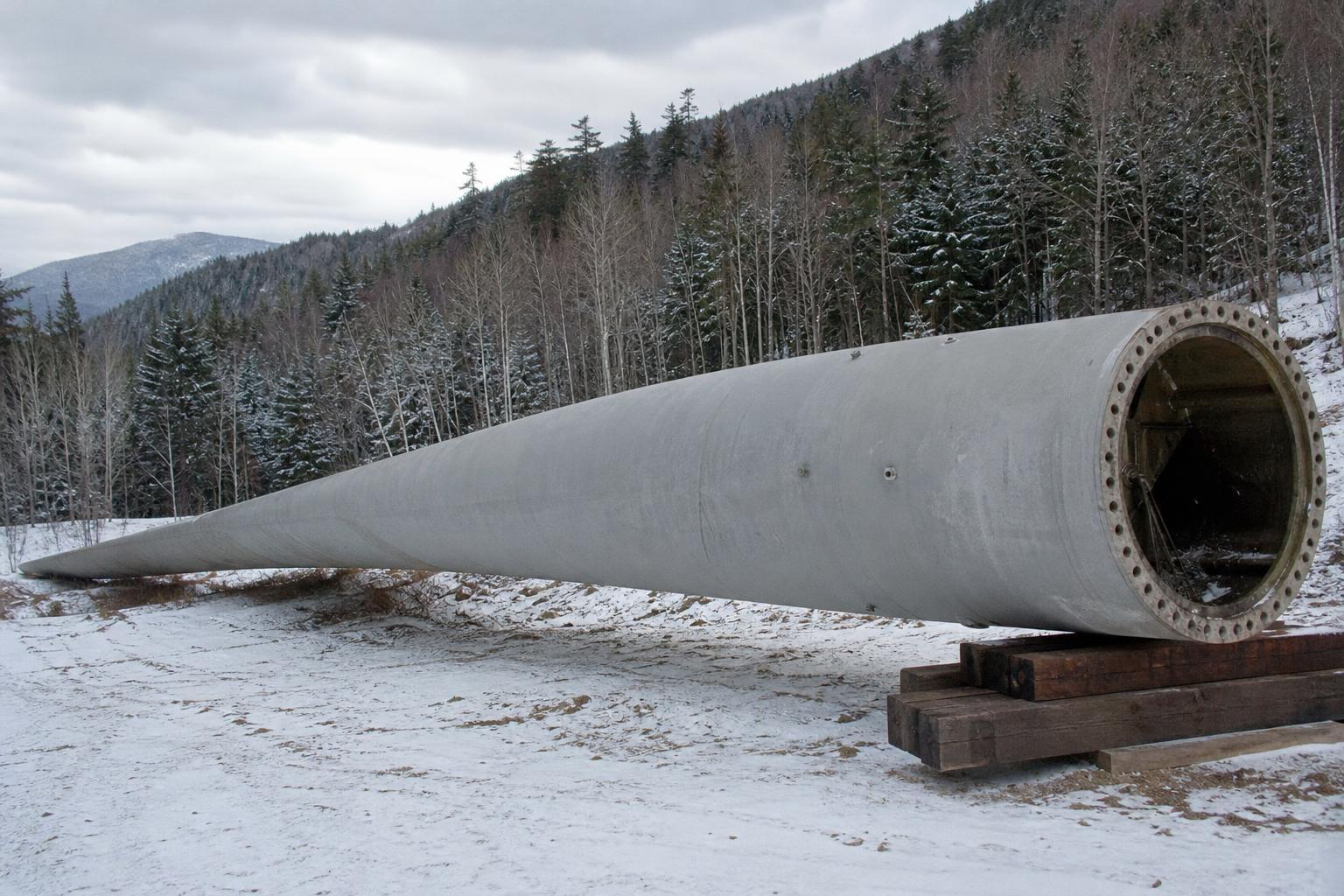
On a blustery New England ridge, a radical machine dared to turn air into electricity. It was a bold, industrial sculpture at altitude, a bet that the future could be spun from wind when coal and oil still felt inevitable. For a brief, roaring moment, the grid hummed with power from a pair of colossal blades unlike anything the world had yet seen.
Grandpa’s Knob, Big Ideas
The site was a rocky summit west of Rutland, an exposed shoulder locals called Grandpa’s Knob. Engineers hauled steel and ambition up narrow roads, then bolted together a tower and nacelle sized not for a farm, but for a utility. The machine connected to a real grid, not just a lab bench, a public promise that wind could do serious work.
Scale Before Its Time
Nothing about this build was timid. Its rotor spanned roughly 175 feet, sweeping a circle big enough to shade a house. At 1.25 megawatts, it challenged the era’s assumptions that only fossil turbines and hydro dams deserved to feed a city. “Build it big enough to matter, or don’t build it at all,” went the unspoken creed behind the project.
Switch On, History Made
In 1941, the machine synchronized to the Vermont grid and began exporting power. The arc of the blades beat like a slow metronome, rolling alternating current into a hungry wartime economy. For about eleven hundred hours, it proved what many had only theorized: the wind could be engineered into reliability.
Beauty, Brute Force, and Physics
The design leaned on two enormous blades, not three, to cut mass and complexity. Aerodynamically, they were elegant, but the structure had to survive gusts, turbulence, and the relentless drumbeat of cyclic loads. The mountain gave abundant energy, and it also gave punishment that tested every bolt and bearing.
When Metal Let Go
Then came the day the mountain bit back. Under hard winds and hidden fatigue, a single blade snapped loose, an eight-ton missile arcing across the valley and landing roughly 230 meters away. “Failure is information,” engineers like to say; here the lesson was written in twisted steel.
Why It Failed, Why It Mattered
Blades don’t quit for one reason. Think stress concentrations at root joints, microcracks marching under variable loads, winter-cold embrittlement, and maintenance windows narrowed by war. The result was a dramatic break, no injuries, and a budgetary cliff. Materials science lagged the vision, and the machine’s duty cycle outpaced the era’s confidence.
The Thirty-Year Quiet
After the blade ejection, repairs proved too costly and too complicated. Funding evaporated as oil stayed cheap, grids grew comfortable, and engineers turned to turbines that burned rather than breathed. For three long decades, the Vermont experiment became a footnote, a cautionary tale that “big wind” was a bridge too far.
What It Got Right
Yet the blueprint it sketched was startlingly modern. It connected to the grid, proving utility-scale wind wasn’t fantasy. It embraced scale, because small turbines struggle with the physics of power. And it generated priceless data, the gritty kind that only full-scale hardware can reveal.
- Grid-first thinking, real markets
- Utility-scale rotor, meaningful capacity
- Field data on fatigue, loads, and maintenance
What It Got Wrong
The materials couldn’t carry the dream. Steel blades were heavy, fatigue-prone, and unforgiving. Control strategies were nascent, and damping of two-bladed rotors posed wicked problems. Redundancy and condition monitoring were limited, so tiny cracks became loud events.
The Echo in Today’s Turbines
Modern machines answer those old questions with composites, advanced controls, and three-bladed rotors that share loads more gracefully. Supervisory systems sniff out fatigue before it bites, while pitch and yaw algorithms tame gusts that once rattled hardware to pieces. The lineage is visible on every horizon where white rotors carve deliberate circles.
A Frontier Spirit, Revisited
There is still something audacious in lifting a hundred-meter sweep into weather and telling it to behave like a plant. The Vermont crew did that with slide rules, rivets, and nerve. Their success was partial, their failure spectacular, and their influence quiet but lasting, a thread running from Grandpa’s Knob to offshore arrays that power whole regions.
What the Blade Taught
Engineering advances one broken part at a time. The thrown blade forced better metallurgy, lighter structures, and a culture that treats loads as stories, not just numbers. “Test, learn, scale” sounds modern, but the cadence is old, hammered into place by pioneers who gambled on the wind.
The Long View
Stand on a ridge and watch a modern farm turn, and you can almost hear the older machine thrum beneath the blade tips. The gap between then and now is materials, models, and craft, but the impulse is the same: steal useful order from chaos and feed it to the grid. On that Vermont height, the future blinked on, flickered, and waited for the rest of us to catch up.
