
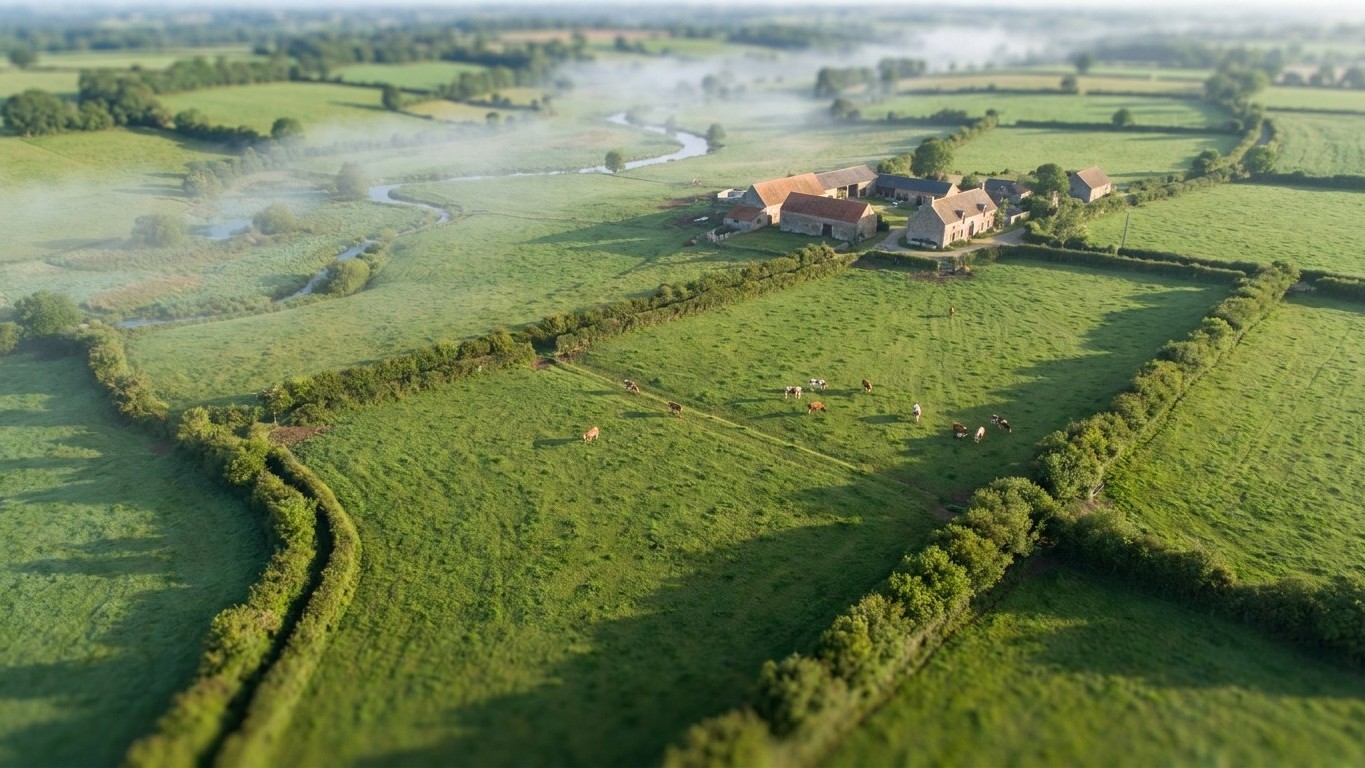
No one will ever pursue the slightest lead there. Eight years after the official abandonment of the airport project, the 1,650 hectares of Notre-Dame-des-Landes, in Loire-Atlantique, have returned to fields, damp meadows, and hedgerowed zones. Where planes were to land, today you encounter cows, beehives, and a few dozen farming operations, situated between long-established peasants and former occupants of the ZAD.
À retenir
- How a60-year-old infrastructure project frozen in place paradoxically preserved a unique ecosystem
- Why the French state must pay billions for having abandoned this airport
- What subtle balance is being negotiated today among three farming worlds on the same land
A project born in the 1960s, frozen for half a century
The story begins well before the Zadists and television cameras. This plan was conceived in the 1960s and revived in the 1990s. Between the initial sketches and its final abandonment, roughly six decades passed—a notably long span for an infrastructure project in France. The declaration of public utility dates back to 2008: it was from this administrative document that the 1,650-hectare area was officially frozen, prohibiting any construction or free sale within the affected boundary.
The chosen land, located roughly twenty kilometers north of Nantes, was no accident. Some 98% of the former Notre-Dame-des-Landes ZAD area comprises wetlands and shelters 146 protected species. A paradox frequently highlighted locally: precisely because the airport project shielded this territory for decades—preventing urbanization and intensive farming—it helped preserve an unusually intact bocage.
On the ground, the administrative machinery was matched by a social clash that became emblematic. A vast agricultural tract of 1,650 hectares became nationally famous in the early 2010s and withstood several coordinated attempts by the state to evacuate it. Expropriated families refused to leave, joined by activists from across France. The site saw the birth of a collective bakery, a brewery, livestock farms, and even, it is said, a pirate radio station set up in the trees.
Nothing built, except barricades
In strictly real estate terms, the record is simple: no runway, no terminal, no hangar ever materialized. The construction site never got underway. What occupied the land for years were expropriations, technical studies, and police operations. Nine million euros were invested by Vinci, a sum modest next to the original 730 million euros budgeted for the infrastructure. In concrete terms, this money funded studies, field surveys, and legal costs—no concrete beam ever followed.
The most visible feature of the site would long be the protest rather than any construction site. The occupied hamlet included a bar, a collective kitchen, forge workshops, dormitories, a first-aid post, a bathroom with a jacuzzi, and it was guarded by 40 tractors linked together. A rural utopia filmed for the world, until the evacuation operation in April 2018, which mobilized thousands of police officers.
The bill of abandonment: hundreds of millions, then a rejection
Is abandoning an airport cost-free? The opposite happened. Beginning in 2018, the state had to negotiate compensation with Vinci, the concessionaire anticipated through its subsidiary Aéroports du Grand Ouest. The compensation for the detriment could range from 305 to 425 million euros for Vinci, but the Conseil d’État advised taking into account the relatively small investments already made to temper the amount. In other words, the claimed sum seemed disproportionate to the money actually spent on the ground.
The matter resurfaced more forcefully. In 2024, Vinci demanded more than 1.6 billion euros from the French state for an airport that never materialized, and on 10 April 2024, the Nantes Administrative Court ruled: this record compensation claim was rejected. The judges stated forthrightly that the state did not err in abandoning the project for purposes of public interest.”
Yet the judicial saga is far from over. The court did leave a door open: the concession company can only claim a termination indemnity and compensation for lost profits, both of which will be set later. Vinci has indicated that the Administrative Court only rejected ancillary claims at this stage, and the dispute over damages will continue until a ruling on the merits, now anticipated in 2026 or 2027. Eight years after the abandonment, the final reckoning has yet to be determined.
The lands, they found a buyer
While lawyers squabble over millions, the farmers had to deal with the real land itself. The restitution of the 1,650 hectares did not happen overnight. The land originally belonged to the state, which had bought it to build the airport, before being transferred back to the Loire-Atlantique department, which owned most of the zone (895 hectares) until 2012.
Initial regularizations took time, between expropriated traditional farmers seeking to reclaim their plots and former Zadists wanting to secure their alternative projects. A year and a half after the airport project’s abandonment, 24 rural leases had been signed, and the Loire-Atlantique department had reached a compromise on the territory’s agricultural plan, with particular attention paid to preserving the bocage.
A few years later, the situation stabilized without fully stabilizing. Since 2019, all the commune’s agricultural lands have fallen within the perimeter for protecting agricultural and natural spaces, and over 80% of the ex-ZAD lands are now covered by rural leases, with about 40% awarded to former Zadists. That division remains sensitive, as every parcel allocation locally continues to echo a political choice between two visions of farming.
Sources: terre-net.fr | assemblee-nationale.fr | franceinfo.fr
