
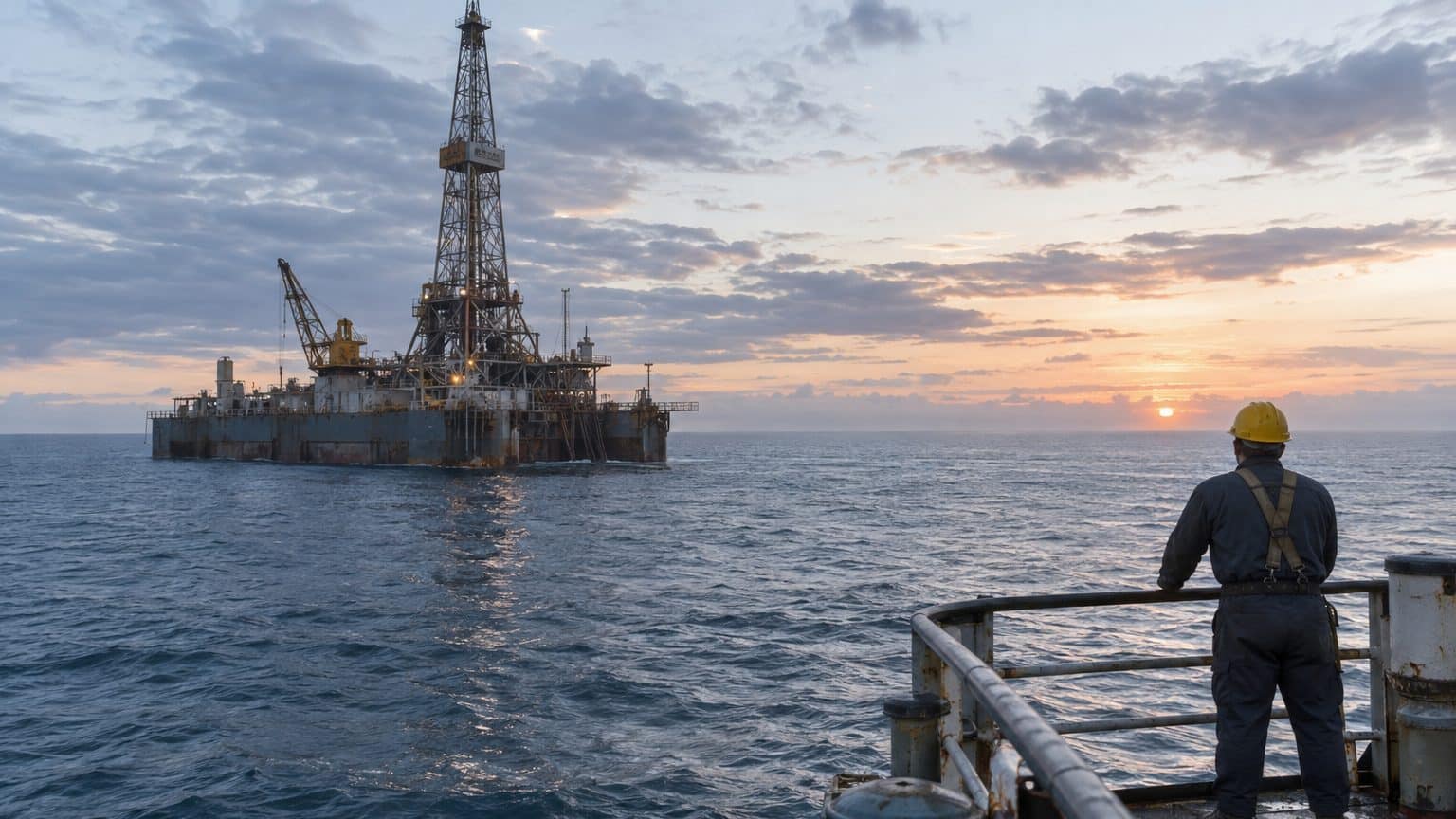
Neither basalt nor depth stopped the American push toward the Earth’s mantle. It was an expense spiraling out of control and researchers at odds about the goal to be reached. Mohole, in 1961, accomplished what no one had attempted before: drilling through the oceanic crust beneath 3,570 m of water. Then it collapsed in the corridors of Congress.
- The CUSS I drill bit touched the Pacific seafloor on March 28, 1961, at a depth of about 3,570 m.
- The barge stayed in position thanks to four engines controlled by a single lever, with no anchor used.
- Cost estimates jumped from a few million dollars to well over $100 million.
- Congress rejected funding in 1966 after roughly $57 million had been spent.
A Bet Launched with $15,000
In 1957, a group of American researchers proposed boring into the Earth’s crust all the way to the Mohorovičić discontinuity, the boundary between crust and mantle. They targeted the ocean rather than continents, because the sea crust is far thinner and the trek to the mantle shorter. The idea carried the aroma of a space race, but inverted: you go down, not up.
The U.S. federal science agency took an interest in the project. It granted an initial $15,000, roughly half of what was requested, to fund the study.
Four years later, the barge set sail.
The vessel was named CUSS I, an old Navy barge converted for drilling. In March–April 1961, it began trials off San Diego at about 950 m depth. It then moved to the environs of Guadalupe Island, off Baja California, Mexico. The drill bit reached the bottom on March 28, 1961, at a depth of about 3,570 m (11,700 feet), more than ten times the height of the Eiffel Tower.
Five Holes and a Single Handle
The team drilled five holes in total. The deepest reached 183 m (601 ft) below the seafloor and penetrated a few meters into basalt. A key core sample was retrieved on April 2, 1961.
The most dramatic moment, however, occurred on the surface. The barge stayed above the hole without a single anchor, thanks to four large engines controlled by a single lever. At 3,570 m of water, any anchor would have been unable to hold its role anyway.
This marked the beginning of dynamic positioning, which would become commonplace at sea. This first phase cost about $1.5 million, i.e., a hundred times the initial grant. The Moho, however, was not reached: the 1961 phase aimed to prove that the method worked, not to touch the mantle. On this point, the technical verdict was unambiguous.
February 1962: the project changed hands.
When the Bill Soars
To steer the second stage, a Houston-based civil engineering company was chosen. It had never drilled before. The choice startled, in a project where every meter of casing had to be bought against the ocean’s terms.
Cost estimates then climbed from a few million dollars to more than $100 million. Such a gap cannot be explained by a simple adjustment: it reflected the scale of what still had to be invented to move from an 183 m hole to a full traverse of the crust.
The researchers, for their part, no longer agreed on priorities. Some called for shallower holes in sediments, more accessible and quicker to exploit, rather than the grand leap toward the mantle. The project thus advanced with a growing budget and a scientific community divided about the objective. In 1966, both the House and the Senate refused funding. Financing was cut in September 1966, after about $57 million had been spent, with no ship built and no deep hole drilled.
About $57 million: nearly 38 times the cost of the 1961 phase.
What Mohole Left Behind
The financial failure did not erase the gains. A program of deep-sediment drilling began as early as June 1966, even as the final vote was being decided. It picked up the approach some scientists had advocated: shallower holes, but more of them.
The methods tried in 1961 gave birth to scientific ocean drilling. This later helped confirm plate tectonics, the theory describing the Earth’s crust as a set of moving plates. Many modern oil platforms and drilling vessels rely today on the dynamic positioning tested by CUSS I.
The terrestrial side of the story remained. The Kola borehole, however, would not be launched until 1970, four years after Mohole’s credits were cut, with Mohole serving as its marine predecessor.
The rock did not refuse. It was votes, estimates, and divergent priorities that halted the drilling, with a drilling ship that never left the drawing board.
Source: earthmagazine.org
