
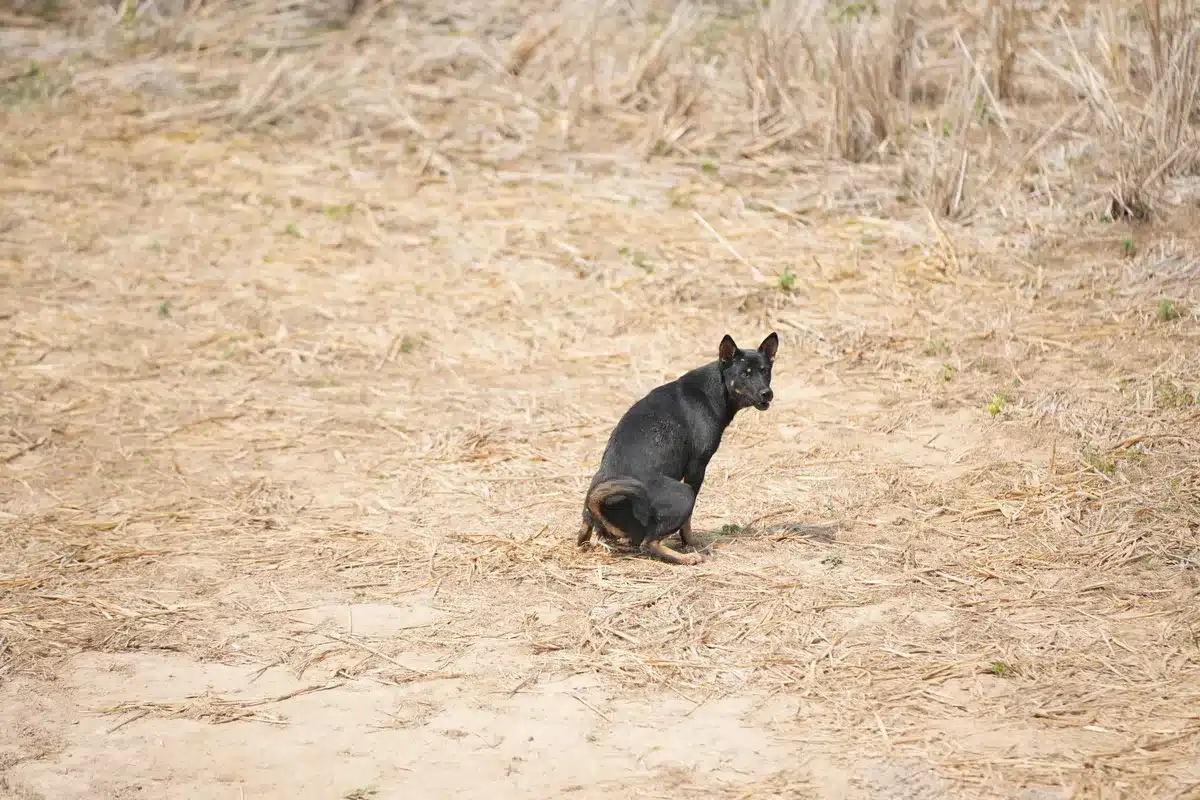
Your dog does not choose the spot where it defecates at random. A study from the Czech University of Life Sciences Prague, conducted on 70 dogs across 37 different breeds over two years, reveals that it systematically aligns its body with the Earth’s magnetic field north-south axis when defecating—and that it abandons this alignment as soon as a solar storm disturbs the field.
What you will learn
- How the researchers isolated the magnetic field from all other factors that could influence the dog’s position
- Why solar storms disrupt dogs’ behavior during their outings
- Which scientific hypothesis links this behavior to navigation and spatial orientation
1,893 defecations analyzed for an unexpected discovery
The study does not lack methodological ambition. For two years, researchers in Prague tracked 70 dogs from 37 different breeds, meticulously recording the body orientation of each animal during 1,893 defecations and 5,582 urinations.
To ensure that their results were not due to random chance, the team systematically controlled for confounding variables: the owner’s behavior, the sun’s position, weather conditions. What remained after all of these were excluded was a clear and reproducible signal.
The dogs align themselves to the Earth’s north-south axis when they crouch, and actively avoid a east-west orientation. No notable exception by breed or size.
When the sun muddles the dog’s internal compass
The most compelling evidence of this magnetic sensitivity comes from an ancillary, yet decisive observation. During periods of natural magnetic disturbances — solar storms that temporarily distort the Earth’s magnetic field — the dogs abandon their usual alignment.
This detail is crucial. It demonstrates that the observed behavior is not a statistical coincidence nor a fixed behavioral habit. It is an active response to a real-time physical signal, precise enough to detect fluctuations that unassisted human instruments would be unable to perceive.
An internal compass, but what is it for?
The most intriguing question remains without a definitive answer: why does this behavior manifest precisely during bathroom breaks?
The researchers’ hypothesis is as elegant as it is speculative. If the dog uses a mental magnetic map to orient itself in space — as proposed for rodents — it would need to calibrate it regularly against a fixed reference. Aligning to north during a moment of forced stillness would be an efficient way to recalibrate this internal map.
The authors compare this mechanism to a hiker who stops to consult his compass before setting off again. A pause that may seem small, but which directs the rest of the journey.
Hunting dogs confirm the trail
This hypothesis is not isolated. A study conducted in 2020 by the same institution, this time focusing on hunting dogs, provided an early validation. The animals consistently oriented themselves along a north-south axis before beginning their journey back to their starting point.
Once this calibration was performed, they were able to take novel shortcuts to return home — suggesting a genuine magnetic mental-map navigation ability, rather than a simple retracing of the route already traveled.
If one crosses the two studies, this calibration presumably occurred after a pause on the ground.
Researchers call for additional studies to refine understanding of this mechanism. In the meantime, your dog pacing around before crouching may not be being capricious. It might be reading its map.
