
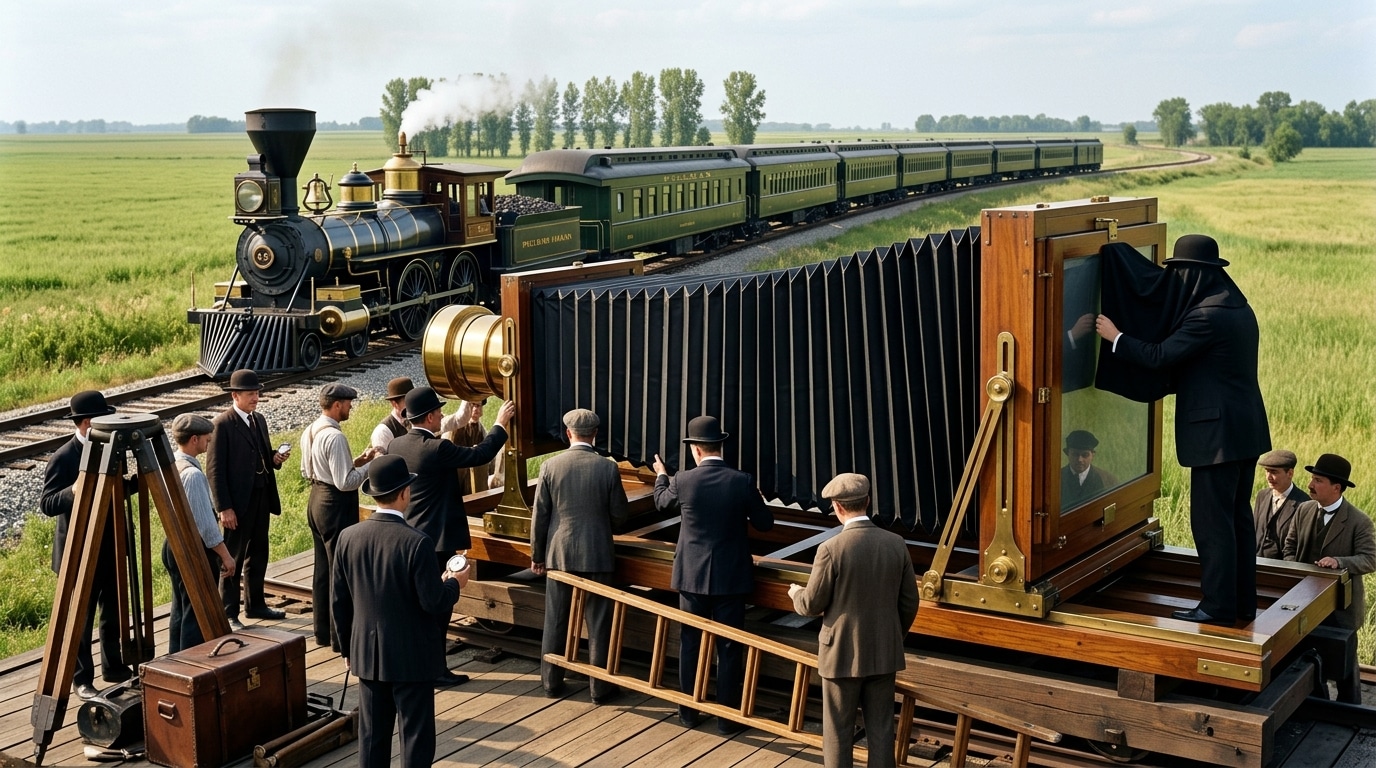
Imagine a camera as heavy as a small car, a device that required fifteen men to hoist it into a horse-drawn van. In 1900, in Chicago, this 635‑kilogram machine had one purpose: to photograph a luxury train in a single shot on a gigantic glass plate.
- In 1900, George R. Lawrence designed the Mammoth Camera, a 635‑kg marvel, to photograph a Chicago & Alton Railway train in a single shot on a glass plate measuring 2.4 m by 1.4 m.
- Initially suspected of trickery in Paris, the image was eventually authenticated and won the Grand Prize of the World at the 1900 World’s Fair.
- Since 2006, the record for the largest camera in the world has been held by a California military hangar transformed into a giant pinhole, measuring nearly 49 meters in length.
- 635 kilos to capture a train: George R. Lawrence’s technical madness
- Giant glass plates and an extraordinary logistical challenge
- The photograph that changed the view of monumental photography
635 kilograms to capture a train: George R. Lawrence’s technical madness
On the eve of the twentieth century, the Chicago & Alton Railway dreamed of a prestige image for its flagship train. Not a banal photo, but a shot capable of showing the entire convoy, locomotive and cars included, in a single print. To meet this challenge, the railway company turned to George R. Lawrence, a Chicago-based photographer and inventor, already known for his taste for the spectacular.
Lawrence did not seek to stitch together multiple pictures or to assemble a montage. He commissioned a tailor-made camera—the largest ever designed at the time. The manufacture was entrusted to J. A. Anderson, also based in Chicago, which brought this machine to life, today nicknamed the Mammoth Camera.
The result bordered on an engineering feat. The device weighed 900 pounds, or about 408 kilograms, to which a plate-holding chassis weighing 500 pounds was added once loaded. All told, the system reached 1,400 pounds, or 635 kilograms, of wood, metal and pure mechanics, resting on a bench capable of extending to nearly 20 feet (about six meters), thanks to a system of double tilting fore and aft.
Giant glass plates and an extraordinary logistical challenge
Such a device would have been useless without a support to match it. Lawrence had plates of glass made, measuring 8 feet by 4.5 feet, or 2.4 meters by 1.4 meters. To give an idea, roughly the size of a garage door, but made of fragile glass designed to capture light for extended exposure times.
Moving such a contraption was no small feat. Fifteen men were required just to load the device into its horse-drawn van. The machine was then transferred to a flatcar to Brighton Park, about six miles from Chicago, before being carried by hand for another quarter of a mile to the field chosen for the shot.
On the day of the photograph, precision had to be surgical. An assistant removed the curtain shielding the plate at the back of the device. Lawrence then removed the lens cap and allowed light to enter for two and a half minutes before resealing it. An exposure time that seems interminable today, but at the time was the only way to expose such a vast photosensitive surface.
The cost of the operation speaks to the project’s ambition. The Chicago & Alton Railway reportedly spent $5,000 at the time for this single plate — an amount sufficient to buy a comfortable house. A colossal investment for a single photograph, but one that would quickly justify itself.
The photograph that changed the gaze on monumental photography
Once the image was obtained, three contact prints were sent to Paris, where the 1900 Exposition Universelle was held. But the reception initially remained chilly. No one in the French capital had heard of a device capable of producing a plate nearly three times larger than the largest ones known up to then.
The skepticism was so intense that even the attestations signed by Lawrence and the leaders of the Chicago & Alton Railway were questioned. A montage, a clever assembly of several photographs, was imagined. The idea that a single glass plate could immortalize an entire train seemed almost unbelievable to the experts of the era.
Yet the truth eventually asserted itself. The photograph was not only authenticated, but it also won the Grand Prize of the World at that same Exposition Universelle. A dramatic reversal for a shot initially suspected of trickery, and a handsome vindication for George R. Lawrence.
Far from stopping there, the photographer continued down this path of gigantism. In 1906, he flown an outfit of 17 kites, which he dubbed his captive airship, to hoist in the air a 49‑pound panoramic device over San Francisco. This produced negatives measuring 22 by 55 inches and opened a new page in aerial photography, long before satellites and drones as we know them today.
Since then, the record for the largest camera in the world has moved to a different category. Since 2006, Guinness World Records has awarded the title to an old aviation hangar transformed into a giant pinhole camera, at the Marine Corps Air Station El Toro in California. Its dimensions are staggering: 13.71 meters wide, 48.76 meters long and 24.38 meters tall, with an exposure time of 35 minutes. But the spirit remains the same as that which animated Lawrence a century earlier: to push the limits of what a simple box can capture in a single image.
From the 1900 photograph of that train to the military hangars repurposed as giant lenses, the history of monumental photography tells mainly of a tenacious obsession: to seize everything in a single glance, even if it means turning the instrument itself into a genuine feat of engineering.
