
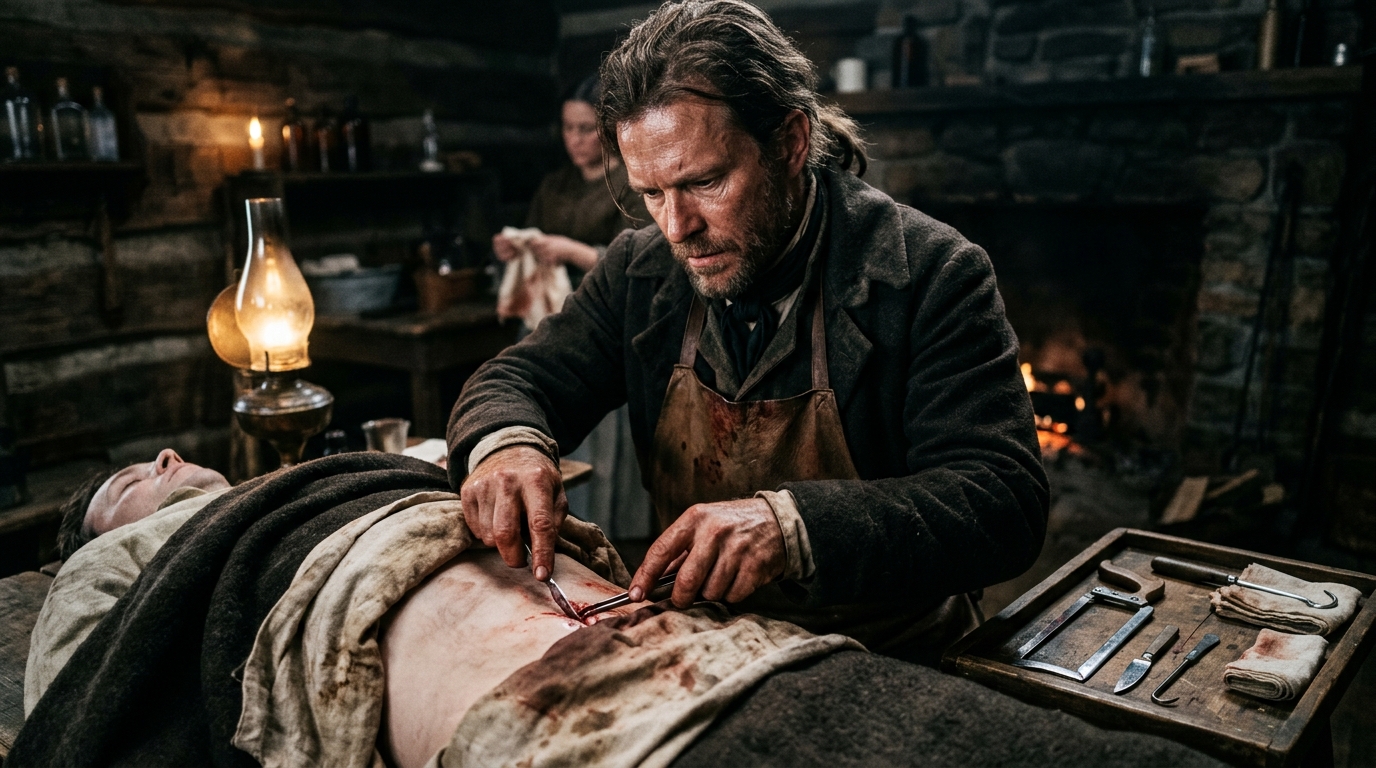
In 1809, a Danville physician opened a woman’s abdomen without anesthesia. He removed a mass weighing more than ten kilograms. Ephraim McDowell had, on his own kitchen table, carried out the first surgical removal of an ovarian tumor ever completed. A feat audacious for the era, and yet real.
- On December 25, 1809, Ephraim McDowell performed in Danville the first successful removal of an ovarian tumor without anesthesia, completed in just twenty-five minutes.
- Jane Todd Crawford, the patient, would survive another thirty-two years after the operation without any recurrence of her disease.
- McDowell would carry out thirteen ovariotomies in his career, eight of which were successful—a remarkable rate for an era that regarded such interventions as destined to fail.
- A pain mistaken for an impossible pregnancy
- Twenty-five minutes without anesthesia that changed the history of surgery
- Jane Todd Crawford, decades of life after the unthinkable
A Pain Mistaken for an Impossible Pregnancy
It all begins in Green County, Kentucky, about a hundred miles from Danville. Jane Todd Crawford had endured months of abdominal pains and a swelling belly that grew more alarming by the day. Several doctors consulted before McDowell arrived agreed on a single diagnosis: a full-term pregnancy, despite the absence of any signs fitting imminent delivery.
Called to her bedside, Ephraim McDowell rejects this explanation. Palpating the patient’s abdomen, he identifies a mass that bears no relation to any known pregnancy. His hypothesis, radical for the time, is an ovarian tumor—a disease the medical knowledge of the early nineteenth century could barely name, let alone treat.
The verdict falls like a sentence. At that period, removing a tumor from the abdomen was almost tantamount to signing the patient’s death warrant. Opening the abdominal cavity exposed the patient to uncontrollable bleeding and infections that no one yet knew how to combat, because the microbial origin was not understood.
Twenty-five Minutes Without Anesthesia That Changed the History of Surgery
On Christmas morning 1809, Ephraim McDowell set to work. There was no anesthesia, no asepsis, none of the tools that would later render surgery bearable. Jane Todd Crawford remained conscious throughout the operation, lying on the physician’s table in Danville as he cut into her abdomen to reach the mass that tormented her.
In just twenty-five minutes, McDowell removed the tumor in one piece. It weighed 22.5 pounds, about 10.2 kilograms—a heft that dizzyingly illustrates what it would feel like inside a human body. The procedure, conducted under such conditions, stood as much a test of medical courage as a gamble on the outcome.
This success was not a solitary stroke of luck. McDowell would perform thirteen ovariotomies over his career, eight of which ended in success—a remarkable rate for an era when the medical consensus deemed such operations inherently fatal. According to the Kentucky Historical Society, four of these procedures were performed on enslaved women, and three survived.
The house where it all happened has not been forgotten by history. It was designated a National Historic Landmark in 1966, in recognition of this first global ovariotomy performed without anesthesia. A symbol that modern surgery owes in part to the audacity of a country physician, long before Pasteur explained why postoperative infections could be fatal.
Jane Todd Crawford, Decades of Life After the Unthinkable
What stands out most in this story is what followed. Jane Todd Crawford remained under McDowell’s watch for nearly a month to recover from the operation. In January 1810, she returned home by horse, a journey of almost one hundred miles, a physical feat hardly believable mere weeks after major abdominal surgery without anesthesia.
She would not merely survive a few more months. Jane Todd Crawford lived another thirty-two years after the intervention. She later settled in Indiana, where she died on March 30, 1841, at the age of 79, never experiencing a recurrence of her illness—a detail that, in retrospect, confirms the accuracy of McDowell’s diagnosis.
To grasp the scale of what McDowell accomplished, one need only compare with later cases. Medical literature documents even larger ovarian tumors, such as a 56.95-kilogram mucinous cystadenoma removed in one piece in Bangalore. A reminder that these masses can reach proportions hard to imagine, far beyond the ten kilograms extracted in 1809.
Today in France, ovarian cancer remains a feared disease precisely because it often presents with few symptoms. The Panorama des cancers 2026 records 5,348 new cases in 2023, frequently diagnosed at an advanced stage due to unclear symptoms, and attributes 3,420 deaths yearly to this disease. Two centuries after McDowell, early detection remains the main challenge.
There is something dizzying about revisiting that Christmas morning in 1809, in a small Kentucky cabinet, where a physician unknowingly defied two centuries of surgical progress. The story of Jane Todd Crawford reminds us that medicine sometimes advances through urgent decisions made far from the reassuring protocols we know today.
