
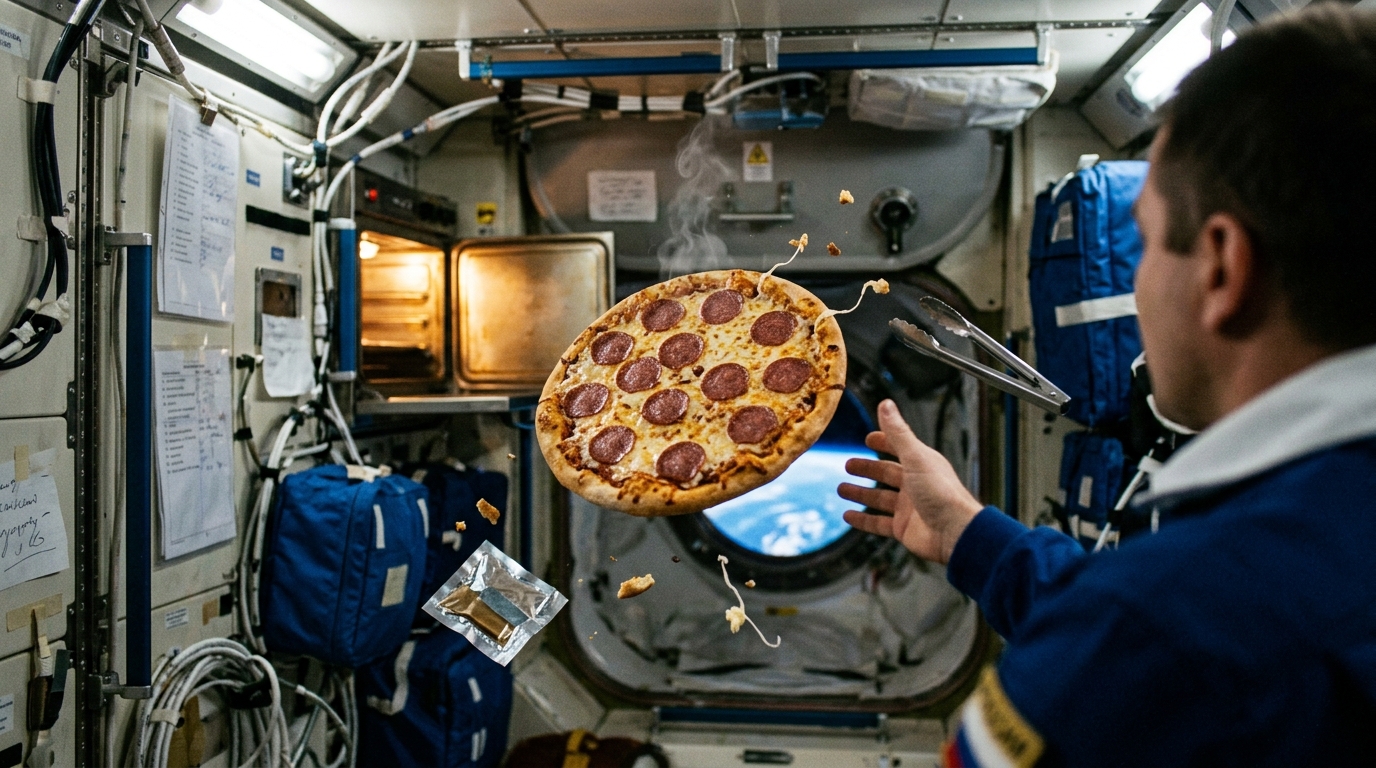
Imagine a fast-food company willing to spare enormous sums to display its logo in space, even going so far as to have one of its products delivered into orbit. This isn’t science fiction. It’s precisely what Pizza Hut accomplished around the turn of the 2000s, in one of the boldest advertising campaigns ever conceived.
- In 2001, Pizza Hut spent roughly a million dollars with the Russian space agency Roscosmos to fund sending a promotional meal to the International Space Station
- The pepperoni was replaced with salami, more stable, and the 15-centimeter pizza was vacuum-sealed to withstand the journey
- The pizza was warmed and tasted in space by Russian commander Yuri Usachev, a scene filmed and later leveraged by Pizza Hut in its global advertising campaign
- A Million Dollars for a Pizza That Will Never Be Eaten Like Any Other
- Roscosmos, the Space Agency That Monetized Its Rockets for Brands
- A Pizza Designed to Withstand Weightlessness
A Million Dollars for a Pizza That Will Never Be Eaten Like Any Other
It all starts with a dizzying figure: in 2001, Pizza Hut paid around a million dollars to the Russian space agency Roscosmos to fund the delivery of a promotional meal to the International Space Station. A sizeable amount for a fifteen-centimeter pizza that no one on Earth would ever be able to taste.
Because that is the core of the operation: the goal wasn’t to feed hungry astronauts, but to create an unprecedented advertising moment. The pizza was merely a pretext, a symbol meant to seize attention and fill television screens worldwide.
The exact sums paid by the brand remain a matter of debate. Some sources cite an initial agreement of about $2.5 million negotiated in 1999 with the Russian space agency to paint a logo on a rocket, before the figure of one million became the most commonly cited reference for the entire venture. These discrepancies were never officially confirmed by Roscosmos, leaving a certain fog around the true accounting of this marketing venture.
What is certain, however, is that this pizza was never intended to be just a meal. It became, almost inadvertently, one of the most discussed advertising objects in space history, a symbol of an era when space was just beginning to catch the eye of terrestrial advertisers.
Roscosmos, the Space Agency That Monetized Its Rockets for Brands
To understand how an American pizza chain managed to secure a place in the Russian space program, you have to go back to the launch of the Zvezda module. This essential component of the ISS lifted off from the Baikonur cosmodrome in Kazakhstan, aboard a Proton-K rocket, and docked with the Zarya module a few weeks later. Zvezda remains the living quarter’s base of the station, measuring thirteen meters long and weighing eighteen tons.
On the side of this Proton-K rocket stood a Pizza Hut logo towering about nine meters high, roughly the height of a three-story building. The press at the time immediately noted that this was a commercial advertisement affixed to a launch vehicle. A powerful symbol for a Russian agency then seeking funding, but also a small revolution within the serious world of aerospace.
In reality, only a fraction of the amount paid by Pizza Hut ended up in the coffers of Khrunichev Center, the rocket’s builder. It is estimated that the center collected about $150,000, with the rest of the envelope siphoned off by advertising intermediaries, including the Russian agency Planeta Zemlya and two American companies. A distribution that shows how the operation rested as much on marketing as on space logistics.
This campaign was also part of a broader strategy. Pizza Hut had planned to invest over $500 million over five years to refresh its image and modernize its restaurants. Even before considering a rocket, the brand seriously explored, in 1999, the possibility of projecting its redesigned logo onto the Moon using lasers. The project was ultimately abandoned for technical reasons, which pushed the brand to lower its ambitions and settle for a Russian launcher instead.
A Pizza Designed to Withstand Weightlessness
Delivering a pizza into space doesn’t happen on a whim. The teams behind the project had to rethink the recipe entirely so that it could survive the voyage and prolonged storage. Pepperoni, initially chosen for the topping, was ultimately dropped after failing a sixty-day preservation test, a timeframe deemed incompatible with the realities of space resupply.
It was replaced with salami, more stable over time, on a six-inch pizza, about 15 centimeters in diameter. The whole thing was vacuum-sealed, military-ration style, before being loaded onto a Russian resupply rocket bound for the ISS, in spring 2001 according to the most widely cited version, although some sources point to an earlier date.
Once aboard the station, the pizza was warmed in the space oven before being tasted by Commander Yuri Usachev, in front of the camera. Far from a mere anecdote, this performance was the centerpiece of the operation: the recording of the meal was then transmitted back to Earth by rocket, and passed along to Pizza Hut’s marketing teams to fuel its global advertising drive.
This small, weightless meal illustrates how space constraints force a complete reinvention of everyday gestures, even the simplest act of eating a pizza, which becomes a real technical challenge when in orbit, balancing the absence of gravity, a dedicated oven, and the need for flawless preservation.
More than twenty years after this curious sequence, the anecdote continues to circulate regularly on social media, often presented as the ultimate example of space marketing. It reminds us, above all, that at a time when orbital conquest remained the preserve of nation-states, a handful of advertisers had already sensed the commercial potential of space, long before private giants truly claimed their stake there.
