
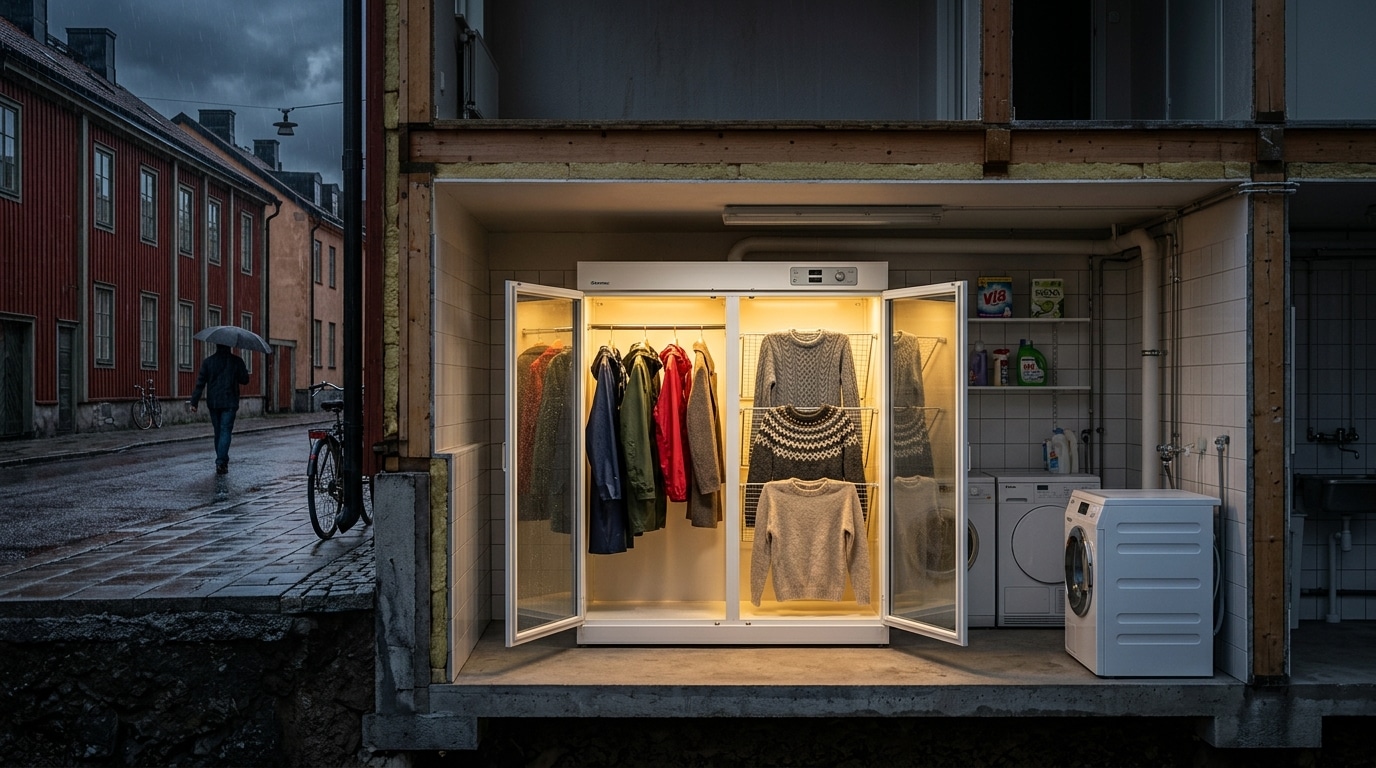
In France, laundry is hung on a folding drying rack wedged between the washing machine and the broom, or people invest in a tumble dryer that weighs on the electricity bill. Elsewhere in Europe, other habits have taken root for decades, long before energy sobriety became a dinner-table topic. In Sweden, for example, there is a common piece of equipment in residential buildings, installed in cellars since the 1980s, that dries clothes without ever using a single drum. Neither violent heat nor mechanical spinning: just warm air circulating slowly. A reminder to reflect on our own drying reflexes.
- In Sweden, communal drying cabinets (torkskåp) have equipped the basements of apartment buildings since the 1980s, emitting gentle heat without a drum or mechanical agitation.
- Warm air, sometimes sourced from the building’s central heating, circulates around the hung laundry for two to four hours, preserving the loft of down jackets and avoiding thermal shock to synthetic fibers.
- Arranging clothes in an arch, with the long pieces at the ends and the shorter ones in the center, improves air circulation and speeds up drying without extra electricity.
- The Swedish dryer, an institution born in the basements
- How this system works without electricity or a drum
- The arch arrangement trick to optimize drying
The Swedish dryer, an institution born in the basements
In most Swedish buildings, the communal laundry is part of daily life as much as the staircase or mailboxes. There you find shared washing machines, but above all a piece of equipment few French people know: the drying cabinet, called torkskåp in Swedish. This piece of furniture, often installed when the buildings were built in the 1980s, resembles a large metal cabinet equipped with rods or racks. Clothes are hung there, the door is closed, and the device takes care of the rest. No drum turning, no motor noise whirring: just a steady, gentle diffusion of heat. This habit has become so ingrained in Scandinavian culture that it is now part of the standard furnishings of collective residences, on par with a bike storage area or a waste room.
How this system works without electricity or a drum
The principle rests on a simple yet effective mechanism. Unlike a conventional tumble dryer that tumbles clothes in a rotating drum, the Swedish cabinet heats the air and circulates it around the hung laundry. The heat is usually produced by an electric resistance, sometimes connected to the building’s central heating system, which limits individual consumption. The warm air rises, passes through the textile fibers, absorbs moisture, then exits through a ventilation duct. This process, slower than a typical tumble-dryer cycle, treats fabrics more gently. Down jackets keep their loft, wool can felt, and synthetic fibers do not suffer the brutal thermal shock that damages them over the long term. Drying time varies with the thickness of the laundry, but generally spans several hours, often two to four hours for winter garments heavily loaded with water.
The arch arrangement trick to optimize drying
To get the most out of this type of cabinet, or even a simple drying rack, the arrangement of garments plays a key role. Arrange the clothes in an arch on the rack, with the long pieces at the ends and the shorter ones in the center, which can facilitate air circulation and speed up drying without additional electrical power. The idea is to create a kind of air tunnel: long coats and sweaters form the edges of the arch, while socks, T-shirts, or underwear occupy the center, where the air flows most freely. This positioning prevents the thicker fabrics from blocking the air flow intended for finer pieces. The time saving, however, remains variable: it mainly depends on the spacing between items, the fabric type, and the room conditions, notably its humidity and ventilation. In a poorly ventilated room, even the best arch arrangement will struggle to work miracles. On the other hand, combined with good air circulation, this simple, free trick often reduces drying time noticeably, without spending a single watt more.
This small gesture, inspired by a Swedish habit dating back several decades, reminds us that there are often simple solutions to dry clothes without multiplying electrical devices. The question remains whether this kind of communal cabinet could someday find its place in French buildings, where shared laundry remains largely to be invented.
