
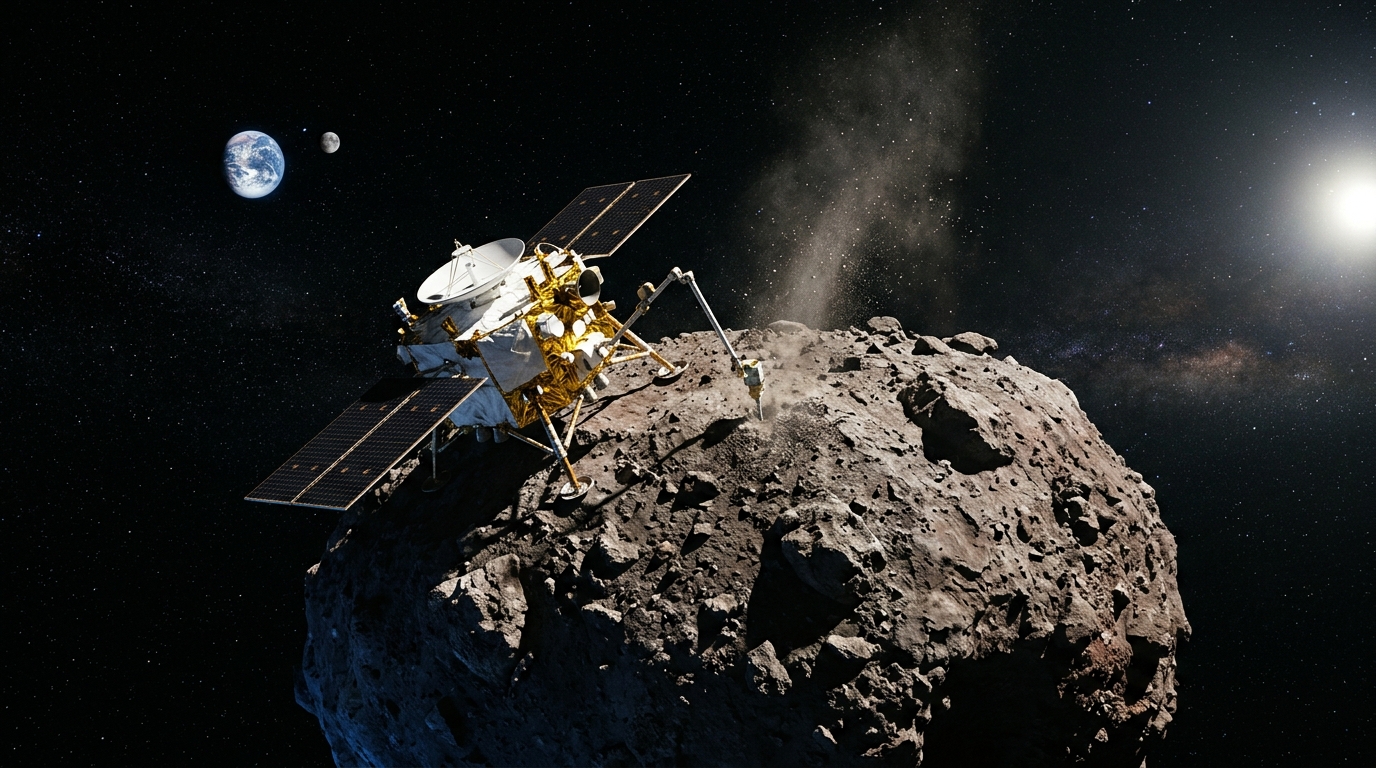
A rock capable of looping back on itself in less than half an hour—that’s no small feat. Kamoʻoalewa, Earth’s discreet little companion, drifts through space tens of millions of kilometers away. Yet China has decided to literally latch onto it to bring back a sample, employing a method never before attempted on an asteroid.
- Kamoʻoalewa is a near-Earth quasi-satellite measuring just over 20 meters according to the first images from Tianwen-2, well below the initial estimates of 40 to 100 meters
- The Chinese probe Tianwen-2, launched in late May 2025, plans to collect at least 100 grams of material using a novel anchoring-attachment technique, in addition to the already proven touch-and-go method
- After dropping the sample capsule on Earth in late November 2027, Tianwen-2 will continue its ten-year mission toward the main-belt comet 311P/PanSTARRS, with an orbital insertion planned for January 2035
- A rock 40 to 100 meters across that spins on its axis in just 28 minutes
- Two novel techniques to extract a fragment from a fast-spinning asteroid
- A ten-year round trip between Earth, a quasi-satellite, and a main-belt comet
A Rock 40 to 100 Meters Across that Spins on Its Axis in Just 28 Minutes
Kamoʻoalewa is not just any asteroid. It belongs to the tiny class of Earth’s quasi-satellites, objects that accompany our planet in its journey around the Sun without ever being truly captured by its gravity. Its distance ranges from about 15 to 39 million kilometers, and its size remains notably uncertain—somewhere between 40 and 100 meters according to ground-based observations.
What stands out most is its rotation speed. While Earth takes 24 hours to complete a turn, Kamoʻoalewa completes one in about 28 minutes. This makes it a rapid rotator, a term used for celestial bodies spinning so fast that the centrifugal force at their surface poses a real puzzle for anyone hoping to land on it.
This size uncertainty was confirmed during Tianwen-2’s approach, which first spotted the asteroid in June 2026. The initial close-up image transmitted by the CNSA revealed a rocky body a little over 20 meters long, far below the earlier estimates. The spatial uncertainty, which had extended up to 100 kilometers from Earth, was narrowed to under a kilometer thanks to the onboard optical navigation cameras.
Two Novel Techniques to Extract a Fragment from a Fast-Spinning Asteroid
Retrieving a sample from such a small and swift object requires precision engineering. Launched in late May 2025 by the CNSA, Tianwen-2 is specifically targeting this quasi-satellite for sampling via brief contact or by anchoring, with sample return planned for 2027.
The first method, known as touch-and-go, is not entirely new. It has already proven successful with NASA’s OSIRIS-REx and Japan’s Hayabusa2. The principle remains the same: the probe descends briefly to the surface, sucks up or scrapes a few grams of material, and then leaves almost immediately without a true landing.
The second technique, however, changes the game. Named anchoring-attachment, it would literally lash the lander to the asteroid’s surface, a first for this type of body. The stated objective is to collect at least 100 grams of material, studied on-site with the 11 scientific instruments onboard.
Some reports mention a target mass that could reach up to 1,000 grams, but this detail has not been officially confirmed by the CNSA. It is therefore prudent to withhold judgment on the exact scale of the sampling until it actually occurs.
A Ten-Year Round Trip Between Earth, a Quasi-Satellite, and a Main-Belt Comet
Tianwen-2 is not a quick mission. With a launch mass of 2,100 kilograms and solar-electric propulsion, the craft was designed for a ten-year odyssey, punctuated by several distinct celestial rendezvous.
After traveling roughly a billion kilometers in about 400 days, the probe positioned itself about twenty kilometers from Kamoʻoalewa in early July 2026. The asteroid’s departure is scheduled for late April 2027, followed by a Earth flyby during which the capsule containing the sample will be released in late November 2027.
Once this precious payload is delivered, Tianwen-2 will not return to base. The spacecraft will use Earth’s gravity assist to resume its journey toward another target: the main-belt comet 311P/PanSTARRS, with an orbital insertion expected in January 2035.
If this mission reaches its end, China would become the third nation to bring asteroid samples back to Earth, after Japan and the United States. A strong symbol for China’s space program, which has been advancing step by step since the rover Zhurong landed on Mars.
Between a tiny rock spinning at full speed and a comet patiently waiting millions of kilometers away, Tianwen-2 sketches a quirky journey. It remains to be seen whether the anchoring on Kamoʻoalewa will live up to its technical promises, and whether the capsule containing this asteroid fragment will indeed touch down on Earth as planned.
